

SK Innovation aims to improve the cost structure of its separator business through the absorption merger with SKIET (SK IE Technology) and to develop energy storage system (ESS) products as a new growth axis. At the same time, the company plans to introduce a new shareholder return policy alongside the merger push.
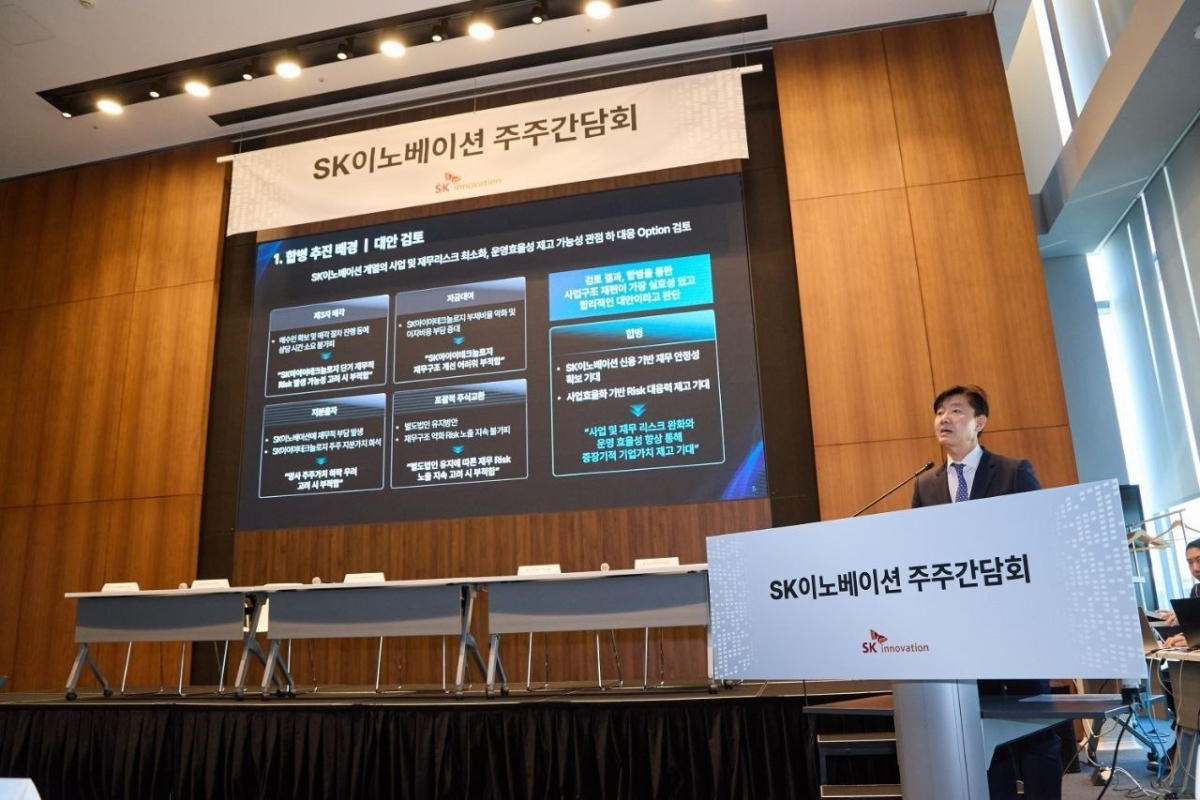
Seo Geon-ki, head of finance at SK Innovation, stated on the 14th during a shareholder briefing session regarding the SKIET merger that "although various options such as third-party sales, loans, capital contributions, and comprehensive stock exchanges were considered, restructuring through merger was judged to be the most effective and rational alternative," explaining the purpose of the merger and future plans. In the subsequent Q&A session, active communication took place between shareholders and the company via online and offline channels on various topics including the outlook for the separator business after the SKIET merger and future shareholder return plans.
The core of this SKIET merger lies in reducing the financial burden of the accumulating deficit in the separator business and securing cost competitiveness. SK Innovation decided to proactively restructure its operations, judging that if SKIET continues as an independent legal entity, its financial risks could spread across the entire group.
In fact, SKIET is facing difficulties due to slowing growth in the global electric vehicle (EV) market, delayed recovery of North American demand following changes in U.S. EV subsidy policies, and oversupply caused by production capacity expansion by Chinese companies. The company believes that with declining separator demand and intensifying competition, revenue expansion is limited, and it will not be easy to quickly close the cost disadvantage compared to Chinese competitors. Currently, the operating rate of its Poland plant is around 20%.
Bae Gi-rak, head of financial planning at SK Innovation, explained that "since SKIET remains a listed company, there are significant cost-saving effects from eliminating separate board and IR organization costs, optimizing production and marketing expenses, and reducing some shared fees related to group brand usage." He added, "Even with the same amount of debt, interest costs can vary significantly due to credit rating differences between SK Innovation and SKIET. The cost savings will also benefit SK Innovation."
SK Innovation identified the ESS (energy storage system) market as a breakthrough for its separator business. Although weak EV demand is expected to persist for some time, demand for non-Chinese ESS battery materials is increasing, particularly in North America. Jeong Jae-seong, CEO of SKIET Gyeong Yeong-ji-won (Head), emphasized, "While it may not be easy to pass through this tunnel in the short term, the current battery market is seeing new expansion in the ESS market as a substitute for declining EVs." He added, "We expect the current deficit structure to turn around within about three years."
Synergies with SK On will also be expanded. According to SK, after the merger, strengthening R&D capabilities for ESS separators and lowering production costs could secure price competitiveness, potentially increasing opportunities for SKIET to supply separators in SK On's ESS order projects. The company expects that as ESS orders increase and the EV market recovers, profitability improvements will accelerate. Until then, the plan is to reduce cost scale and raise funds to create a structure that generates profits within two to three years.
SK Innovation plans to announce its shareholder return method by the end of this year or no later than early next year. Currently, it is internally reviewing specific methods and scales such as dividends and treasury stock cancellation. Seo, the head of finance, promised, "Since growth investment, debt reduction, and shareholder return are inseparable, we will create opportunities to communicate again with shareholders after comprehensively considering this year's performance, debt levels, and growth investments."
SK Innovation is pursuing this merger through a small-scale merger method. SK Innovation will survive while SKIET will be dissolved. The merger ratio is 0.1174540 shares of SKIET common stock for every one share of SK Innovation common stock, with 4,481,300 new shares of SK Innovation allocated to SKIET shareholders. SK Innovation has set a limit of approximately 35 billion won in preparation for the exercise of stock purchase rights from November 24 to December 13. While the company expects the scale of exercises to be modest, it plans to respond using cash and other resources held by SKIET if necessary.

 in INDUSTRY
