

Hyundai Rotem is rapidly increasing the export share of its rail business (RS division). The company's strategy is to diversify its export product lineup, which had been centered on electric multiple units (EMUs), into high-speed rail vehicles and others, thereby boosting its market share in the global rail market and improving profitability.
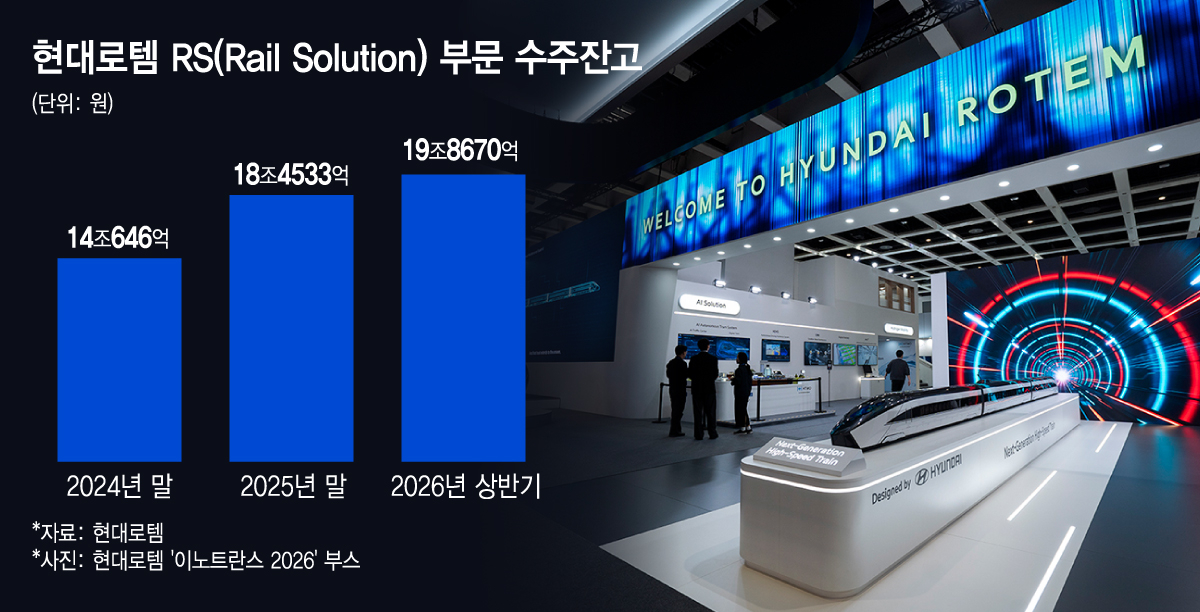
According to industry sources on the 29th, Hyundai Rotem's rail business order backlog stood at 19.867 trillion won as of the end of the first half of this year, an increase of 1.4137 trillion won from the end of last year (18.4533 trillion won). Compared with the end of 2024 (14.0646 trillion won), it rose by 41.3%. The rapid growth in the order backlog is analyzed as being driven by consecutive wins on large overseas projects. Recently, Hyundai Rotem has been restructuring its order-taking structure from a domestic-centric model to one focused on overseas business.
In fact, the company secured the Queensland EMU project worth approximately 1.3 trillion won in Australia in 2023, and won the Los Angeles Metro EMU project worth approximately 900 billion won in the United States in 2024. Last year, it secured an EMU project worth 2.2027 trillion won in Morocco, the largest single rail project in history. With Uzbekistan, where Korea-style high-speed rail was exported for the first time in 2024, additional supply negotiations are underway with a target of signing a contract by early next year. The possibility of winning the order has increased as the governments of both countries recently signed a "Memorandum of Understanding (MOU) on Strengthening Strategic Cooperation."
Driven by expanded overseas orders, Hyundai Rotem's export revenue is also increasing. While domestic and export shares were each around half in 2024, exports exceeded domestic sales in the first half of this year, with exports at 679.1 billion won compared to domestic sales of 448.9 billion won.
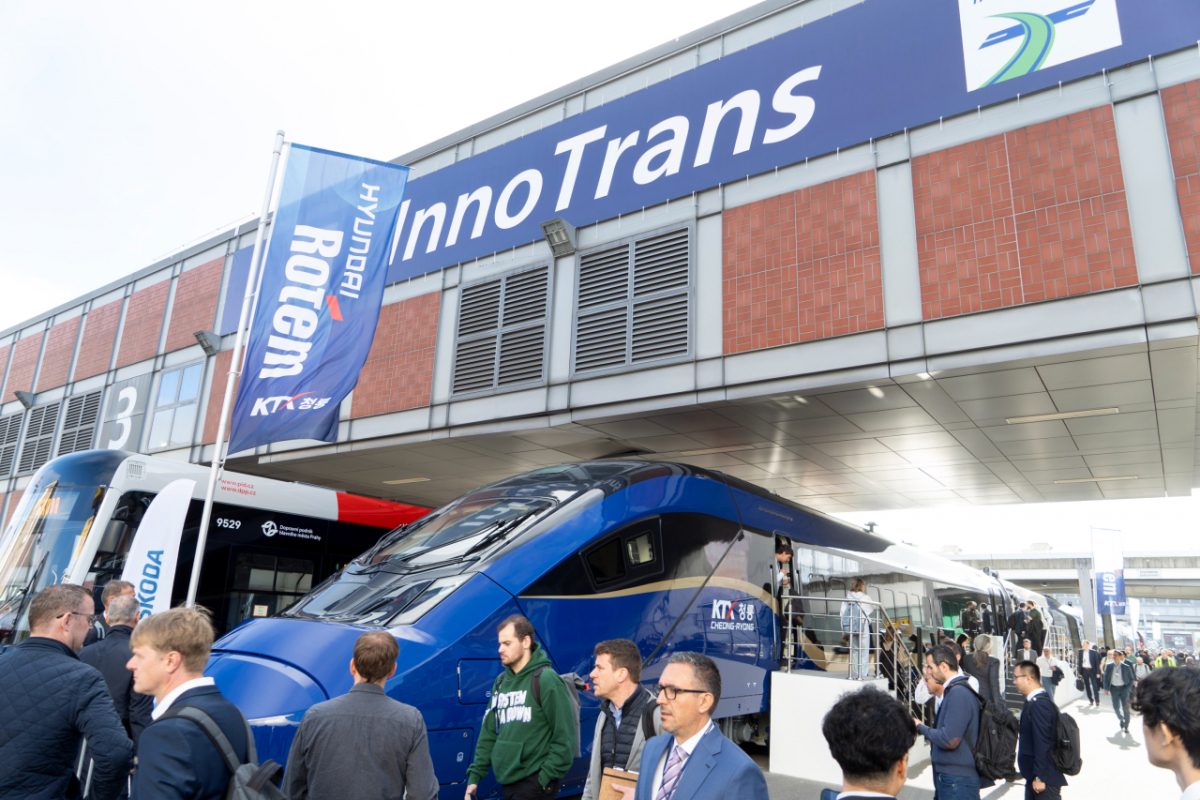
Hyundai Rotem is accelerating its efforts to capture the global rail market. As part of this strategy, the company set up its largest exhibition booth in its history at "Innotrans 2026," the world's largest biennial rail industry exhibition. The booth was placed in a prominent first-floor space immediately visible from the exhibition hall entrance. Nearby were global rail companies such as France's Alstom and China's CRRC (China Railway Rolling Stock Corporation). In the outdoor real-vehicle exhibition area, "KTX-Cheongryong" was positioned at the very front.
Currently, the project Hyundai Rotem is focusing on most overseas is the U.S. New York Metropolitan EMU replacement project, worth up to 1 trillion won. Global rail companies such as Alstom and Germany's Siemens are also expected to enter this project. It is known that Hyundai Rotem aims to secure approximately half of the total volume.
The company is also stepping up efforts to capture the high-speed rail market beyond EMUs. As it is evaluated as a latecomer in the global high-speed rail market, its goal is to expand into the Middle East and Central Asia using the Uzbekistan export as a springboard. The company plans to actively leverage capabilities at the Hyundai Motor Group level, including design, physical AI, and hydrogen.
Expanded exports are also expected to lead to improved profitability in the rail business. This is because the domestic rail vehicle market has a high share of public procurement and an bidding structure centered on price competition, limiting profit generation. The market expects that profitability will significantly improve once the Morocco project enters full-scale production next year. Forecasts also suggest that rail business revenue will increase by more than 30% next year.
A Hyundai Rotem official said, "We will do our best to showcase K-rail capabilities overseas through a differentiated rail vehicle lineup that utilizes both hydrogen and AI simultaneously."

 in INDUSTRY

