

The Samsung Group is accelerating its push into the global artificial intelligence (AI) infrastructure market, expanding beyond semiconductors to encompass data centers, power, cooling, batteries, and construction. Major affiliates, including Samsung Electronics, have made a joint investment in the U.S.-based AI infrastructure firm Helix Digital Infrastructure (hereinafter referred to as “Helix”), securing a foothold that allows the group to consolidate its diverse AI infrastructure capabilities into a single entity.
According to industry sources on the 29th, Samsung’s total investment in Helix amounts to $1 billion (approximately 1.36 trillion won), with Samsung Electronics contributing $500 million and five other affiliates sharing the remaining $500 million. Helix is an AI infrastructure specialist established by global private equity firm KKR alongside NVIDIA, U.S. power company Vistra, and the Kuwait Investment Authority (KIA). At its inception, the founding investors committed to long-term capital totaling approximately $10 billion. Samsung’s $1 billion investment will be added to this base.
This investment is drawing attention because it goes beyond a simple equity stake in an AI infrastructure company. Most of the projects Helix is pursuing align with areas where Samsung affiliates already possess competitive advantages or are cultivating as future growth drivers.
A defining characteristic of Helix is that it is not merely an investor in data center construction. The company aims to be an “AI infrastructure one-stop operator” by directly investing in and providing integrated solutions across the entire AI infrastructure spectrum, from data center development and operation to power generation, transmission and distribution, optical communication networks, and networking. NVIDIA handles AI technology and infrastructure, while Vistra supports power procurement.
As AI data centers scale up, securing only the buildings and servers is no longer sufficient to build out infrastructure. It is now necessary to secure the power and transmission/distribution networks required to operate large-scale GPUs (graphics processing units), cooling systems capable of handling the massive heat generated by servers, and communication networks for rapid data transfer. The proliferation of AI data centers is effectively creating a new industrial ecosystem that spans semiconductors, power, cooling, construction, communications, and finance.
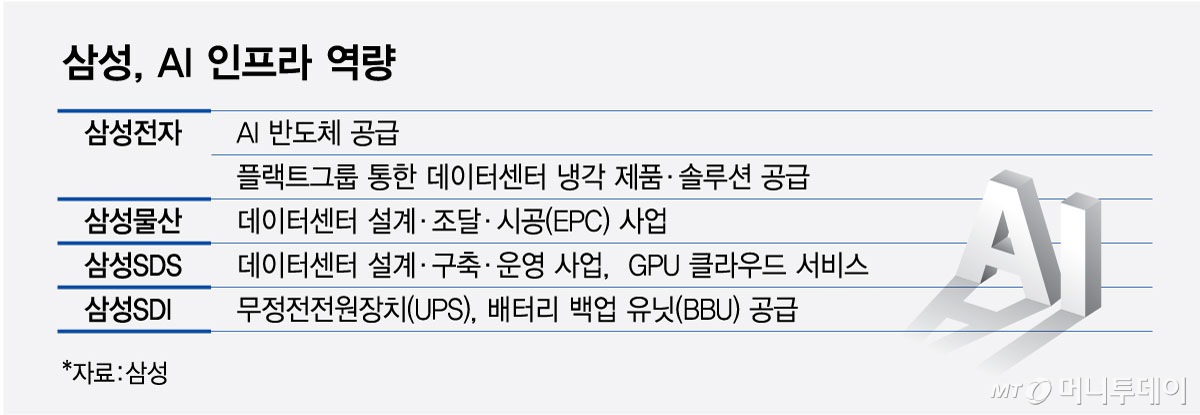
With Samsung joining Helix as a key investor, a channel has been established to connect the group’s diverse business capabilities with global AI infrastructure projects. Samsung is one of the domestic conglomerates with the broadest value chain for AI data centers. Specifically, this includes △Samsung Electronics’ AI semiconductors and data center cooling solutions, △Samsung C&T’s construction of data centers and power facilities, △Samsung SDS’ data center operations and GPU-as-a-Service (GPUaaS) cloud services, and △Samsung SDI’s battery technology used in uninterruptible power supplies (UPS) and battery backup units (BBU), among other capabilities essential for data centers.
Helix has also taken note of Samsung’s comprehensive capabilities. Adam Selipsky, CEO of Helix, stated, “As a world-leading technology company, Samsung possesses unique capabilities that will benefit both Helix and its customers.” He added, “We look forward to collaborating with Samsung to accelerate the construction of next-generation digital infrastructure for hyperscalers (large-scale cloud operators) worldwide.”
From Samsung’s perspective, this approach offers an opportunity to propose the group’s products and solutions together from the early stages of data center projects, rather than having each affiliate individually target global hyperscalers. The scope of beneficiaries in the AI business, which has previously been highlighted primarily through semiconductors such as high-bandwidth memory (HBM), server DRAM, and solid-state drives (SSDs), could expand to encompass the broader infrastructure sectors of cooling, construction, IT, and energy storage.
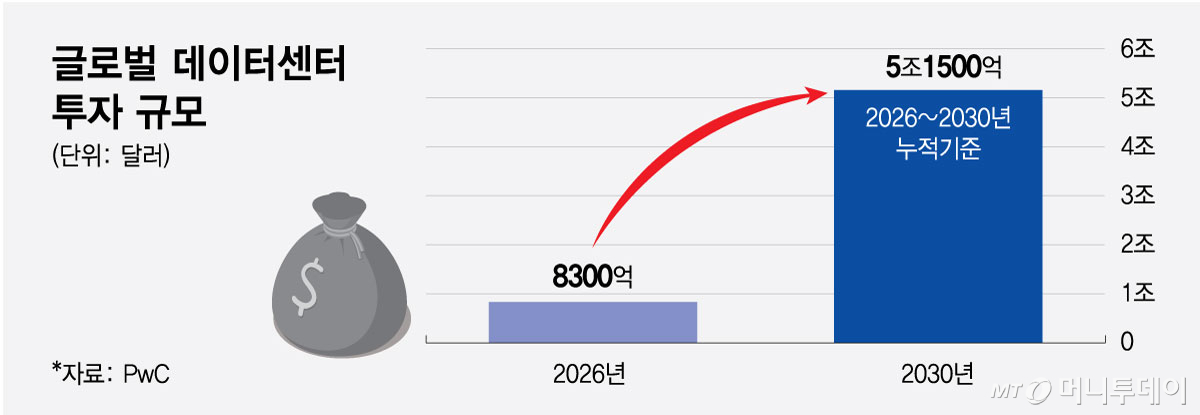
The rapid growth of the AI infrastructure market is also bolstering Samsung’s moves. According to PwC, cumulative global capital investment in data centers from this year through 2030 is projected to reach 5.15 trillion won (approximately 7,000 trillion won). In simple terms, this means an average of over 1 trillion won (approximately 1,400 trillion won) will be invested in data centers annually over the next five years.
Investment in data centers does not end with a single construction phase. Core equipment such as GPUs and servers typically requires replacement every four to six years, generating continuous investment demand. Samsung’s strategy is to combine its capabilities in semiconductors, cooling, construction, IT, and energy storage to establish a new group-level growth axis in the rapidly expanding global AI infrastructure market.
In particular, this investment in Helix extends Samsung’s recent strategic investments aimed at securing future growth drivers. This month, Samsung Electronics signed a strategic partnership with French AI firm Mistral AI and initiated a large-scale equity investment. The two companies plan to jointly develop their own AI model specialized for semiconductor design and manufacturing by combining Samsung Electronics’ semiconductor technology and manufacturing data with Mistral AI’s model technology.
Samsung Electronics has continued to make strategic investments in future growth areas such as AI, bio, and healthcare, while also focusing on expanding synergies with its existing businesses. In June last year, the company made an additional investment of $175 million in U.S.-based gene analysis equipment firm Element Biosciences, securing its position as the largest shareholder.
Previously, in October of last year, Samsung Electronics and Samsung C&T invested $110 million in Grail, a U.S. company holding multi-cancer early detection technology. This move reflects an effort not only to inject capital into promising companies but also to secure new business opportunities by linking them with Samsung’s existing capabilities in AI, medical devices, and digital health.

 in INDUSTRY

