

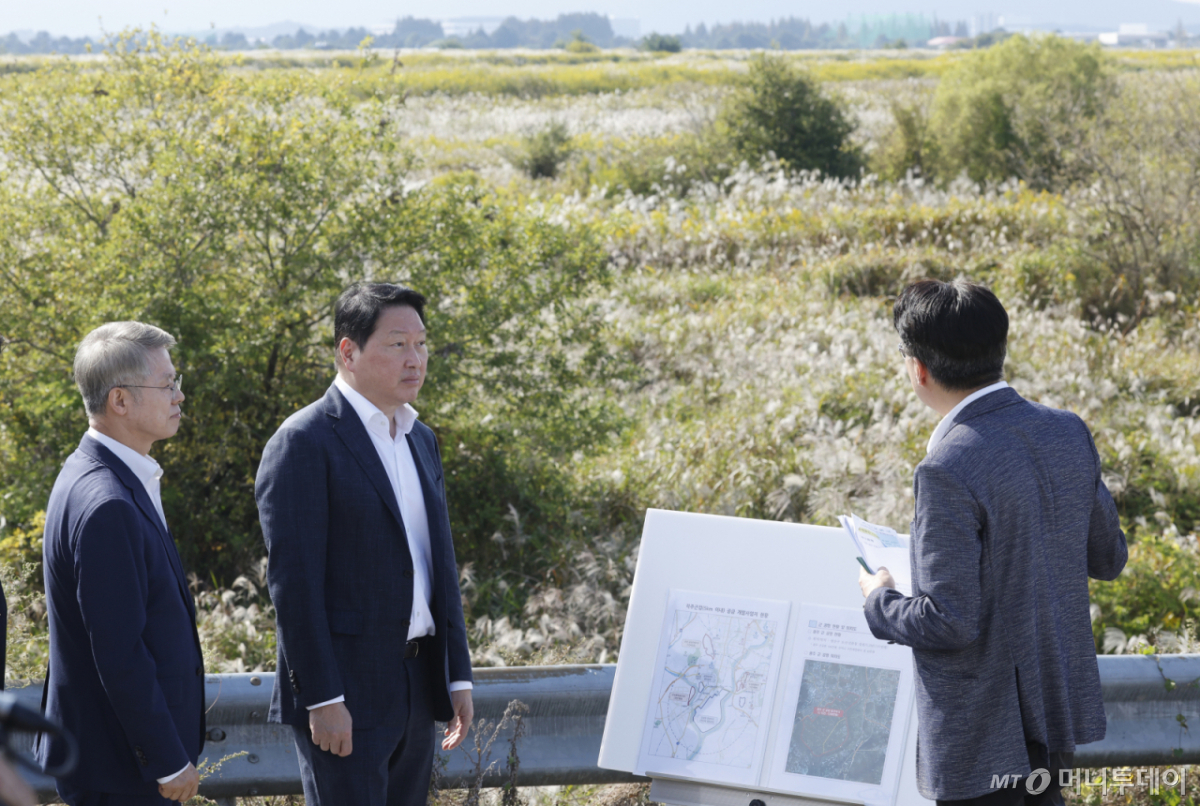
SK Group Chairman Choi Tae-won visited the Gwangju military airbase area, a candidate site for the Honam semiconductor national industrial complex, for the first time and stated, "If the timing is delayed due to delays in building power and water infrastructure, we will break ground first." This indicates an intention to carry out the construction of basic infrastructure and the semiconductor fab simultaneously to advance the point at which production capacity can be expanded as much as possible.
Choi (Chairman) visited the planned relocation site of the Gwangju military airbase ammunition depot on the afternoon of the 9th and said, "I believe semiconductor demand will increase at a fairly rapid pace," adding, "We must accelerate the speed of expansion."
He stated, "The Yongin semiconductor cluster has brought its completion date forward by 12 years, but that alone is not enough," adding, "Another site needs to be developed, and it must be pursued in parallel if necessary." Regarding this visit, he explained, "It was to check at what speed facilities can be built here."
The specific groundbreaking date for the Honam semiconductor fab has not yet been determined. However, SK Hynix clearly expressed its intention to proactively begin construction as conditions are met, rather than simply waiting for a national-level power and water supply plan.
Choi (Chairman) emphasized, "Once construction begins, we will proceed at the fastest possible speed," adding, "If power and water are delayed and the timing slips, we will break ground first. We will not spare any construction costs." This reflects a plan to simultaneously advance infrastructure development and production facility construction in preparation for potential semiconductor supply shortages.
The possibility of expanding the investment scale was also left open. Choi (Chairman) said, "So far, the Honam semiconductor cluster is planned to be about two-thirds the size of Yongin," adding, "If there is greater land demand, this side may become larger." This is interpreted to mean that beyond the currently planned two fabs, additional expansion could be undertaken depending on future demand.
On the day, Choi (Chairman) toured the Gwangju military airbase control tower and the planned relocation site of the ammunition depot along with key executives, including SK Hynix CEO Kwak No-jeong. This is the first time Choi (Chairman) has personally visited the Honam industrial complex planned site since the government, Samsung Electronics, and SK Hynix announced in June a plan to invest a total of 800 trillion won to build four semiconductor fabs.
After receiving a briefing on the site's current status from officials of the Air Force 1st Combat Wing, Choi (Chairman) heard plans for basic infrastructure development, including power and water supply and permits, from Gwangju Metropolitan City officials. He then spent about 15 minutes inspecting the planned relocation site of the ammunition depot to assess the actual site conditions.
The government and the metropolitan city are pushing a plan to first develop approximately 208,000 square meters that can be prioritized for development, including the planned relocation site of the ammunition depot and areas for resolving complaints, out of the total 8.2 million square meters designated as the national industrial complex planned site. The Gwangju military airbase area was designated as a candidate site for the Honam semiconductor national industrial complex in July, and Korea Land and Housing Corporation is currently conducting a design study for the industrial complex.
According to the current schedule, move-in agreements, permits, design, and some site preparation will be completed by the end of next year, with construction beginning in 2028 when the military airbase site is handed over. If progress goes according to plan, initial semiconductor production could begin in June 2030.
Remaining tasks include relocating Gwangju Airport's domestic flights to Muan International Airport, dispersing military units, lifting military protection zone restrictions, and national industrial complex designation and site construction work. The metropolitan city plans to advance permits and basic infrastructure development in line with corporate investment schedules.

 in INDUSTRY
