

Hyundai Motor is set to secure global growth drivers by strengthening R&D and its parts supply chain based on expanded production capacity in India, which has grown into the world's third-largest automotive market. To this end, the company will secure new production hubs and pour 2.1 trillion won over the next seven years.
Hyundai Motor held a completion ceremony for its new Pune plant on the 14th in Talegaon, Maharashtra state, India. The event was attended by key executives including Chung Eui-sun, Chairman of Hyundai Motor Group, Jang Jae-hoon, Vice Chairman, and Jose Munoz, CEO of Hyundai Motor. Local dignitaries, including Devendra Fadnavis, Chief Minister of Maharashtra state, also participated.
In his welcome address, Chung said, "Since we first entered India 30 years ago, we have strived to earn the trust of local customers. Since launching our first model in the country, the 'Accent,' India has become a core pillar in our global growth process," adding that "the completion ceremony for the Pune plant will mark the opening of a new chapter locally."
This year, marking the 30th anniversary of Hyundai Motor's entry into India, is also on the verge of surpassing 10 million cumulative sales in the local market. According to the Society of Indian Automobile Manufacturers (SIAM), Hyundai Motor's cumulative domestic sales volume in India as of the end of the third quarter this year was recorded at 9,884,960 units. Last month, domestic sales in India increased by 10.9% year-on-year to 57,166 units. Total sales, including exports, reached 77,916 units, setting a new all-time monthly record.
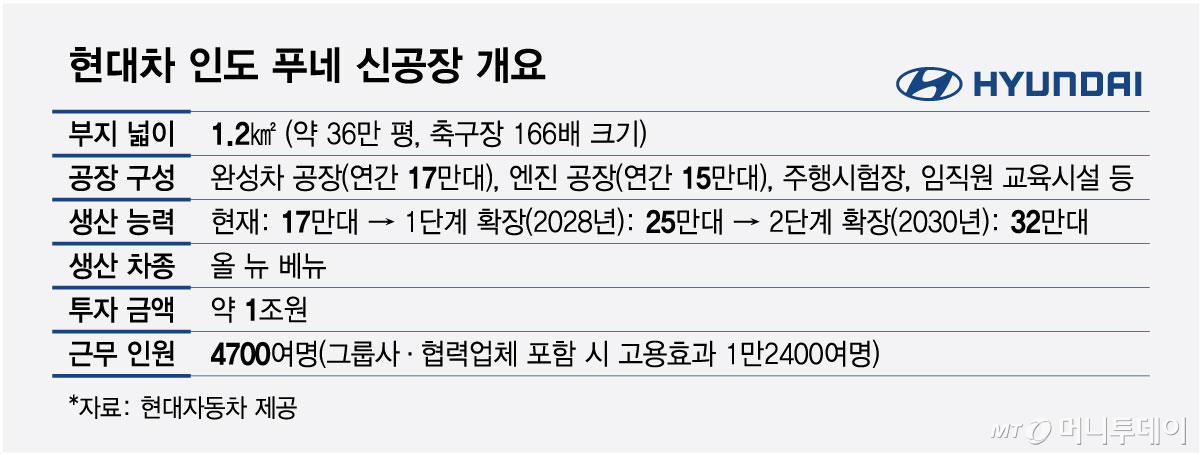
The current annual production capacity of the Pune plant is 170,000 units, with projections to expand to 250,000 units by 2028 and 320,000 units by 2030. Including the Chennai Plant 1 and 2 (824,000 units), Hyundai Motor's production capacity in India will increase from the current 994,000 units to 1,144,000 units by 2030. When combined with Kia's Anantapur plant (431,000 units), the Hyundai Motor Group will be able to produce more than 1.5 million units annually starting from 2028.
Hyundai Motor has introduced approximately 200 industrial robots responsible for welding operations at the Pune plant, along with an AI (artificial intelligence)-based crack detection system. The company is also utilizing AR (augmented reality) technology in training new employees.
Additionally, the Hyundai Motor Group announced a plan to invest $15.5 billion (approximately 20.7 trillion won) over seven years from this year through 2032 at the completion ceremony to strengthen R&D capabilities and parts supply chains in India and expand its business into future mobility sectors.
Level 2 autonomous driving technology tailored to the local market will be applied to new models, and the electric three-wheeler being jointly developed with Indian two-wheeler manufacturer TVS is set to be commercialized by the end of next year. The group also plans to establish a local investment-specialized legal entity in collaboration with affiliates.
The background for Hyundai Motor Group's expanded investment in India lies in high market growth potential. India, with a population exceeding 1.4 billion, is the world's third-largest automotive market after the United States and China. Conversely, the number of vehicles per 1,000 people is lower than in major automotive markets, leaving significant room for new car demand to expand as income rises and road infrastructure improves.
Chung has also demonstrated a focus on the Indian business. The day marked the sixth anniversary of Jeong (Chairman)'s appointment. He visited India last January as well to inspect local plants and emphasized a 'home brand strategy' to transform into an Indian national enterprise. This aims to strengthen its market position by reflecting the needs and characteristics of local consumers.
Hyundai Motor plans to unveil 26 new models and product improvement models by fiscal year 2030, while expanding its lineup of HYBE lead vehicles and electric vehicles. It is also pushing for the entry of its luxury car brand Genesis into the Indian market. Through these efforts, the company aims to raise its share of the Indian domestic market to over 15% while increasing the proportion of utility vehicles such as SUVs in total sales to more than 80%.
Meanwhile, the expansion of Hyundai Motor Group's business in India is also leading to increased local revenue for domestic parts manufacturers. The number of domestic parts companies that entered India alongside Hyundai Motor and Kia grew from 68 in 2011 to over 120 with the completion of the Pune plant. Seongwoo Hi-Tech's revenue in India increased by 54.6% from 345.8 billion won in 2019 to 534.6 billion won last year. During the same period, Seo Yeon E-Hwa and HL Mando's revenue in India also grew by more than 97% and 90%, respectively.

 in INDUSTRY
