

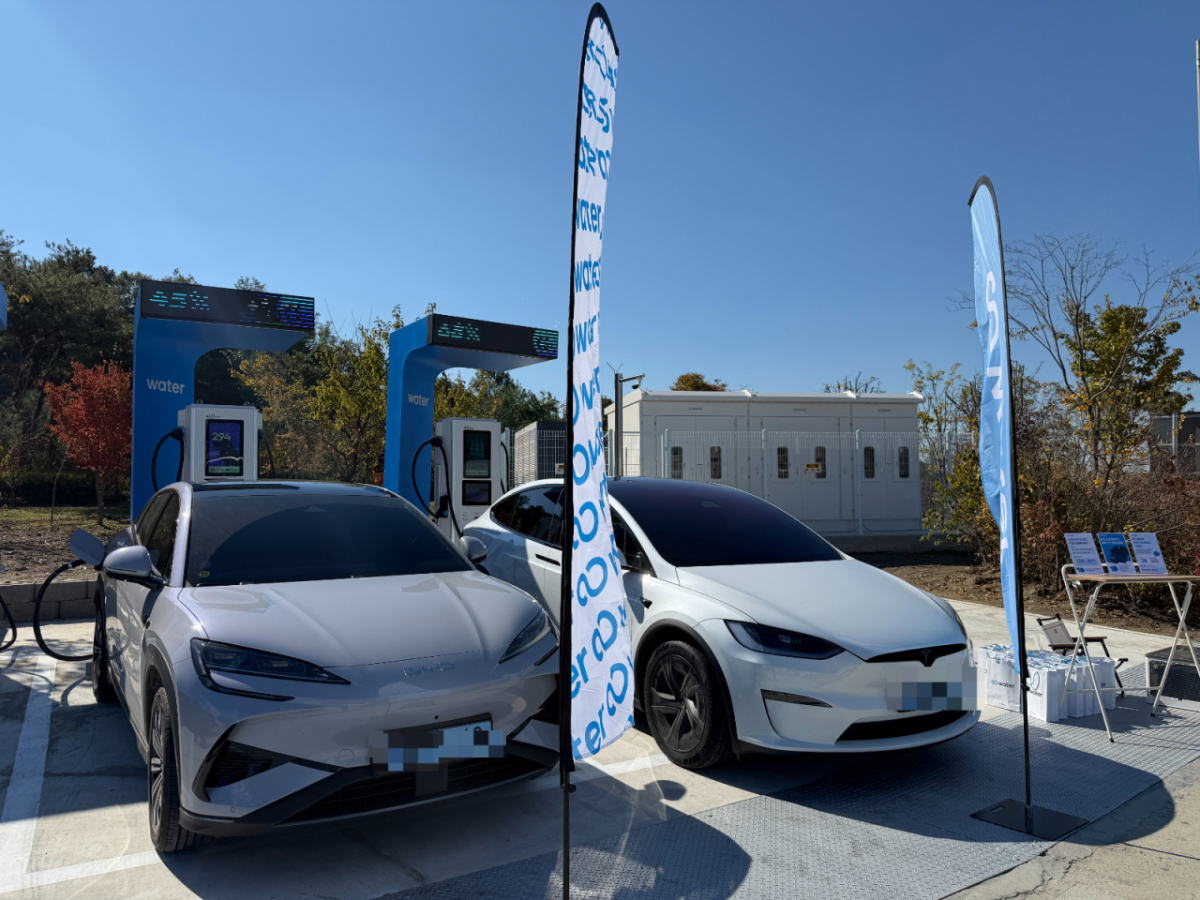
The numbers displayed on the EV charger screen had quietly surpassed 200 kW (kilowatts). The Hyundai Motor IONIQ 5, which began charging at a battery level of 15%, increased its output as it approached 30%. After the figure dropped once, it hit 200 kW again when the battery reached 54%. It was a moment to verify the actual performance of a 400 kW-class super-fast charger that has appeared at an expressway rest area.
The EV charging brand Water revealed this charging performance on the 22nd at its newly installed super-fast charging station in the Jecheon direction of Geumwang Rest Area on the Pyeongtaek-Jecheon Expressway in Eumseong County, Chungcheongbuk-do. Seven chargers were lined up on site: four 400 kW units, two 200 kW units, and one 100 kW unit.
The charging output of the IONIQ 5 demonstrated that day continued to change depending on the battery level. The Tesla Model Y accompanying it started charging at a battery level of 9%, but its output did not exceed 60 kW until it reached 15%, gradually increasing thereafter. This is because while the charger itself can deliver speeds up to 400 kW, the power actually accepted by the vehicle varies depending on battery temperature, remaining charge, and the vehicle’s charging system.
One charger was equipped with both DC Combo cables, primarily used in domestic EVs, and Tesla’s North American Charging Standard (NACS) cable. This allows vehicles to be charged without separate adapters, tailored to the vehicle type. When using the service for the first time, users register their vehicle via the Water app; thereafter, they can charge without separate authentication using 'AutoCharge,' which utilizes vehicle identification information.
In fact, there are not many vehicles in Korea capable of fully utilizing output reaching 400 kW. However, Water is strategically installing these chargers as a preemptive investment considering future demand. In reality, the company plans to add 123 chargers at 23 expressway rest areas nationwide by the end of this month. Of these, 62 are 400 kW units. Once construction is complete, Water’s expressway charging network will expand to 73 rest areas with 397 chargers.
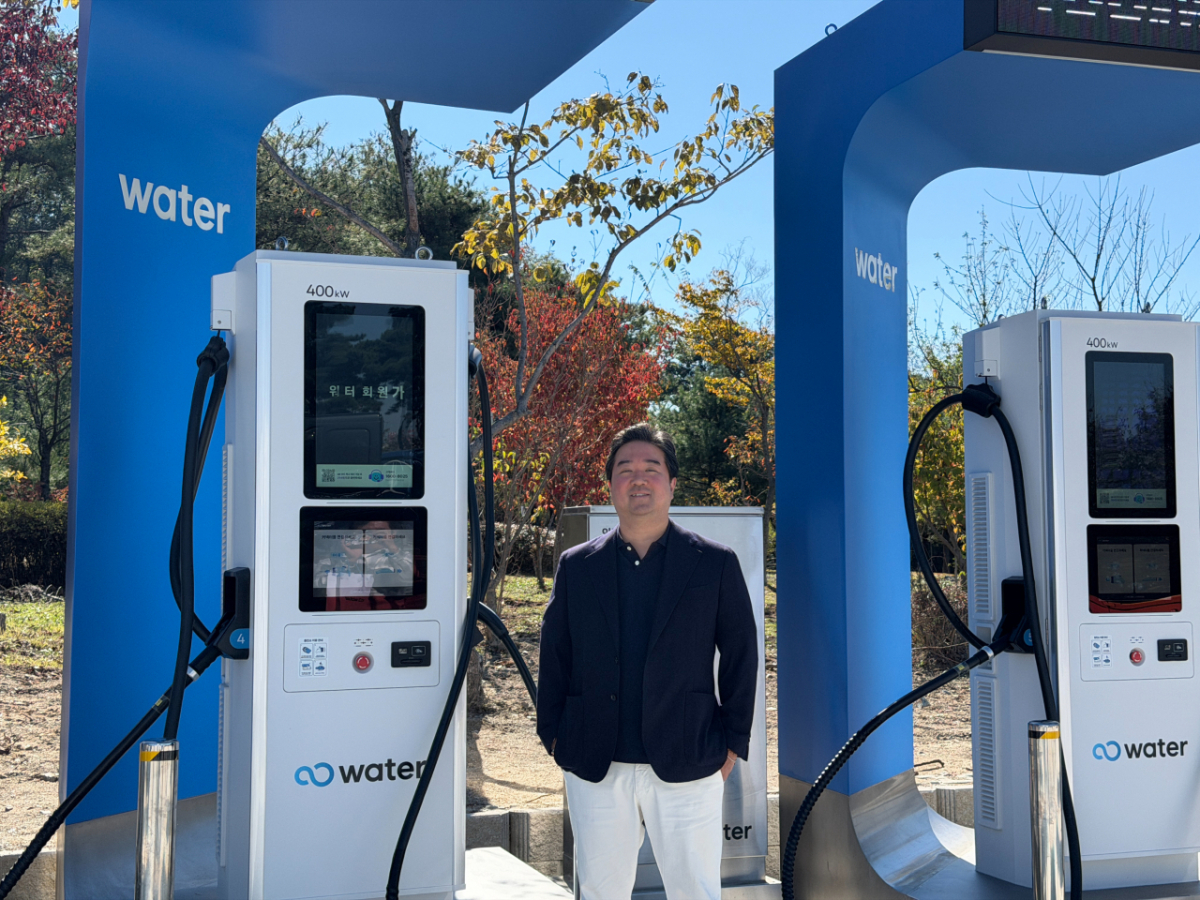
At a press conference held after the site visit, Yoo Dae-won, head of the EV Charging Business Division (Water) at Bright Energy Partners, emphasized that future vehicle performance must be considered when investing in chargers. He noted that while the actual average charging output at Water stations is approximately 75 kW, the average output for the top 10% of vehicles with fast charging speeds reaches 177 kW. He also explained that considering a 10-year operating period, it is necessary to secure higher output than what is immediately required.
Yoo (CEO) stated that operational stability is also essential. According to Water, the average daily number of charges per expressway charger is 11 times, which is more than approximately 3 times for urban fast chargers. During holidays when demand surges, utilization rates at some stations rose as high as 78%. The structure is such that if a charger breaks down or stops for maintenance, it can immediately lead to waiting times and inconvenience.
Water announced that it maintains an uptime rate—the proportion of time chargers are available without breakdowns or maintenance—at approximately 99%. Yoo (CEO) pointed out that "predictability and uptime will be important going forward," stating that users must be able to easily check whether a charging station is operating normally.
The company also highlighted its fee competitiveness. The Water member rate at the new station is 294 won per kWh for one year after opening. This is 99.1 won, or about 25%, cheaper than the public super-fast charging fee of 393.1 won set by the Ministry of Climate, Energy and Environment for chargers of 200 kW or more. It is also lower than Water’s existing fast-charging rate of 347 won. However, fees may be adjusted in the future depending on market conditions.

 in INDUSTRY

