

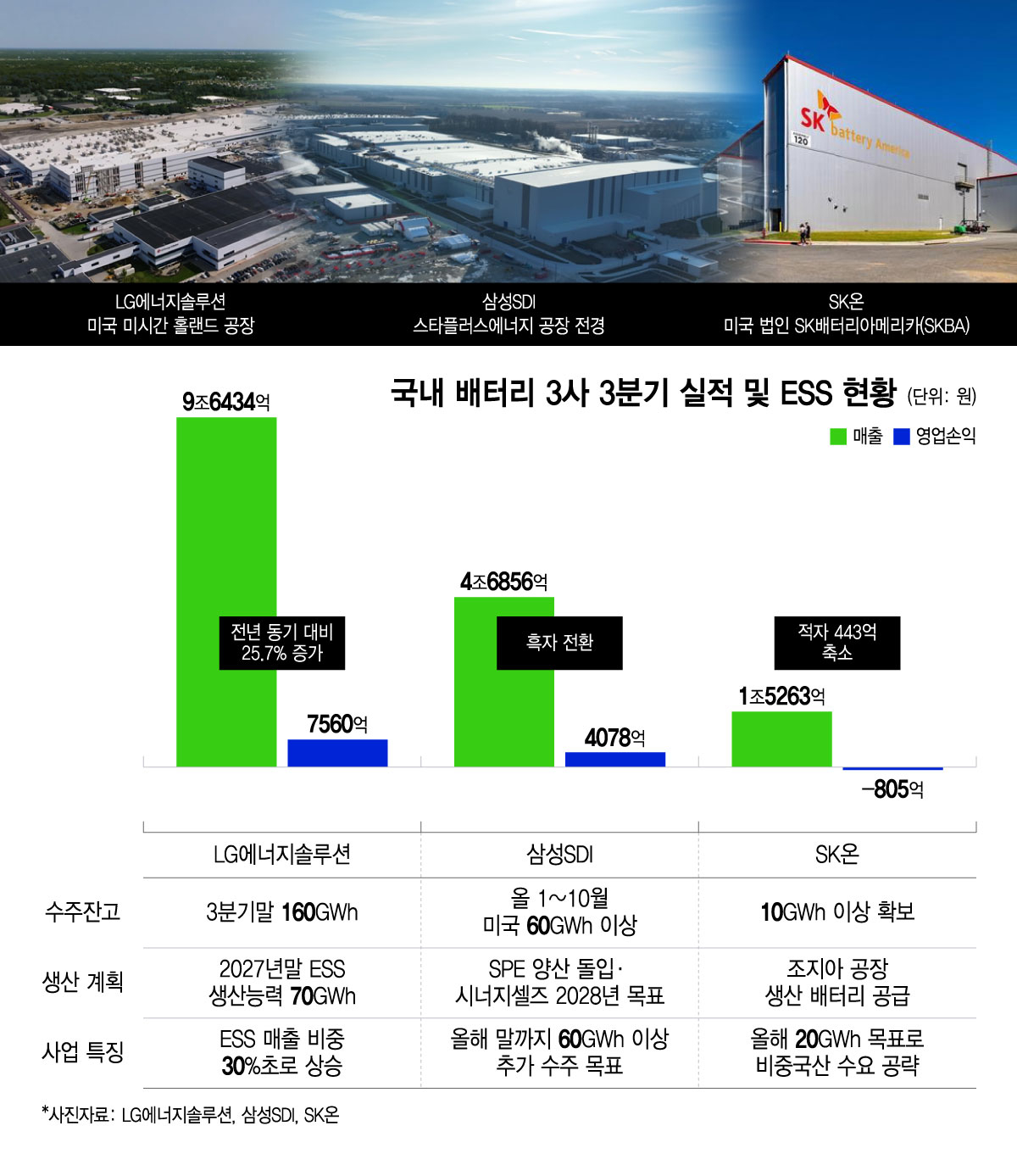
South Korea's battery industry is turning its attention to energy storage system (ESS) volumes for 2029. LG Energy Solution and Samsung SDI, which have already secured work orders for the next two years, are pushing for additional contracts, while SK On has joined the pursuit with a goal of signing contracts worth more than 20 gigawatt-hours (GWh) this year.
According to industry sources on Tuesday, LG Energy Solution's global ESS order backlog reached 160 GWh as of the end of the third quarter this year. Samsung SDI signed supply contracts for over 60 GWh, primarily in the United States, from January through October this year. Both companies are reportedly negotiating contracts centered on volumes after 2028. SK On has secured orders for approximately more than 10 GWh.
This is already reflected in third-quarter earnings. In fact, LG Energy Solution's consolidated revenue for the third quarter of this year was 964.34 billion won, a 59.0% increase from the same period last year, and operating profit rose 25.7% to 756 billion won. ESS shipments increased by more than 60% compared to the previous quarter, and the share of the ESS business in total revenue expanded from 22.7% in the fourth quarter of last year to the low 30% range in the third quarter of this year. This represents an increase of around 10 percentage points (p) in nine months.
LG Energy Solution also raised its annual revenue growth target from a mid-10% to 20% range compared to the previous year to 35–40%. Lee Chang-sil, CFO of LG Energy Solution, explained, "Following additional project orders from grid customers in the ESS business, we have also signed our first battery energy storage system (BESS) supply contract with a big tech company, securing volumes through 2028."
He added, "We will expand production capacity to 70 GWh by the end of next year, including a new prismatic line, from over 50 GWh of pouch production capacity by the end of this year." He emphasized, "We will strengthen our strategy of selection and concentration to maximize operational efficiency with limited resources."
Samsung SDI also succeeded in turning profitable in the third quarter, driven by expanded sales of ESS and battery backup units (BBU) for data centers. Revenue for the third quarter of this year was 468.56 billion won, a 52.6% increase from the same period last year. Operating profit turned positive at 407.8 billion won. Samsung SDI plans to increase its ESS order scale to over 120 GWh this year through additional orders by the end of the year.
Separately, it is accelerating the expansion of local production capacity. Cho Yong-hwi, head of Samsung SDI's ESS Business Team, disclosed, "The LFP (lithium iron phosphate) ESS cell line at SPE (Star Plus Energy) in the United States began mass production in early October, and we are also promoting the transition from NCA (nickel-cobalt-aluminum) to LFP." He added, "Synergy Cells in the United States will also begin mass production of LFP for ESS between the second half of 2028 and early 2029." He continued, "We are focusing on securing production volumes from SPE and Ulsan after 2029, as well as volumes from Synergy Cells."
SK On posted an operating loss of 80.5 billion won in the third quarter of this year but narrowed its deficit by 44.3 billion won compared to the same period last year while focusing on the ESS business. In August, it signed a supply contract for 9 GWh of LFP pouch cells with NeoVolta Power in the United States. It plans to supply batteries produced at its factory in Georgia, U.S., to NeoVolta over five years starting from 2027. While setting a target of 20 GWh in global orders annually, it is discussing additional supply contracts totaling more than 10 GWh with multiple U.S. customers.
Kim Young-gwang, head of SK On's Financial Management Division, stated, "Following the Trump administration's strengthened regulations on China and its trend toward supply chain restructuring, interest in non-Chinese products has risen among U.S. ESS operators and system integrators that previously used Chinese-made battery cells." He added, "Inquiries regarding product specifications, available supply volumes, pricing conditions, and long-term contracts have increased from companies using Chinese-made cells."

 in INDUSTRY
