

With the implementation date for the US Minimum Import Price (MIP) for solar products less than a month away, the restructuring of the global solar supply chain is also expected to accelerate. Expectations are rising for Hanwha Solutions, which has established a production system in the US, and OCI Holdings, which produces non-Chinese polysilicon.
According to industry sources on the 12th, the US government plans to implement the MIP for solar products under Section 232 of the Trade Expansion Act starting from the 4th of next month. The minimum import prices by item were set at $21 per kilogram for polysilicon, $100 per kilogram for ingots and wafers, $0.22 per watt (W) for cells, and $0.38 per W for modules. With an additional 15% tariff applied, the effective import price of modules is projected to reach $0.43 to $0.44 per W.
This policy focuses not only on raising import prices but also on restructuring the China-centric solar supply chain. Until now, Chinese companies have led the global market by leveraging large-scale production capacity and low costs.
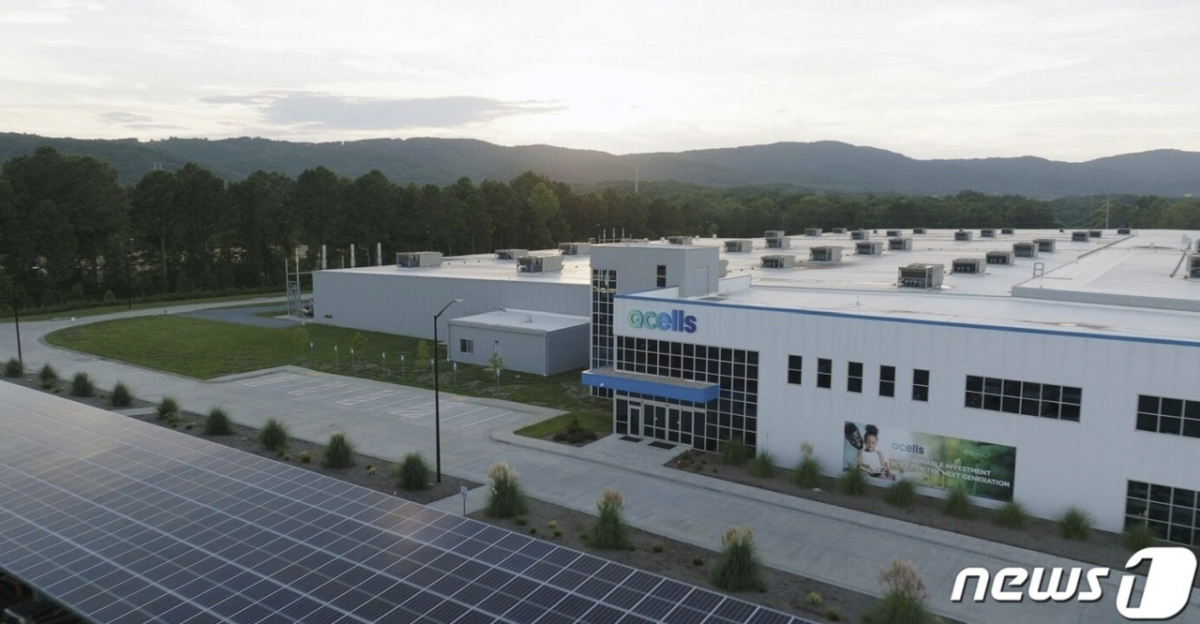
First, Hanwha Solutions is expected to benefit primarily through its local production facilities in the US. Through "Solar Hub," a vertically integrated solar production system established in Cartersville, Georgia, it is strengthening supply chain competitiveness covering everything from ingots to cells and modules. As import module prices rise, the relative price competitiveness of US-made products increases. According to industry sources, Hanwha Solutions' new module contract prices are being formed at more than $0.1 per W higher than previous averages. Residential use is estimated at mid-$0.4 per W, while power generation projects are around $0.4 per W.
OCI Holdings is expected to expand supply contracts with US customers based on non-Chinese polysilicon produced in Malaysia. This is because US solar companies must reduce their reliance on Chinese raw materials to meet tax credit and Foreign Entity of Concern (PFE) requirements. OCI Holdings' polysilicon production capacity is approximately 35,000 tons annually. Most of the production volume from next year is expected to be sold through long-term supply agreements (LTAs) with US customers.
Observations also suggest that a policy environment favorable to the solar market will be created as the Democratic Party secured a majority in the recent US midterm elections. However, considering factors such as Hanwha Solutions' existing low-price contracts and inventory burden, and the time lag in reflecting OCI Holdings' sales prices, the benefits for domestic companies are expected to materialize fully from mid-next year onward.
Domestic companies are accelerating efforts to secure non-Chinese supply chains. Hanwha Solutions is focusing on stabilizing its local production system by increasing the operating rates of wafer and cell production lines at its Cartersville plant. Recently, it was also selected as a "Top Performer" in all eight categories of the module reliability assessment by global solar evaluation agency PVEL, including products produced at the Cartersville plant. Sales contracts for most of next year's module production volume from the Cartersville plant have been secured, and new contracts are being pursued for supply volumes after 2028.
OCI Holdings also recently approved a borrowing proposal at its board of directors to expand the production capacity of its Vietnamese subsidiary Neo Silicon Technology (NST) from the existing 2.7 GW (gigawatts) to 5.4 GW.
An industry official emphasized, "Actual local customer demand is currently greater than expected," adding, "Although the preferential treatment for US-made products and specific conditions for tax credits have not yet been finalized, building a de-China supply chain will be inevitable in the medium to long term."

 in INDUSTRY
