

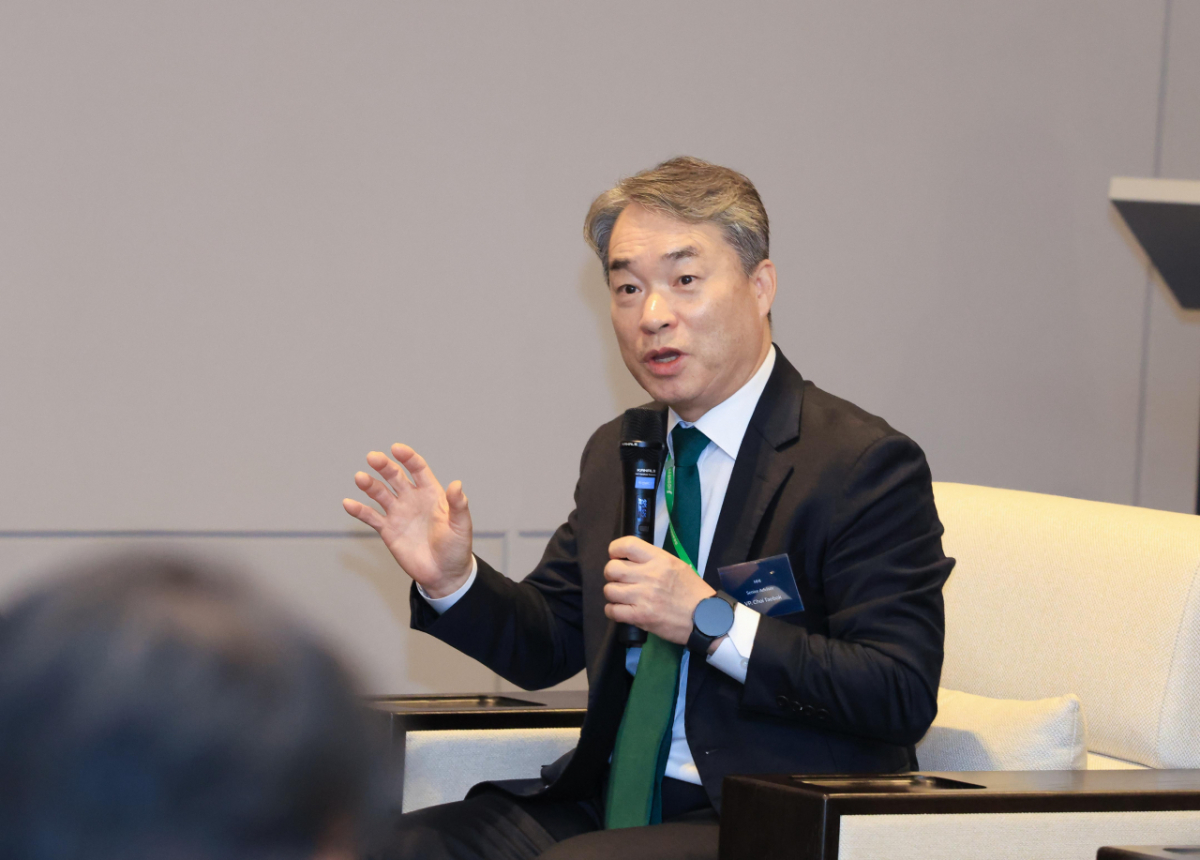
"We judge that it is entirely possible to achieve our target of 10 trillion won in annual sales by 2035."
Choi Tae-bok, executive director at HD Hyundai Heavy Industries, expressed confidence in the growth outlook for the special vessel business during a press briefing held on the 12th at HD Hyundai Heavy Industries in Ulsan. "To boost sales in our special vessel division, which currently stands at around 1 to 2 trillion won annually, we are pursuing expansion of domestic warship construction capacity, local production overseas, and the export of design and engineering technology," he said.
Production capacity to expand two- to threefold… Pursuing parallel overseas local construction and technology exports
First, HD Hyundai Heavy Industries will bolster its domestic production capacity through integration with HD Hyundai Mipo Dockyard. Executive Director Choi stated, "In addition to our existing two large dry docks, we have secured two more large dry docks and plan to further develop a submarine factory." He added, "In particular, we are utilizing Dock 4 among the four large docks at HD Hyundai Mipo Dockyard for special vessel construction. Even if we prioritize using just one of HD Hyundai Mipo Dockyard's docks, our production capacity can double compared to before." He further noted, "We expect that by fully utilizing HD Hyundai Mipo Dockyard's facilities in the future, we can expand domestic warship construction capacity to at least three times its current level."
Overseas, the company plans to expand its local construction business from Peru to other countries. Alongside exporting vessels built in Ulsan, it will strengthen efforts to transfer design and production technology to purchasing nations and have them produce vessels directly at local shipyards. Executive Director Choi projected that vessels built and exported from Ulsan and those built locally overseas would each account for roughly half of future output.
The export of design and engineering technology is also being cultivated as a new revenue source. "Many people assume we are exporting defense products based on cost-effectiveness, but what lies behind that cost-effectiveness is actually our technological capability," said Executive Director Choi. He added, "Even the United Kingdom, which boasts world-class engineering technology, generates substantial profits. HD Hyundai Heavy Industries will leverage the know-how accumulated to date to create revenue by exporting not only warship construction services but also our accumulated design and production technologies."
'ASV Alpha' without waiting for government orders… Differentiation through modular platform
The unmanned vessel market is a sector that HD Hyundai Heavy Industries is highlighting as a new growth driver. The company's recent unveiling of the medium-sized unmanned surface vessel "ASV Alpha," jointly developed with U.S. defense firm Anduril, on the 12th, was part of this strategy. This vessel is a prototype developed through the companies' own investment, rather than awaiting government orders.
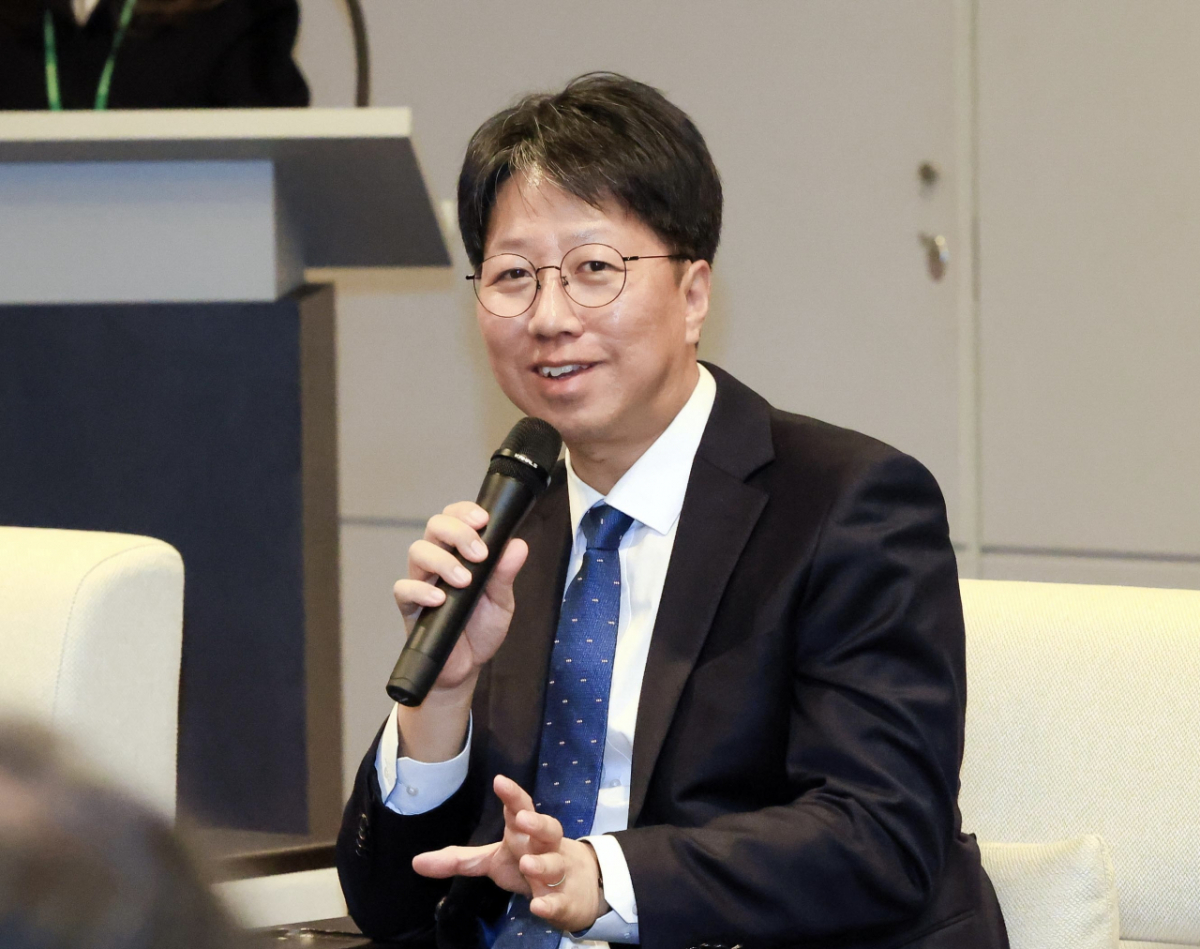
Lee Sang-bong, senior executive director at HD Hyundai Heavy Industries, cited company-led development and a modular platform as key differentiators from existing domestic unmanned surface craft projects. He explained that while previous domestic projects were centered on government research and development tasks, this time the companies analyzed market demand and developed the product proactively. "We believe we are the first to apply a modular concept to the platform," said Senior Executive Director Lee. "It was designed with maintenance, repair, and overhaul (MRO) considerations from the initial design stage, based on the concept of being crewless."
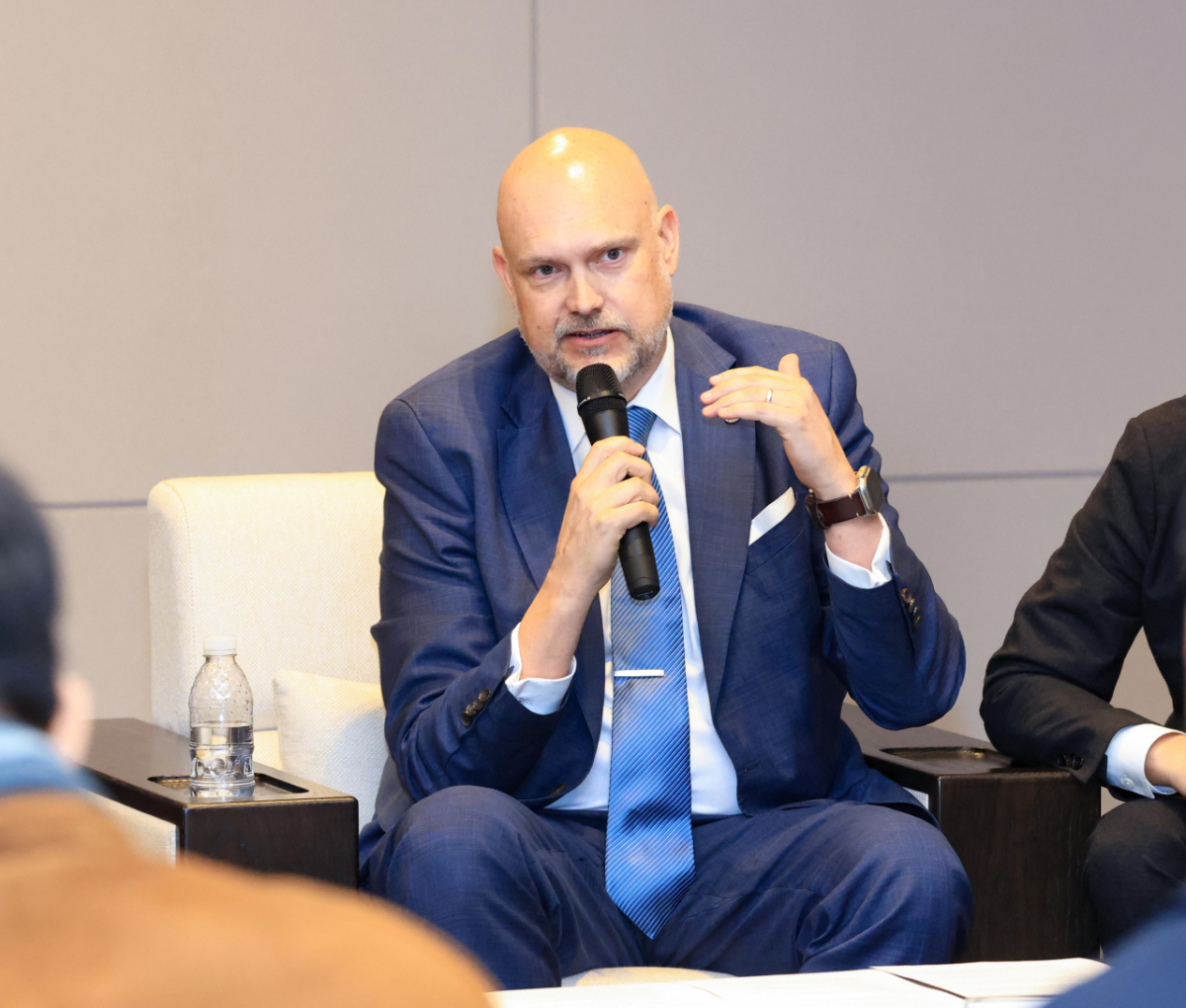
In particular, the strengths of ASV Alpha lie in its scalability to carry various weapons and sensors, and the combination of technologies from both companies. Shane Annett, senior vice president at Anduril Industries, expressed confidence, stating, "ASV Alpha is modular, capable of flexibly integrating any weapon system or sensor that each nation desires. Moreover, we are the only entity that simultaneously possesses expertise in warship construction, autonomous navigation, and mission execution software."
Targeting U.S. Navy unmanned vessel program… Positive evaluation of autonomy technology
The two companies plan to use ASV Alpha as a springboard to target the U.S. Navy's Medium Unmanned Surface Vessel (M-USV) program. "We already exceed the requirements demanded by the U.S. Navy," said Executive Director Choi. "I believe we can achieve good results in the U.S. market next year." If selected for future projects, specific weapon systems will be applied in consultation with the U.S. Navy.
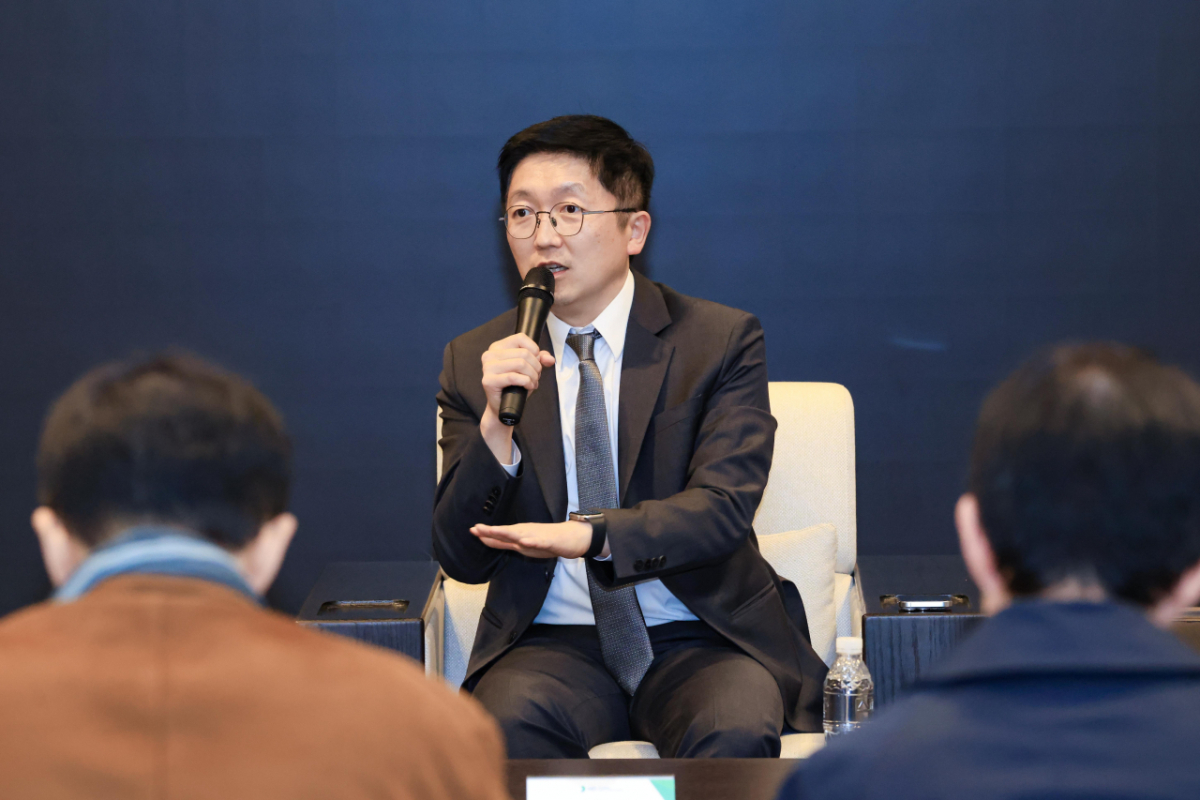
The companies have already received positive technical evaluations from U.S. Navy officials. Kim Hyeong-taek, executive director at HD Hyundai Heavy Industries, stated, "During an autonomy technology demonstration held on the 14th of last month in Long Beach, U.S., the U.S. Navy evaluated that we possess autonomous performance comparable to top-tier competitors for the M-USV program." He added, "They paid attention to the fact that we demonstrated navigation, institutional investor automation, and Anduril's mission autonomy technology all at once, noting these are functions necessary for unmanned vessels. They also expressed great expectations for the Alpha vessel launched today."
For U.S. projects, the plan is to respond with Anduril taking the lead and HD Hyundai Heavy Industries cooperating. If they secure a contract for a U.S. Navy project, the vessels will be built locally in the United States. If demand arises from other countries, the two companies will jointly target the market. Senior Executive Director Lee predicted, "Based on the experience accumulated from our local construction business in Peru, we will be able to provide timely technical support, including design and construction methods, in the U.S. as well."
Considering experimental projects with South Korean Navy… Securing test operation track record to expand exports
Interest in ASV Alpha continues in other overseas regions as well. Senior Vice President Annett expressed confidence, saying, "Interest is high not only in the U.S. and other AUKUS member states but also in the Middle East and Europe." He added, "As maritime security environments change, demand for new unmanned capabilities is increasing." He further noted, "We signed a cooperation agreement one year ago, and it has been just one year since we launched the vessel today. Please look forward to what comes next."
The possibility of cooperation with the South Korean Navy also remains open. Executive Director Choi emphasized, "We have been sharing progress for some time and discussing various utilization options extensively." He added, "We are reviewing various experimental projects that utilize ASV Alpha or similar platforms." Currently, the South Korean Navy is considering three directions: small unmanned surface craft mounted on warships, combat-oriented unmanned surface craft, and platforms serving as motherships for combined manned-unmanned forces. The navy plans to launch a design project for combat-oriented unmanned surface craft next year, but medium-to-large unmanned surface vessels have not yet reached the full commercialization stage.
Executive Director Choi explained that it is possible for the military to adopt an unmanned surface vessel proactively developed by a private company. "The project could proceed under government leadership, but conversely, there is also a method where the government adopts a product led by a company," he said. He revealed, "While it may be procedurally difficult for the navy to immediately adopt ASV Alpha, if the military provides test operation opportunities for privately developed vessels, we can pursue overseas exports based on the operational track record secured."

 in INDUSTRY


