

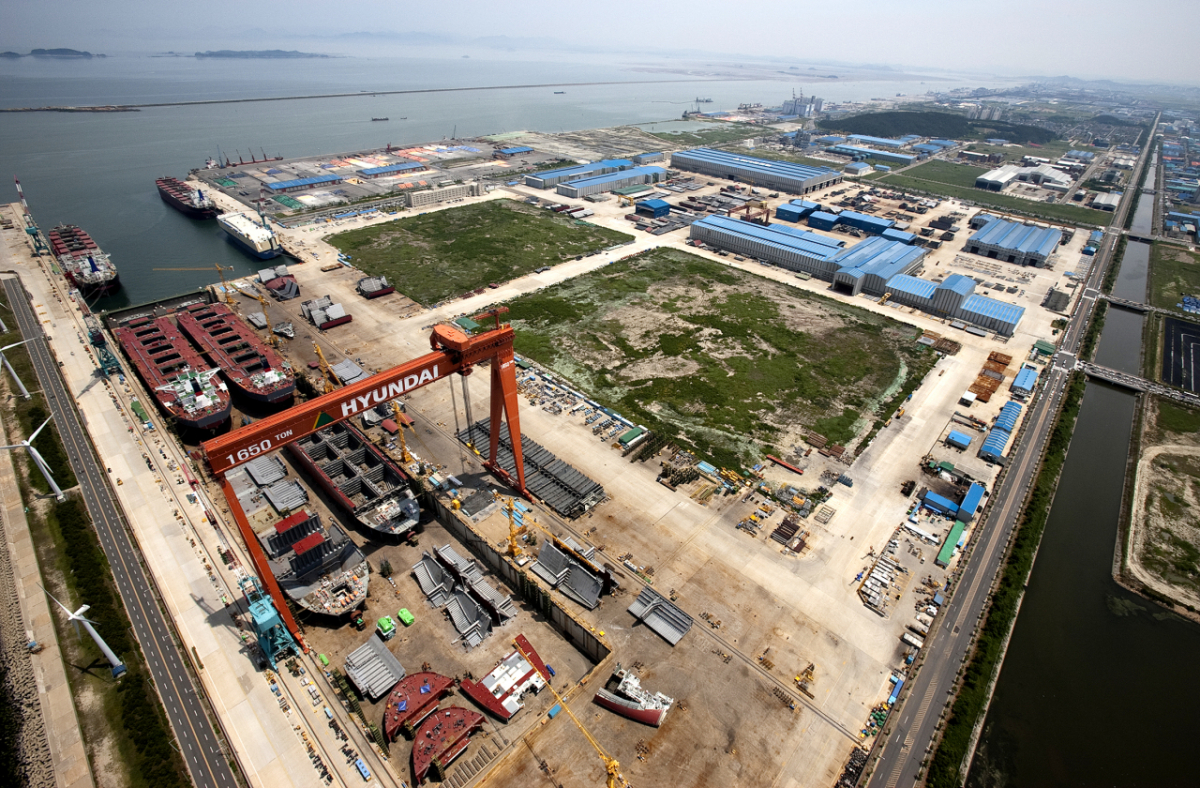
#. The number of workers employed at Gunsan Shipyard in Jeonbuk Special Self-Governing Province reached approximately 5,250 in 2016. Eighty-six local subcontractors operated centered around the shipyard, and annual transaction volume exceeded 29 billion won. Then, a restructuring of the shipbuilding industry struck. When the shipyard could no longer build ships in 2017, subcontractors that lost work shut down, and nearby commercial districts were also hit. Although production of ship blocks resumed in 2022, there were limits to restoring the former vitality.
In response, Gunsan City is positioning offshore wind power as a core pillar for the regional economy's resurgence. The key plan is to develop an offshore wind industry cluster (complex) on approximately 330,000 square meters (100,000 pyeong) of idle land within the shipyard's total site of about 1.8 million square meters, while reserving land for shipbuilding. The concept is to concentrate production facilities for equipment and materials needed to build offshore wind power plants in this area.
The starting point is the infrastructure already in place for shipbuilding. Gunsan Shipyard, acquired by J-Ocean Heavy Industries from HD Hyundai Heavy Industries, features a 700-meter-long dock and a 1,650-ton Goliath crane.
The extensive yard required for ship manufacturing, along with facilities for cutting and welding steel plates and assembling heavy structures, directly overlaps with the processes needed to produce equipment and materials for offshore wind turbines.
HJ Heavy Industries, which is establishing a production hub on the idle shipyard land, plans to manufacture towers—massive steel pillars required to erect generators—the Offshore Substation (OSS), a large structure that collects electricity from multiple generators and transmits it to shore—and Transition Pieces (TPs), connecting steel structures that link the bottom foundations driven into the seabed with the upper towers. An official at HJ Heavy Industries emphasized, "We will begin production in 2028."
Unison is building the turbine factory. Unison plans to construct a turbine factory on approximately 100,000 square meters of shipyard land. Production targets include 10-megawatt-class turbines developed as a national project and 13.6-megawatt and 16-megawatt-class turbines utilizing imported overseas technology. The plan is to manufacture 25 units of the 13.6-megawatt class in Gunsan and supply them to Hanbit Offshore Wind, which is scheduled to break ground next year by Unison's parent company, Myeongwoon Industrial Development.
Shipbuilding-Based Production Facilities… Meeting West Coast Demand and Port Access
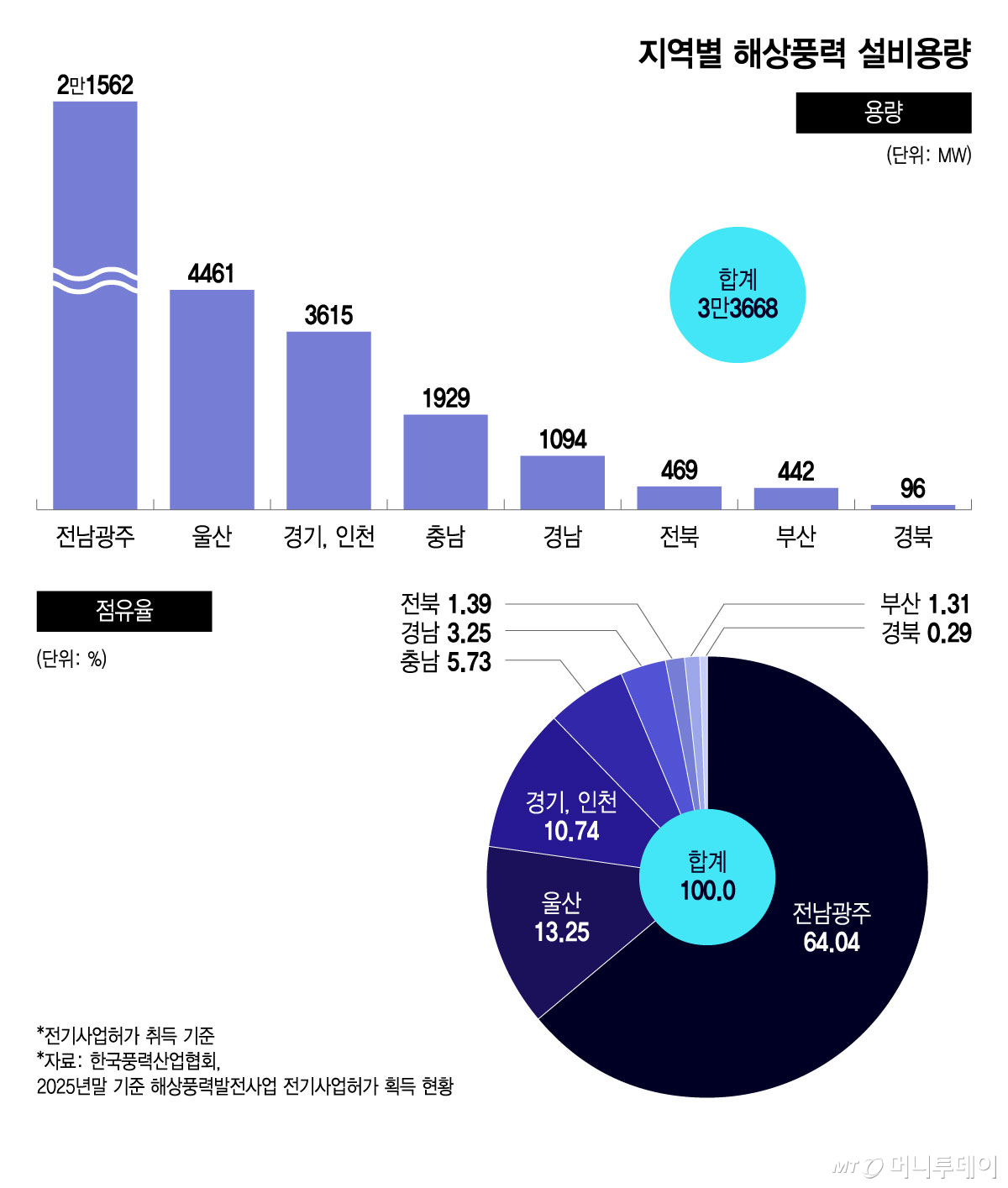
Demand is cited first as the background enabling cluster development. Offshore wind power business permits obtained by developers in the Southwestern Sea and Chungcheongnam-do regions adjacent to Gunsan Shipyard account for approximately 70% of the national total. This matches the government's stated target of 25 gigawatts for offshore wind power deployment by 2035.
Aggregating and producing various equipment and materials needed to develop wind power plants reduces logistics costs and improves economic viability. The proximity of the shipyard and Gunsan Port is also advantageous. It is rare for offshore wind equipment to be products that can be shipped individually to the site immediately after completion at the factory. To transport towers, turbine nacelles, and other components to the power plant according to installation schedules, extensive land near a pier is needed for storage and assembly. The revised plan for the Fourth National Port Basic Plan released by the Ministry of Oceans and Fisheries in July includes the development of an offshore wind support pier at Pier 7 of Gunsan Port. Once the pier is built, the likelihood increases that local companies will participate in loading and transporting equipment manufactured in Gunsan to West Coast power plants.
Space for wind component manufacturers is also expected to expand in nearby Saemangeum. A basic plan amendment reviewed by the Saemangeum Committee on the 28th of last month included a plan to increase industrial land to 37.5 square kilometers. If component manufacturers settle in Saemangeum, they can procure parts locally, assemble them into large equipment at Gunsan Shipyard, and ship them from Gunsan Port.
Furthermore, Gunsan City has decided to pool its efforts to promote the K-Wind Offshore Wind Industry Cluster as a national project. The cluster will feature large offshore wind turbines of 20 megawatts or more, blade technology development, testing and certification facilities, and a demonstration base, linked with the government's Korea Green Transformation (K-GX) strategy.
Wind Industry with Significant Job Creation… Gunsan City: "The Last Golden Time"
As offshore wind equipment production ramps up, it is expected to lead to regional job creation and economic revitalization. The employment-inducing effect of wind power generation is significantly higher than that of other energy sources. According to a domestic study (Yang Min-young and Kim Jin-su, 2023, "Energy Economics Research"), the employment induction coefficient for wind power is 8.7 people, compared to 7.7 for solar, 5.5 for nuclear, 2.1 for gas combined-cycle, and 1.3 for coal-fired power. This means that when final demand of 1 billion won occurs in the wind industry, approximately 8.7 jobs are induced, including direct employment as well as upstream and downstream industries such as equipment manufacturing, construction, transportation, maintenance, and services.
Parties advancing the project, such as J-Ocean Heavy Industries and HJ Heavy Industries, estimate that if annual production of offshore wind equipment reaches 1 gigawatt in Gunsan, approximately 7,000 jobs will be created annually, including 600 to 800 direct employees and supply chain companies.
In an interview with Money Today, Mayor Kim Jae-jun of Gunsan City stated, "The resurgence of Gunsan Shipyard is not merely an issue for a single company but directly linked to the recovery of the entire regional economy." He added, "Offshore wind power is an industry that revives what Gunsan originally excelled at, so we must seize this opportunity while companies and skilled personnel who have endured the time are still present." He further promised, "Work from factories entering Gunsan must flow to local partner companies, and citizens' income must be reconnected to sales in neighborhood commercial districts. We will train specialized personnel in collaboration with regional universities and research institutions, and support job transitions for existing shipbuilding and machinery industry workers as well as employment and settlement of local youth."
Finally, Mayor Kim urged, "What Gunsan needs now is not simple support, but an opportunity to rise again. As the private sector steps up investment and the national energy industry structure is being reorganized, this is the last golden time for Gunsan to leap forward again. We expect decisive action from the government and Jeonbuk Special Self-Governing Province, along with policy finance and national project support."

 in INDUSTRY


