

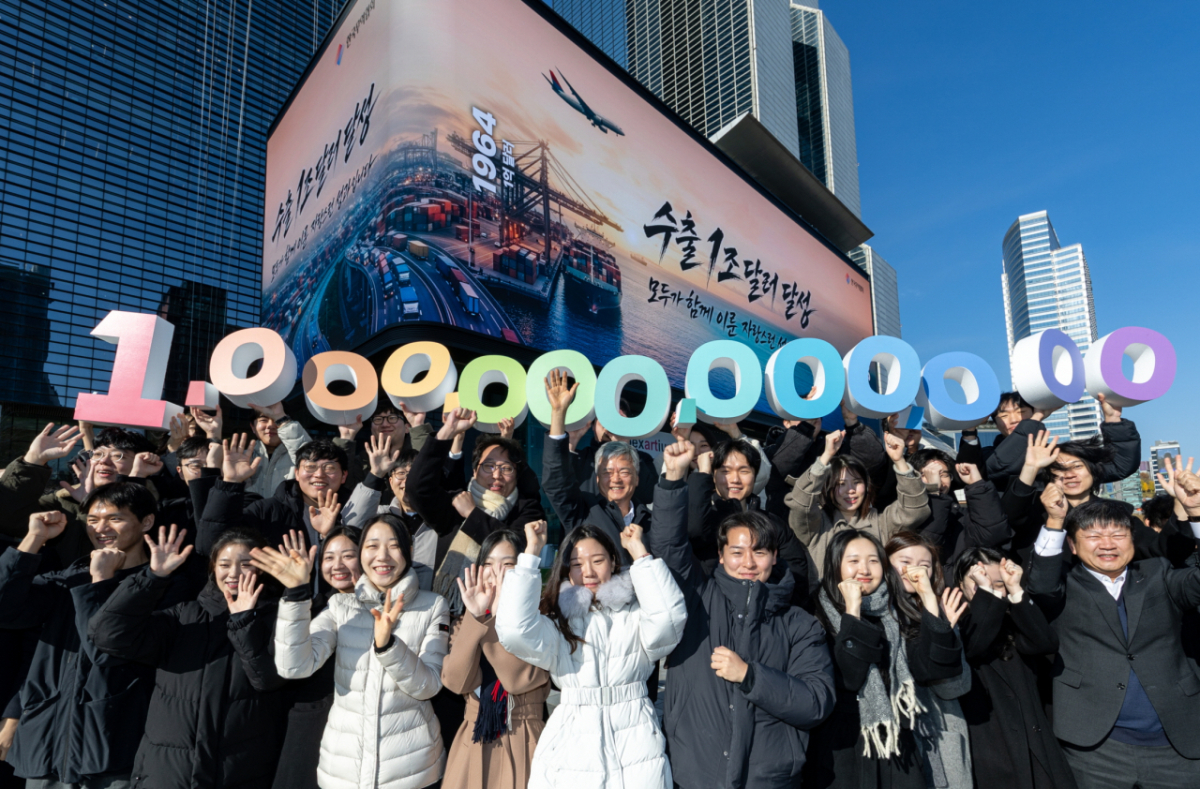
The Korea International Trade Association (KITA) said on Nov. 19 that South Korea's achievement of $1 trillion in exports, making it the world's fourth country to reach the milestone after the United States, Germany and China, underscores the need to diversify export markets and strengthen the foundation for sustainable growth.
"It is important to further diversify exports to build a foundation for sustainable growth and establish a virtuous cycle that allows the benefits of exports to spread throughout the economy," KITA said.
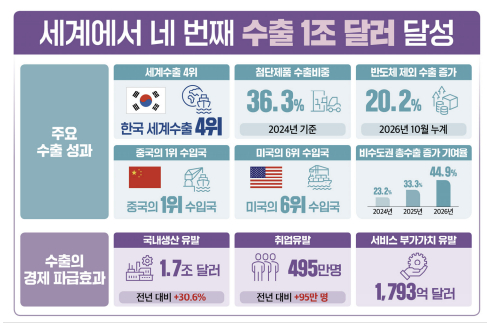
KITA estimated that $1 trillion in exports generates the equivalent of 4.95 million jobs. The milestone is also expected to generate $1.7 trillion in domestic production and $179.3 billion in value added in the service sector.
South Korea has the smallest population among the four countries to reach the $1 trillion export milestone, but recorded the highest per capita exports at $19,376 when it achieved the feat. This reflects a success built on expanding into overseas markets rather than relying on a large domestic market.
Semiconductor exports rose 193.1 percent year on year through October, making the sector the biggest contributor to South Korea's entry into the $1 trillion export club.
High-tech products account for 36.3 percent of the country's manufacturing exports, the highest share among the world's five largest exporting nations.
South Korea also ranked sixth globally in exports of AI-related products last year. It has long established itself as the world's largest producer of memory chips, which are essential for data centers, smartphones and graphics processing units (GPUs).
Its organic light-emitting diode (OLED) displays are also highly competitive in markets for smartphones, TVs, gaming monitors and automobiles, thanks to their high added value.
Non-semiconductor exports also performed well, rising 20.2 percent from a year earlier. In shipbuilding, for example, South Korea trails China in total vessel orders but remains a global leader in high-value-added segments, including large liquefied natural gas (LNG) carriers.
Automobiles, dairy products and synthetic resins remain major export items, while biotechnology and beauty products are making increasingly large contributions to exports.
KITA said the achievement reflects both qualitative growth led by higher unit prices and solid growth in export volumes.
"While rising export volumes drove growth in the past, this year's achievement of $1 trillion in exports was made possible by a combination of qualitative growth led by higher unit prices and sustained increases in volume," the association said.
It added that South Korea had shifted its main export industries from labor-intensive light manufacturing to advanced manufacturing, improving the quality of its exports. "The country has evolved from a technology follower into a key global supplier in advanced industries," it said.
KITA also said the positive impact of exports on the domestic economy through increased production, value added and employment was at an unprecedented level.
It called for stronger links between manufacturing and the AI ecosystem to further enhance export competitiveness, and urged the creation of a virtuous cycle in which profits generated during economic booms are reinvested in future competitiveness through research and development, talent, industries and infrastructure.

 in INDUSTRY

