

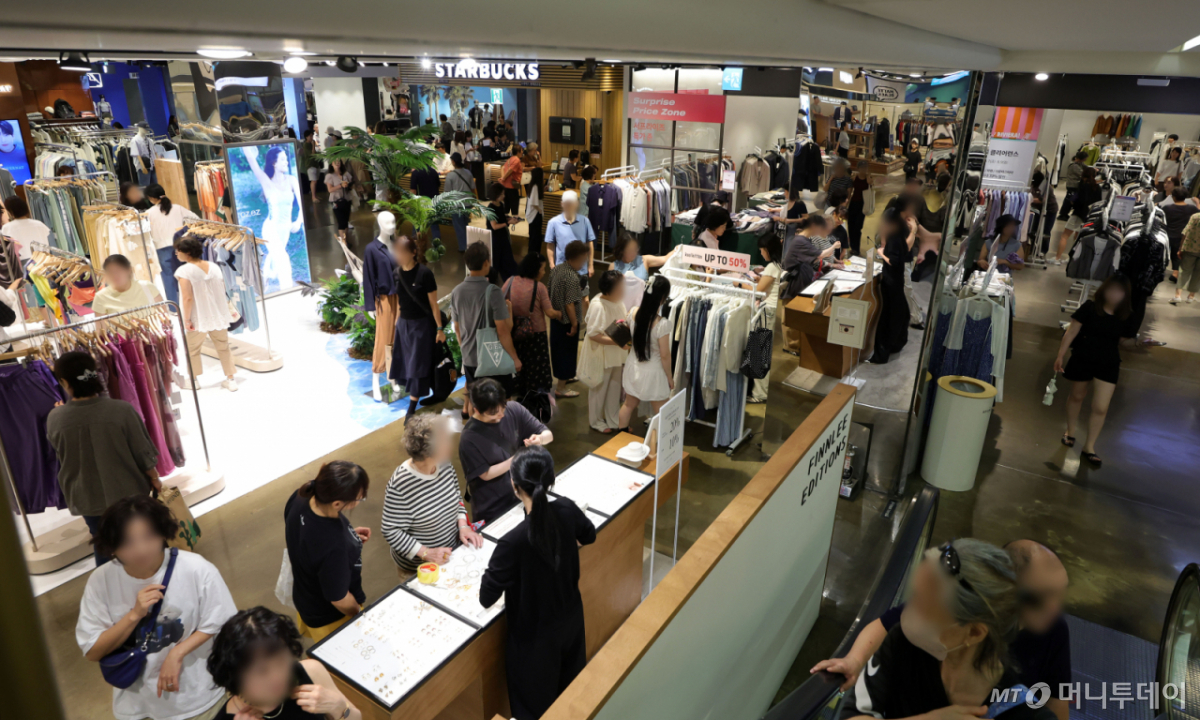
As fashion consumption, which had been subdued for some time, revives, signs of recovery are emerging in the performance of Korea's domestic fashion industry. With domestic clothing consumption rebounding centered on department stores and foreign tourists also flocking to major commercial districts, fashion companies based on offline LINE stores have benefited. In particular, analysts note that this recovery goes beyond mere sales growth; it has led to improved profitability as strategies such as selling at full price and improving product composition took effect.
According to the fashion industry on the 18th, major fashion companies including Samsung Wholesale Fashion Division, Hanssem, LF, and F&F recorded generally improved performance in the first half of this year. While growth drivers varied by company, the recovery of department store sales and expanded foreign consumer spending served as common background factors.
Indeed, the recovery trend in department store consumption is clear. According to the Ministry of Trade, Industry and Energy, department store sales increased by 17.4% year-on-year in the first quarter, followed by growth exceeding 20% in the second quarter. For fashion companies, unlike last year when consumers kept their wallets closed, signs of recovery have emerged from key offline LINE sales channels.
One area where profitability improvement was most pronounced is Samsung Wholesale Fashion Division. Second-quarter sales reached 593 billion won, up 16.3%, while operating profit rose to 54 billion won, a 63.6% increase. With profits rising much more steeply than sales, the operating profit margin also climbed to 9.1%, up 2.5 percentage points from the previous year. Strategies such as improving sales of existing brands and benefiting from new brands, combined with reducing discount sales and increasing the proportion of full-price sales, contributed to profit improvement.
Hanssem also showed a similar trend. Second-quarter sales increased by 7.4% to 363.2 billion won, while operating profit surged 525% to 4.6 billion won. In particular, offline LINE sales including department stores grew by 8.7%, driving overall sales growth. The proportion of offline LINE sales also expanded from 77.8% to 78.8%.
The increase in visitors to Korea added a new consumer layer to the fashion industry. F&F reported second-quarter sales of 399.6 billion won and operating profit of 86.5 billion won, up 5.5% and 2.9% year-on-year, respectively. As foreign visitor numbers increased in tourist districts such as Myeong-dong, MLB sales showed strong performance. The recovery of domestic consumption combined with foreign spending supported the rebound of offline LINE stores.
LF also saw increases in both sales and profits for the first half of the year. Second-quarter sales rose 2% to 465.4 billion won, while operating profit remained at a similar level to the previous year at 44.1 billion won. Cumulative operating profit for the first half reached 88.5 billion won, up 19% from the previous year. Growth in core brands such as Hedge and Dax was bolstered by strengthened positions of imported brands including Barber, Kin, and U-Force.
Industry analysts suggest that it is difficult to view the recent improvement in fashion industry performance as a simple consumer rebound. With sales reviving centered on department stores and tourist districts, companies are lowering their reliance on discounts while strengthening brand competitiveness and product composition, leading to improvements in the quality of sales as well.
A fashion industry official stated, "As consumer sentiment recovers, offline LINE sales centered on department stores are improving, and the increase in foreign tourists is boosting sales in major commercial districts." The official added, "In the second half of the year, how long the consumption recovery trend continues and securing competitiveness for each brand will determine performance."

 in LIVING
