

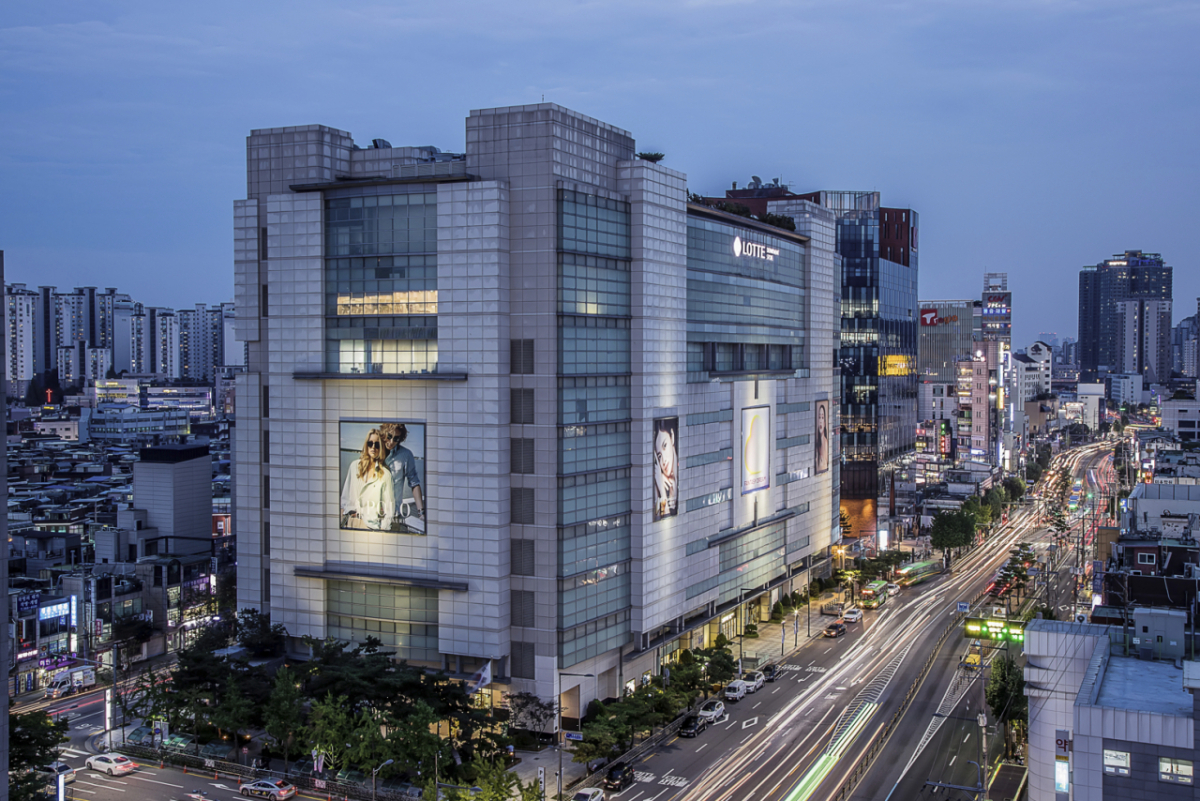
Since taking the helm at Lotte Department Stores at the end of last year, Jeong Hyeon-seok (CEO) has launched a full-scale store restructuring initiative. The company is adopting a 'two-track strategy': decisively closing underperforming stores with prolonged sales slumps while simultaneously investing heavily in high-growth-potential locations to improve its overall health.
According to Lotte Shopping on the 20th, among the 30th Lotte Department Stores currently operating nationwide, the company retains ownership of 14 stores, including the Main Store, Jamsil Store, and Busan Main Store. The remaining stores are operated under lease agreements through sale-and-leaseback arrangements or investment trusts.
Since Jeong (CEO) assumed office, Lotte Department Stores has focused on 'store selection.' In particular, stores located in declining commercial districts or those lagging behind competitors due to poor performance are the top priority for restructuring. The Mia store in Gangbuk District, Seoul, currently under negotiation for sale to EIS Asset Management at approximately 200 billion won, is a prime example. Prior to this, the Bundang store ended its operations in late March following coordination with landlords.
Both stores have recently struggled with poor performance. According to industry sources, total sales (transaction value) for the Mia store last year amounted to 153 billion won, while the Bundang store recorded 151.1 billion won, representing declines of 3.4% and 5.8%, respectively, compared to the previous year. Among Korea's 65 major department stores, both ranked near the bottom at positions 57th or 58th. Despite their favorable locations, they faced a double burden from the growth of e-commerce and competition from rival store chains.
Industry observers interpret this decision as Lotte Department Stores abandoning its 'multi-store strategy' maintained over the past 30 years. The shift reflects a strategic pivot toward substance-driven management focused on maximizing profitability rather than expanding store numbers.
Consequently, further store restructuring by Lotte Department Stores is considered likely. Among stores retained as assets, those with annual sales of 200 billion won or less last year or those experiencing sharp recent sales declines are being highlighted as potential candidates. For instance, the Busan Centum City store is expected to soon begin sale negotiations once the local government completes procedures to change the land use designation.
Simultaneously, Jeong (CEO) has chosen a strategy of concentrating investment in high-growth-potential core stores to expand scale. The Jamsil store, linked with Lotte World Mall and targeting annual sales of 4 trillion won, began large-scale renovations last year. Meanwhile, the Main Store, which saw a significant increase in foreign tourists, is pursuing plans to renovate its underground spaces and install an ultra-large media facade to create a second 'Lotte Town.'
Following the Busan Main Store, Incheon Store—now being cultivated as the fourth store to achieve 1 trillion won in annual sales—and Nowon Store, a key hub in northern Seoul, have recently completed major renovations. Plans are underway to open a new wing at Cheongnyangni Store in the second half of this year. This strategy involves using funds secured through asset monetization to enhance financial stability while actively investing in strengthening the competitiveness of core stores.
This substance-focused strategy has already proven successful. In the first half of this year, operating profits from Lotte Department Stores' domestic locations reached 295.9 billion won, a 54.8% increase compared to the same period last year. Notably, average sales growth for major stores receiving concentrated investment stood at 21%, surpassing the overall average sales growth rate of 15%.
Shortly after taking office last year, Jeong (CEO) established a Future Strategy Headquarters and personally served as its head to conduct intensive reviews of profit structures across all stores. Evaluations suggest he is applying his experience from leading Uniqlo (FR Korea), where he successfully turned around the fashion brand's losses through store closures and expansion into flagship locations. Last year, Lotte Chairman Shin Dong-bin accelerated the restructuring pace by eliminating Lotte Shopping's retail group headquarters organization for the first time in nine years during a regular executive reshuffle, shifting to a system of responsible management for each subsidiary.

 in LIVING

