

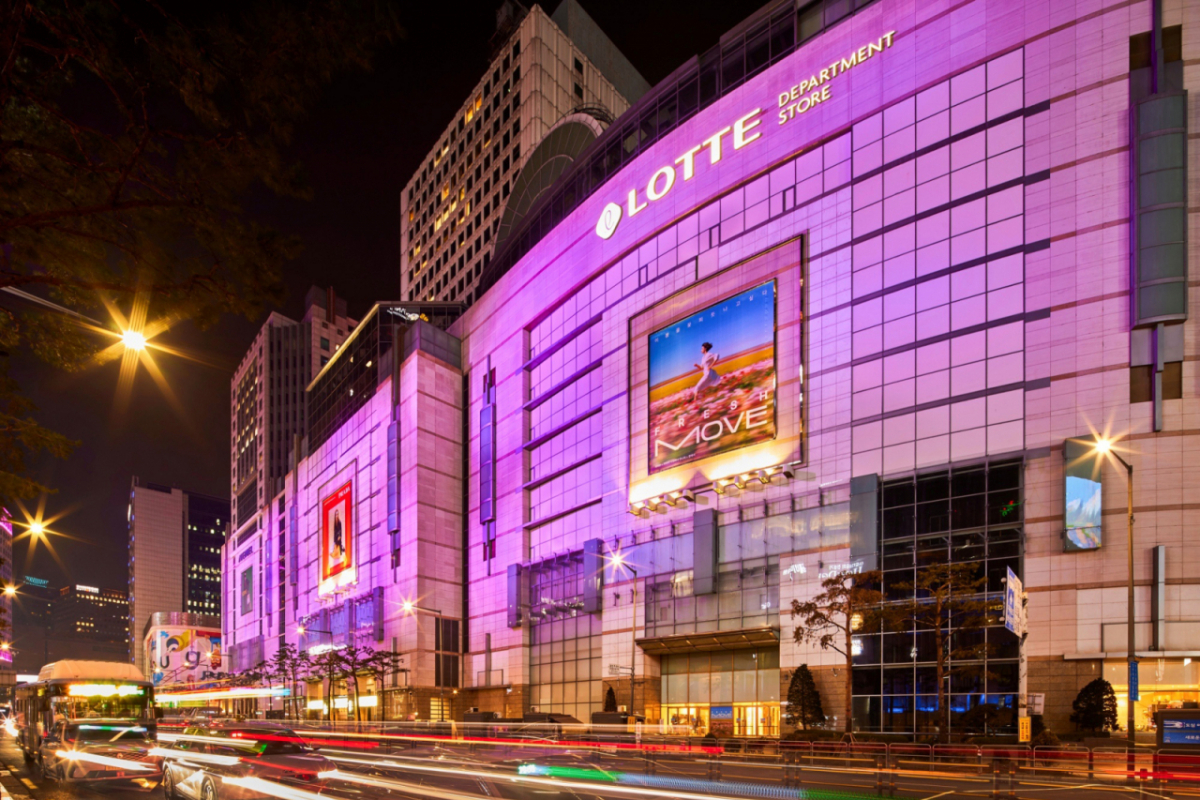
Since the end of last year, Jeong Hyeon-seok (CEO), who has led Lotte Department Store, has embarked on a full-scale store restructuring. The strategy involves decisively closing stores with long-term sluggish sales while simultaneously investing heavily in high-growth potential branches—a 'two-track strategy' aimed at improving corporate health.
According to Lotte Shopping on the 20th, Lotte Department Store has focused on "selecting good from bad" among its branches since Jeong (CEO) took office. In particular, stores with poor performance due to sluggish surrounding commercial districts or being overshadowed by competitors are the top priority for restructuring. The Mi-a branch in Gangbuk-gu, Seoul, currently under discussion for sale to E-Guide Asset Management at a price around 200 billion won, is a prime example. Prior to this, the Pangyo branch ended operations in late March following negotiations with landlords.
Both branches have recently suffered from poor performance. According to industry sources, total sales (transaction value) for Mi-a last year were 153 billion won, and Pangyo's sales were 151.1 billion won, representing decreases of 3.4% and 5.8%, respectively, compared to the previous year. Among Korea's 65 major department stores, they ranked among the lowest at 57th or 58th place. Despite their favorable locations, they faced a double burden from the growth of e-commerce and being overshadowed by competitors' branches. Currently, Lotte Department Store owns 14 branches as assets out of its 30 nationwide operations, including the main store, Jamsil branch, and Busan Main Branch. Other branches are operated on a lease basis through sale-and-leaseback arrangements or investment trusts.
Industry observers interpret this decision as Lotte Department Store abandoning its "multi-store strategy" maintained for the past 30 years. The company has shifted its strategy from expanding store numbers to focusing on profitability and internal strength management. There are also indications that Lotte Department Store may undertake further store restructuring. Among the branches owned as assets, those with annual sales of 200 billion won or less last year or those experiencing a sharp recent decline in sales are likely candidates for action. For instance, it is reported that the Busan Centum City branch is highly likely to begin sale negotiations immediately once the local government completes procedures for changing the land use designation.
At the same time, Jeong (CEO) is pursuing a strategy of concentrating investment in high-growth core branches to expand scale. The Jamsil branch, linked with Lotte World Mall and targeting 4 trillion won in annual sales, began large-scale renovations last year. The main store, which has seen a significant increase in foreign tourists, is also promoting plans to renovate its underground space and install an ultra-large media facade to create a second "Lotte Town." Additionally, Incheon branch, being developed as the fourth "1 trillion won annual sales" branch after Busan Main Branch, and Norwon branch, a hub store in northern Seoul, recently completed large-scale renovations. Plans are also underway to open a new wing at Cheongnyangni branch in the second half of the year. This strategy involves using funds secured through asset securitization to enhance financial stability while actively investing in strengthening the competitiveness of core branches. The internal strength strategy has been proven by results. In the first half of this year, operating profit for Lotte Department Store's domestic branches reached 295.9 billion won, a 54.8% increase compared to the same period last year. Particularly, the average sales growth rate for large-scale stores that received concentrated investment was 21%, surpassing the overall average sales growth rate of 15%.
Immediately after taking office last year, Jeong (CEO) established a Future Strategy Headquarters and personally served as its head to intensively review the profit structure of all branches. He is credited with applying his experience from Uniqlo (FR Korea), where he successfully turned losses into profits by closing stores and focusing on hub-based large-scale expansion during his tenure as CEO, to Lotte Department Store. Shin Dong-bin, Chairman of Lotte Group, strengthened the momentum for restructuring last year by eliminating the Lotte Shopping Retail Group HQ organization in its regular executive personnel changes for the first time in nine years and shifting to a system of responsible management for each subsidiary.

 in LIVING
