

#The Fair Trade Commission imposed a fine of 234.927 billion won on five companies, including Samsung Electronics and three other affiliates, in 2021 for allegedly funneling in-house cafeteria meal volumes to Samsung Wellstore. It also branded the case as the largest-ever instance of unfair support. Approximately four years and ten months later, last April, the Seoul High Court ruled that there was insufficient proof of intent to provide support or excessive economic benefits, canceling both the fine and the corrective order. The Korea Fair Trade Commission is now appealing to the Supreme Court, awaiting its decision.
Over the past decade, the Korea Fair Trade Commission has returned more than 580 billion won in fines after losing administrative lawsuits. In the financial sector as well, as companies increasingly file appeals against penalties, refunds of fines by the Financial Services Commission are rising rapidly. When excessive measures are halted, not only the fines but also interest and legal fees incurred for litigation response become a burden on the national treasury.
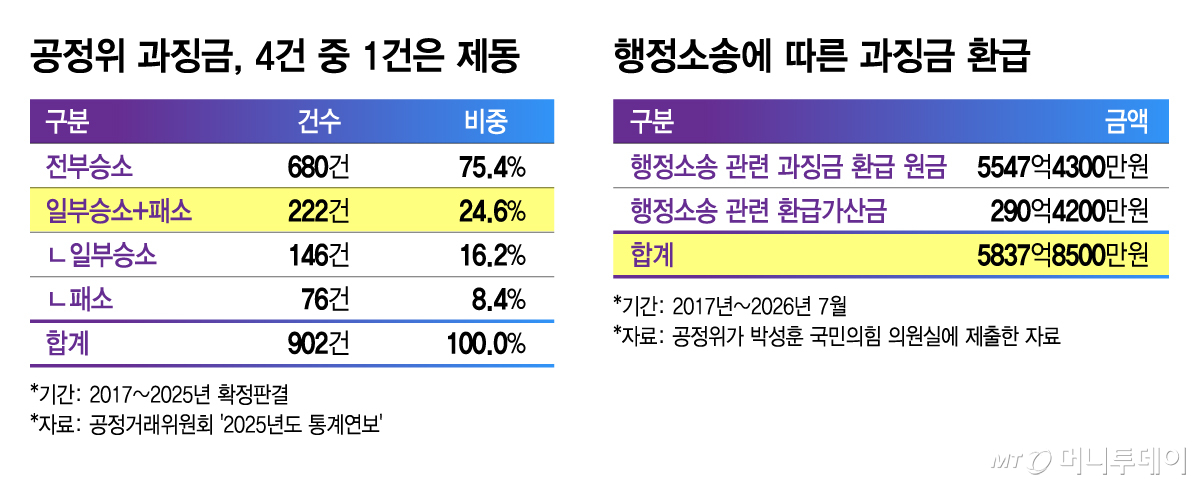
According to the Korea Fair Trade Commission's "2025 Statistical Yearbook" released on the 16th, among 902 finalized administrative lawsuits from 2017 to 2025, the Korea Fair Trade Commission won all claims in 680 cases. Partial victories occurred in 146 cases, and total losses in 76 cases. The Korea Fair Trade Commission classifies partial victories as wins, announcing an official victory rate of 91.6%. However, if only full victories where the original penalty was entirely upheld are counted, the victory rate drops to 75.4%. This means that for every four final rulings, courts have halted part or all of the initial penalty in one case.
The problem lies in the costs incurred when penalties fail to pass judicial scrutiny. According to data submitted by the Korea Fair Trade Commission to the office of People Power Party lawmaker Park Sung-hoon, the principal amount of fines returned to companies due to administrative lawsuits from 2017 through July this year totaled 554.743 billion won. Including refund surcharges with interest nature totaling 29.042 billion won, the total refund amount swelled to 583.785 billion won.
Litigation costs incurred by the government are also taxpayer money. According to data submitted by the Korea Fair Trade Commission to the office of People Power Party lawmaker Lee Yang-soo, external lawyer fees were 2.85 billion won in 2021, 2.944 billion won in 2022, 2.921 billion won in 2023, and 3.003 billion won in 2024. The government has also budgeted 5.8 billion won for the Korea Fair Trade Commission's administrative litigation execution budget next year.
Appeals against Financial Services Commission decisions are also increasing. Data submitted by the Financial Services Commission to the office of People Power Party lawmaker Kim Sang-hoon shows that new administrative lawsuits related to penalties rose from 23 cases in 2022 to 26 in 2023, 36 in 2024, and 45 in 2025. This year alone, 16 new cases were filed through May.
As lawsuits have increased, the amount of fines refunded has grown significantly. The Financial Services Commission returned only 108 million won in fines to companies and financial institutions in 2022, but this rose to 637 million won in 2024 and 789 million won in 2025. In just five months this year, refunds reached 35.63 billion won, surpassing 4.5 times the total annual refund amount of last year.
When strong penalties are imposed, companies must bear fines as losses and engage in long-term legal responses. If a penalty is overturned, additional costs such as refund surcharges and government litigation expenses become a burden on national taxes. There are calls for sufficient evidence and precise fine calculations to be required from the initial penalty stage.

 in LIVING
