

Chinese DRAM manufacturer Changxin Memory Technologies (CXMT) listed on the Shanghai Stock Exchange on the 27th. Market attention focused on its stock price surging 466% above the offering price on its first day of trading. However, what truly matters in this initial public offering (IPO) is not the stock price but the fact that China's semiconductor industry has fundamentally altered its capital-raising structure.
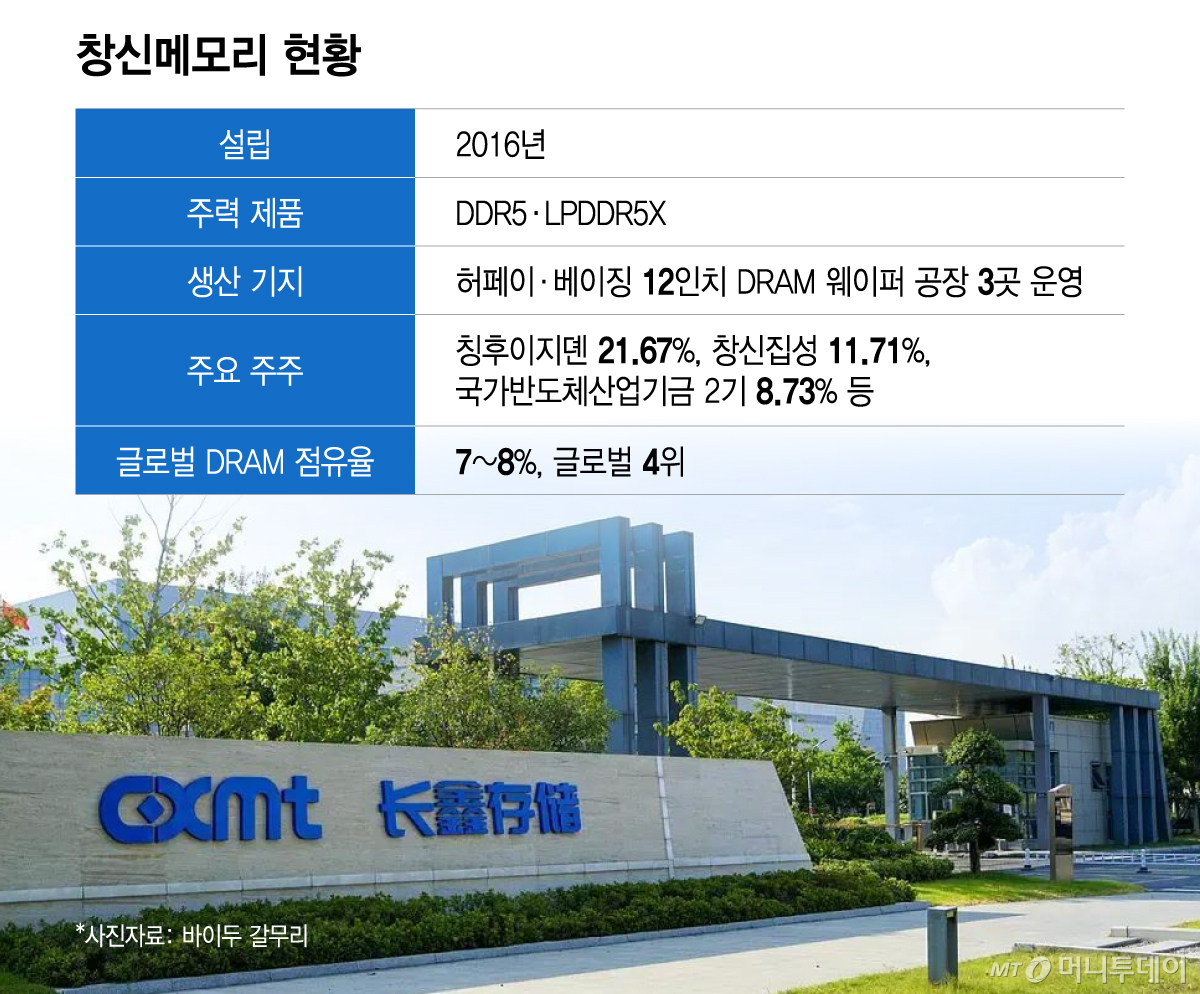
Changxin Memory's listing signifies that China's memory industry, which had relied on government support, has begun raising growth capital through the capital market. If NAND manufacturer YMTC (Yangtze Memory Technologies Corporation) also lists, China will connect its entire memory sector—spanning both DRAM and NAND—to the capital market. YMTC entered pre-listing guidance procedures with CITIC Securities in mid-May.
Changxin Memory's growth trajectory encapsulates China's state-led semiconductor development model: national semiconductor funds, local governments, and state-owned financial institutions bear initial risks to nurture companies; once operational foundations are established, these firms list on stock exchanges to secure subsequent growth capital. Changxin Memory launched in 2016 with funding support from the Hefei municipal government and raised approximately 57.92 billion yuan (about $8.6 billion) through this IPO.
In this process, the AI boom served as a pivotal catalyst accelerating IPOs for Chinese memory companies. After operating at a loss for nearly a decade, Changxin Memory recorded its first annual profit last year due to surging DRAM demand and erased all accumulated losses since its establishment in the first half of this year.
However, attributing Changxin Memory's stock surge on its listing day solely to the AI boom is difficult. While low offering prices and limited circulating shares (only 6.73% of total equity) likely amplified price increases, investor enthusiasm was also driven by expectations that the Chinese government will continue supporting the memory industry.
Capital is as critical as technology in the memory sector. Building advanced production facilities and transitioning processes repeatedly require investments totaling tens of trillions of won. Listed companies can continuously raise funds post-IPO through rights offerings (paid-in capital increases), corporate bonds, and convertible bonds. If both Changxin Memory and YMTC enter the stock market, China will establish a long-term capital platform capable of supplying funds across its entire memory industry covering both DRAM and NAND.
This development could also reshape supply structures in the memory sector. Historically, memory market cycles have followed a pattern: rising prices prompt manufacturers to expand capacity, increasing supply and subsequently driving prices down. If Changxin Memory continuously raises capital from the stock market to boost production, an additional decision-maker will influence supply dynamics. With YMTC joining, China could expand production capabilities in both DRAM and NAND segments.
More notably, state-owned shareholders held over 36% of Changxin Memory's equity prior to listing. Unlike Samsung Electronics, SK Hynix, and Micron—which adjust investment speeds during downturns while prioritizing profitability and shareholder value—Changxin Memory may also factor in national strategic goals such as semiconductor supply chain independence and market share expansion. Consequently, even if DRAM prices fall, the company might continue investing. This could delay price recovery by making it harder to quickly resolve oversupply conditions.
Of course, Changxin Memory is unlikely to catch up with the existing three major players in advanced memory segments like HBM (High Bandwidth Memory) within a short timeframe. Some projections suggest AI demand will absorb new supply from Chinese manufacturers.
However, what truly matters in this listing is not current technological gaps or memory supply-demand forecasts. When companies nurtured by state losses gain the ability to repeatedly raise investment capital through stock markets, how will industrial order transform? If YMTC also lists, the new competitors facing the global memory industry may extend beyond just two Chinese firms—they could include China's government driving industrial growth and the entire capital market supplying funds.

 in OPINION
