

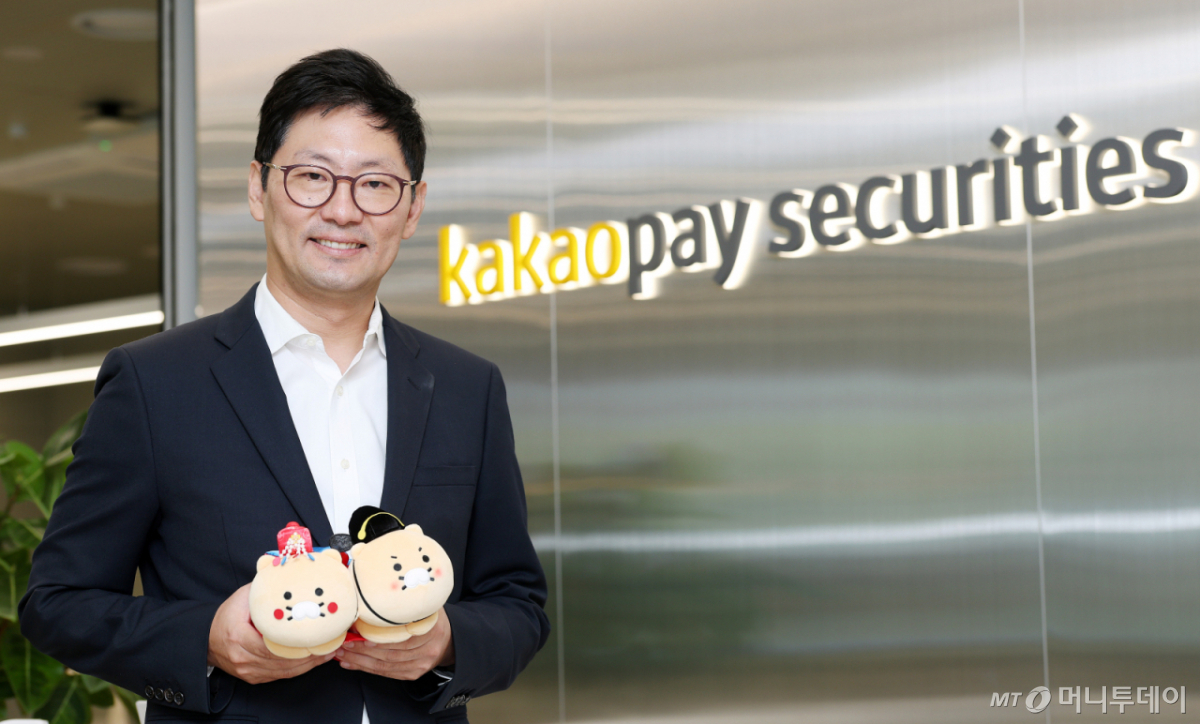
"We have expanded our customer touchpoints with a new attempt to cultivate investment habits in daily life."
Shin Ho-cheol, CEO of Kakao Pay Securities, recently met with Money Today and introduced the company's deepening retail customer base as it enters its seventh year since launch. He stated, "Rather than aggressive marketing, our strategy is to gradually cultivate customers by transforming investment culture," and announced plans to launch an AI (artificial intelligence) agent within this year to further enhance the investment experience.
After Kakao Pay acquired JustInvest Securities in 2018 and changed its name to restart as Kakao Pay Securities in 2020, the company has drawn attention from the securities industry with a full-fledged growth trend this year. Following its first annual operating profit last year, it recorded an operating profit of 631 billion won in the first half of this year, surpassing last year's full-year performance.
Industry observers evaluate that after a long wait, Kakao Pay Securities has finally reached a stable growth trajectory. As of the end of the first half, the company's deposited assets amounted to 21.1 trillion won, a 279% increase from the same period last year, and its monthly stock trading customers reached 1.61 million. Recently, it received approval for investment brokerage business, signaling plans for further business expansion.
Shin (CEO) also set a goal to open an era where 20 million Koreans participate in the capital market within three years through healthy investment experiences supported by AI. To achieve this, it launched the campaign "In 2026, South Korea Will Be a Country Where People Receive Stocks Upon Marriage" last July. This is an ambitious plan to establish a culture of gifting stocks on every celebratory occasion, starting with marriage and childbirth.
The following is a Q&A with Shin (CEO).
-It feels like an IT company atmosphere in a securities firm office.
▶Since launching based on fintech, many people who aim for fresh attempts have gathered. We also put effort into recruiting talent who seek alternative methods while adhering to the framework of finance. The securities industry to which our company belongs is also considered to have a culture more open to new attempts compared to other financial sectors.
-How has this challenging culture impacted business performance?
▶We found our own growth equation. Generally, investors are attracted through massive marketing, but we judged that we could not compete with existing securities firms in terms of budget scale and that such methods were not effective. At the beginning, we focused on lowering the threshold for investing in daily life. Proposing to invest hundreds of won remaining after online payments into funds on a regular savings basis was also an unprecedented attempt at the time. Of course, this itself did not directly lead to profits, but we expanded the experience gained by quickly broadening customer touchpoints into "stock collecting." Instead of customer acquisition, we focused on "cultivation."
-It must have been a difficult choice.
▶There were many opinions that it was difficult because it was an uncharted path, but we could confirm behavioral changes in the customer base through data analysis. Last year, we traveled across the country conducting customer interviews and met several customers with trading volumes larger than expected. We observed the journey of users who had no prior interest in securities trading naturally flowing into our service via Kakao Pay's simple payment system, gradually increasing their trading volume, and transforming into active investors.
-The favorable domestic and international market environment also played a role.
▶It is not significantly different from other securities firms that top customers account for a large portion of the company's operating revenue. Initially, we attempted to target this customer group separately. However, we judged it did not fit our model and instead chose a method of broadening the base to naturally form top customers.
-What was the differentiation you aimed for?
▶First is connection and accessibility. We view the fact that there are many touchpoints where people encounter investing in daily life, such as being able to invest with money remaining after purchasing items via simple payment at convenience stores, as a key differentiator. Second is service completeness; the monthly repeat usage rate for "stock collecting" customers is around 90%. The number of users increased significantly from 100,000 to 150,000 in the first two months of the service's launch to approximately 1.2 million by June last year.
-The churn rate appears to be quite low.
▶We actively reflected customer feedback to make the service easy to use. For "stock collecting," we continuously added features such as automatic selling upon reaching a target return rate and partial buying based on set price conditions. We designed it to help customers continue investing according to their own plans, with a focus on long-term investors. A simple and easy user experience (UX) like KakaoTalk was the key keyword.
-What meaning does the investment brokerage license received last July carry?
▶We aim to find new business opportunities beyond simple intermediation. This aligns with the trend of expanding venture capital. So far, Kakao Group has actively invested in startups, producing success stories such as Naver (operator of Upbit) and Danggeun Market, but it lacked the connections to take them all the way to listing. We believe that if Kakao Pay Securities enters as an initial public offering (IPO) lead underwriter and takes on the pre-listing bridge period for invested startups after the early and intermediate stages, a virtuous cycle within the group can be strengthened. Rather than closing large deals at once, our strategy is to accumulate several appropriate deals, and we are also considering preparing advisory strategies suitable for company sizes. Preparing for SPACs (Special Purpose Acquisition Companies) is also part of this effort.
-How are you preparing for the era of artificial intelligence (AI)?
▶We received significant stimulation from acquaintances in Silicon Valley and domestic technology companies. The direction is to become an "AI-native company." In the early stages of adoption, we conveyed the message that "we should view AI not as artificial intelligence but as augmented intelligence." The intent was to encourage proper investment rather than hostility. Subsequently, enthusiasm for utilization among members grew, and we found that the scale of AI tool usage per person significantly exceeded the industry average. When we held an internal hackathon, one-third of the members voluntarily participated and created agents for their respective tasks. Personally, I use an agent trained on internal documents to check work progress, which helped reduce the gap in work context between executives and frontline staff.
-We are also curious about the direction of external AI services.
▶Since last year, we have sequentially introduced "How Was It," "Why," and "What If." These are AI services that explain previous day's market conditions and reasons for fluctuations, providing scenarios and interpretations to refer to in decision-making. The direction for the next stage is an "AI agent on the side of customers, not securities firms." We aim to design it to provide proper explanations before recommending investment products. Initially, the agents were equipped only with technical analysis, but based on the judgment that they did not seem to be on the customer's side, we decided to add educational functions. Since many customers have limited investment experience, if sufficient understanding is not established beforehand, it could lead to unexpected losses, which ultimately would not benefit the company either. Moving away from a supplier-centric approach is also Kakao's way. We are preparing with this year as the target.
-What are your medium-to-long-term goals or plans?
▶In addition to becoming a comprehensive investment securities firm and strengthening retail competitiveness, there are two more points. First is "Globalization of K-stocks." With the trend of increasing overseas interest in the Korean stock market, we are focusing on expanding exposure and reviewing various plans including collaboration with overseas partners. Second is "A financial culture that gifts the future." Just as one sends a gift via KakaoTalk on birthdays, we want to create a culture where stocks are gifted when a baby is born and relatives contribute, similar to giving a stock alongside a first birthday ring. The campaign for newborns next year will be the start, and we aim to expand this into a culture of gifting stocks at every new beginning in life, such as marriage and childbirth. Of course, stocks are assets that can incur principal losses, but we believe our role is to help people understand long-term and diversified investing.
-You started a campaign to give domestic stocks to newlywed couples; isn't the burden significant?
▶We are executing the budget within an estimated range of up to 100,000 won per household. While there are cheaper methods to cultivate customers, we judged that this scale was necessary to give the campaign topicality and establish a starting point for gift culture. We started this campaign because we want to make it a sustainable trend rather than a one-off event.
-You moved from IT/fintech to the securities industry and were reappointed as CEO; what are your reflections?
▶The early philosophy of Kakao, "to go down an uncharted path," aligns well with my personal creed, which is good. I am also getting along very well with members of other securities firms, so I am very satisfied. I felt it was a warm industry where we compete with each other but raise our voices together on common agendas.

 in STOCK
