

"Recent market volatility reflects a recalibration of memory sector fundamentals and expectations for AI (artificial intelligence) investments. A meaningful rebound is expected as companies navigate the earnings season." (Cho Soo-hong, Director of Research Center at NH Investment & Securities)
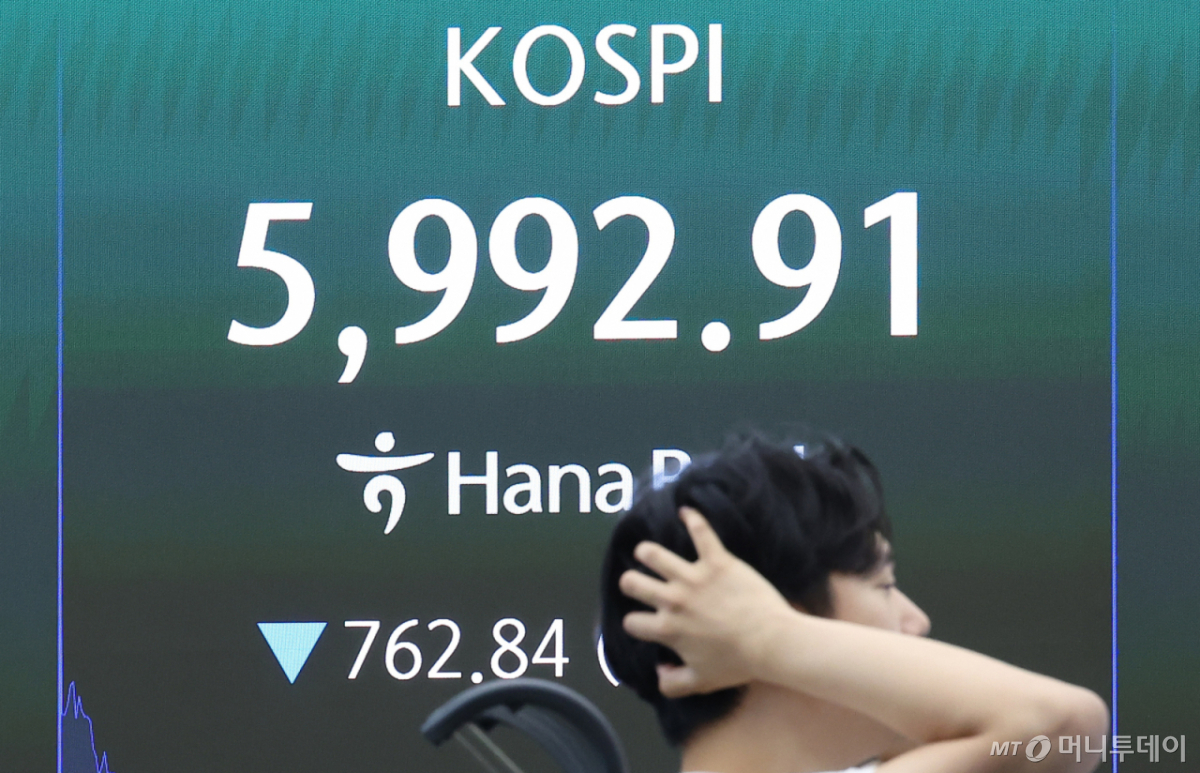
On the 28th, the KOSPI index plummeted by more than 10%, falling below the 6,000-point level during trading hours. This was the first time since April 14 that the 6,000-point threshold was breached. Although the market has experienced a volatile trend with nearly a 30% decline this month alone, securities firms unanimously diagnose the current situation as an "excessive undervaluation zone." However, given the continued instability in supply and demand dynamics, voices expressing optimism about psychological recovery are not as strong as before.
MoneyToday conducted an urgent diagnostic survey with eight research center directors from major securities firms regarding the sharp decline in the KOSPI index. The directors identified concerns over memory oversupply triggered by China, doubts about AI investment prospects, and mechanical selling related to ETFs (exchange-traded funds) such as single-stock leverage as key drivers of the market plunge. Yoon Chang-yong, Director of Research Center at Shinhan Investment Corp., stated, "While the initial decline stemmed from a reevaluation of AI investment sustainability and concerns over China's semiconductor industry catching up, the widening drop was driven by a supply-demand shock resulting from large-scale foreign investor selling combined with mechanical trading in leverage and ETF products."
Earlier, global semiconductor stocks plummeted following news about DUV (deep ultraviolet) lithography equipment shortages at Yangsan, a Chinese semiconductor equipment manufacturer. Additionally, as the market focused on financial stability amid expanded AI investments, this became negative for the AI and semiconductor sectors, directly impacting domestic markets with high exposure to Samsung Electronics and SK Hynix. On this day, foreign investors sold off 5.7828 trillion won worth of KOSPI stocks in net sales, marking three consecutive days of trillion-won-level net selling.
Regarding the significant decline in the KOSPI index since July, which has fallen by 29% compared to the end of last month—far exceeding drops seen in other major global markets—the primary factor cited was supply-demand imbalances. Cho Soo-hong, Director, noted, "In a situation where domestic market volatility has expanded beyond levels seen during the financial crisis, multiple negative factors acted in combination. In a market trend dominated by supply and demand rather than fundamentals, repeated sharp declines have dampened investor sentiment." Lee Byeong-geon, Director of Research Center at DB Securities, added, "The increased weight of cyclical sectors like semiconductors, coupled with capital flowing into volatility-amplifying products such as single-stock leverage, led to mechanical rebalancing that further heightened volatility. Diversification across investment sectors is necessary to reduce overall market volatility."
On the semiconductor sector, which heavily influences the domestic market, directors diagnosed that concerns are excessive relative to fundamentals. Kim Hyun, Head of Research Division at Daol Investment & Securities, stated, "We believe actual demand for HBM (high-bandwidth memory) and data center memory remains robust. The current situation does not resemble past periods where demand collapsed or oversupply caused a sharp downturn." Choi Hyeon-jae, Director of Research Center at Yuanta Securities, remarked, "Concerns over China's semiconductor catch-up efforts are unfounded given the significant technology gap; they do not pose a threat to the industry cycle. However, market interest rates could be a potential risk factor."
Directors unanimously emphasized that the index level, which has fallen to just above 6,000 points, represents an "excessive undervaluation zone." Park Young-hoon, Director of Research Center at Hanwha Investment & Securities, said, "The drop to the low 6,000s indicates an oversold condition. However, we expect volatility to persist for some time, and the market bottom may rise gradually." Lee Seung-hoon, Director of Research Center at IBK Investment & Securities, added, "The intraday low of 6,000 points on this day reflects an overly aggressive short-term adjustment in prices and valuations. A gradual rebound is expected from the 6,000-point level. However, looking ahead to next year, breaking through previous highs in the KOSPI will be challenging due to peak-out risks related to macroeconomic factors, AI, and the semiconductor industry."
Conditions for a rebound include confirmation of AI investments by big tech companies, earnings growth led by semiconductor firms, and easing concerns over interest rates. Director Yoon Chang-yong stated, "The most critical factor is confirmation of AI investment plans by major U.S. tech companies. If signs emerge of recovering semiconductor demand, resumption of foreign capital inflows, and stabilization of real interest rates, the market will enter a revaluation phase driven by fundamentals."
Concerns were also raised about resolving supply-demand issues stemming from single-stock leverage products. Director Choi Hyeon-jae pointed out, "Due to the structure of single-stock leverage rebalancing, when stock prices fall, additional selling occurs mechanically toward the end of trading hours, and when they rise, additional buying is triggered, creating supply distortions that amplify directional trends. Institutional improvements must accompany a fundamental recovery in supply-demand conditions." Director Kim Hyun added, "While not the root cause of the sharp decline, these products play a role in amplifying volatility. Measures such as limiting total product sizes, dispersing rebalancing timing, and implementing flexible management of price deviations are necessary."

 in STOCK
