

The "retail investors" who once drove the KOSPI into the 9,000-point era are seeing their ammunition dwindle. In just about two months, 34 trillion won has been withdrawn from individual investors' securities accounts, causing a noticeable deterioration in domestic supply and demand. Securities firms now believe that foreign investors, who have been selling off in large volumes for some time, will become the key force shifting market direction as retail investors run out of buying power.
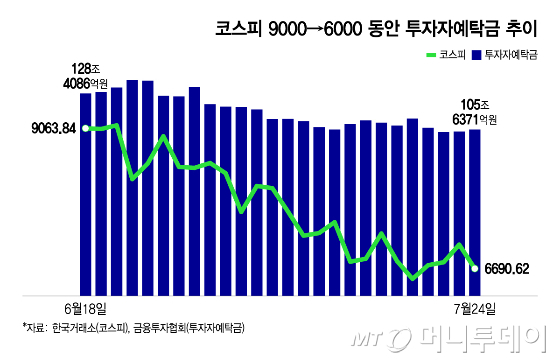
According to the Korea Financial Investment Association on the 28th, investor deposits on standby totaled 105.6371 trillion won as of the 24th. This represents a 17.73% drop compared to June 18, when KOSPI first broke through the 9,000-point level (128.4086 trillion won). Compared to the record high of over 139 trillion won reached on June 4, more than 34 trillion won has completely evaporated in less than two months.
Investor deposits refer to funds transferred by investors into securities accounts for stock trading or left after selling stocks. While these standby funds do not immediately act as negative factors for the stock market, their decline means that "ammunition" available for investment at any moment is shrinking.
This downward trend in ammunition became particularly steep during KOSPI's plunge from 9,000 to 6,000 points. After reaching 109.8332 trillion won on April 8 and maintaining the 110th trillion won level ever since, deposits first fell below 110 trillion won on the 9th of this month, dropping to 107.1279 trillion won, and further declined to 103.8765 trillion won by the 22nd.
Individual investors' ability to absorb selling pressure from foreign and institutional investors has also noticeably weakened. Since June 23, individuals have consistently purchased net shares whenever a sell-side circuit breaker (futures market) was triggered, helping defend the index. However, unlike on June 23 when they bought a net total of 859.10 billion won as both the sell-side circuit breaker and the general circuit breaker were activated, their purchases on the 24th — when only the circuit breaker was triggered — amounted to just 517.82 billion won.
Kim Seok-hwan, a researcher at Mirae Asset Securities, stated, "Individual investors have exhausted their additional buying capacity due to significant losses in leveraged products," and added, "Market supply and demand will stabilize only after further deleveraging and forced liquidation processes take place."
However, there is positive news that the trend of foreign selling pressure is easing. Foreign investors recorded a net purchase of 1.1283 trillion won in April but switched to net sales, with net outflows reaching 44.7147 trillion won in May and 48.6248 trillion won in June. This month, they sold off 9.8311 trillion won, signaling a moderation from the previously sharp over-selling trend. Since the 16th, they have also recorded five consecutive days of net purchases.
Experts in the financial investment industry unanimously suggest that foreign investors are unlikely to increase selling in the short term. Jo Soo-hong, head of the Research Center at NH Investment & Securities, noted, "In the past, foreign investors responded to rising semiconductor profits with net sales," and predicted, "As a result of sustained net selling, foreign ownership in the KOSPI semiconductor sector has now reached historical lows, suggesting that additional downward pressure from foreign net selling will gradually ease."
Thus, the diagnosis is that foreign investors, rather than individuals, are more likely to become the driving force behind a market trend reversal. Kim Hyun, head of the Research Division at Daol Investment & Securities, explained, "As individual investors have been absorbing large volumes of foreign selling up until recently, customer deposits have rapidly declined, leaving them with weaker standby buying capacity compared to before." He added, "In the early stages of a rebound following a sharp drop, it is common for foreign investors to initiate purchases through low-price buying and short covering. Therefore, it is necessary to confirm sequential buying inflows starting from semiconductor sales termination and futures markets."
Earnings reports were cited as key points for foreign investors' return to the domestic stock market. SK Hynix is scheduled to announce its second-quarter results on the 29th, while Samsung Electronics will release its finalized second-quarter earnings on the 30th. Yoon Chang-yong, head of the Research Center at Shinhan Investment Corp., diagnosed, "Foreign investors are among the most likely to return first when valuation and earnings credibility recover, making their restoration of risk appetite ultimately the core factor for future supply and demand trends."

 in STOCK
