

As Samsung Electronics and SK Hynix plummeted, the KOSPI fell by over 10%. This is interpreted as a result of rapidly cooling investor sentiment due to concerns over a Chinese semiconductor counterattack, with the KOSPI collapsing below the 6,000-point level during trading. Experts advised that selective investment focused on sectors where competitive advantages are confirmed and earnings improvements are visible is crucial.
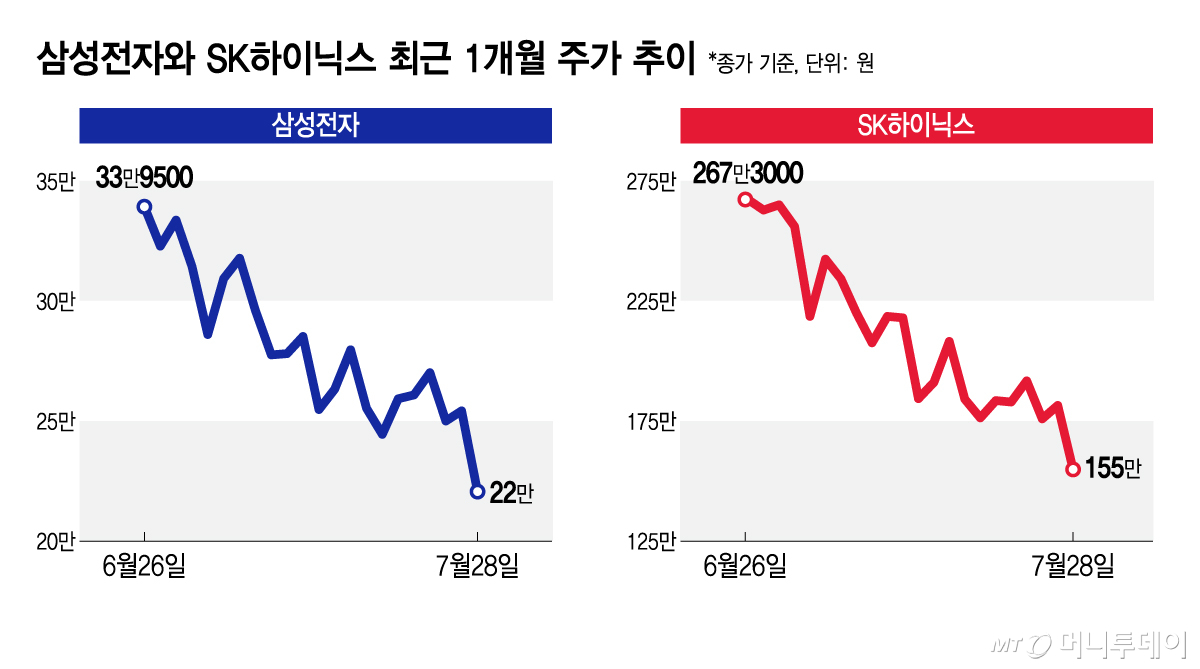
According to data from the Korea Exchange on the 28th, Samsung Electronics, a bellwether of the KOSPI and one of the top two semiconductor stocks, closed regular trading at 220,000 won, down 34,000 won (13.39%) from the previous day. This marked its lowest closing price since April 30.
SK Hynix also closed regular trading at 1.55 million won, down 266,000 won (14.65%) from the previous day. SK Hynix had surpassed a historical high of 2.987 million won on the 25th of last month, but has since repeated fluctuations and fallen to roughly half that level.
Given that Samsung Electronics and SK Hynix account for half of the total market capitalization of the KOSPI, the decline in the KOSPI also reached a record high. The KOSPI index closed regular trading at 6,023.66 points, down 10.84% (732.09 points) from the previous day. Selling pressure surged from the market open, triggering sidecars (futures market circuit breakers) and circuit breakers in succession. In particular, during trading today, the KOSPI index was pushed down to 5,992.91, breaking the 6,000-point line for the first time in about three months since April 14.
The decline of major semiconductor stocks appears to reflect investor sentiment regarding caution triggered by signals of China's semiconductor catch-up efforts. The market viewed that concerns over a potential shakeup of the oligopolistic structure of the DRAM market, led by Samsung Electronics, SK Hynix, and Micron, were influenced by the IPO (initial public offering) of Chinese memory semiconductor company CXMT (Changxin Memory Technologies). Analysts also noted that possibilities of memory price declines due to supply expansion, plans for an IPO by YMTC (Yangtze Memory Technologies), and news on the localization of China's DUV (deep ultraviolet) lithography equipment also dealt blows.
The situation in the New York stock market also affected domestic investor sentiment. Overnight, the Philadelphia Semiconductor Index fell by over 2%, and AI bellwether Nvidia dropped nearly 5%. SanDisk, AMD, and SK Hynix American Depositary Receipts (ADRs) also all declined.
However, experts diagnosed that the fundamentals of the semiconductor sector remain robust, reaching a low point within this year, and the market will soon rebound.
Kim Hyun, head of the Research Center at Daol Investment & Securities, said, "The actual demand for HBM and data center memory remains robust, and it does not appear to be a business environment that will sharply decline due to reduced demand or oversupply as in the past." He added, "If the U.S. FOMC holds the base rate steady at its July meeting and confirms the ceiling on U.S. interest rates accordingly, the process of confirming the expansion of capital investment by big tech companies and securing data center profitability by early August will serve as material for a rebound."
Han Ji-young, a researcher at Kiwoom Securities, stated, "Since semiconductor stocks underwent sharp corrections after July, investor sentiment has become fragile, leading to sensitive reactions even to news about domestic production of Chinese DUV equipment. The domestic stock market has reached the bottom in terms of valuation and has passed the peak of supply-demand volatility, so a strategy of buying shares in leading stocks during correction periods is expected to show significant effectiveness."

 in STOCK
