

Investor sentiment in semiconductor companies froze amid a surge in China's Changxin Memory (CXMT) stock prices and concerns over circular financing within the AI (artificial intelligence) sector, causing the KOSPI to fall nearly 11%. With circuit breakers triggered across both the KOSPI and KOSDAQ markets due to a general contraction in investor sentiment, attention is focused on whether SK Hynix's earnings report tomorrow (the 29th) will thaw the frozen market mood.
On the 28th, the KOSPI closed at 6,023.66 points, down 732.09 points (10.84%) from the previous trading day, as investor sentiment in semiconductor stocks, which had frozen due to CXMT's surge, spread to the broader market. The KOSPI opened at 6,400.27 points, down 355.48 points (5.26%), and triggered a sell-side sidecar (futures market circuit breaker) at 9:06 a.m., followed by a circuit breaker activation at 10:13 a.m. as the index plummeted into the 8th% range. This marked the eighth circuit breaker activation of the year and the third this month alone.
The KOSDAQ also showed weakness from the market open, closing at 705.85 points, down 59.01 points (7.72%) from the previous trading day. A sell-side sidecar (futures market circuit breaker) was triggered at 9:14 a.m., and a circuit breaker activated at 12:01 p.m. This was the third KOSDAQ circuit breaker activation of the year. The KOSDAQ saw its intraday level break below the 700th mark for the first time in one year and three months.
At 2:34 p.m., the KOSDAQ hit 699.42 points, marking the first time since April 16, 2025, that the index fell below the 700th level after approximately one year and three months.
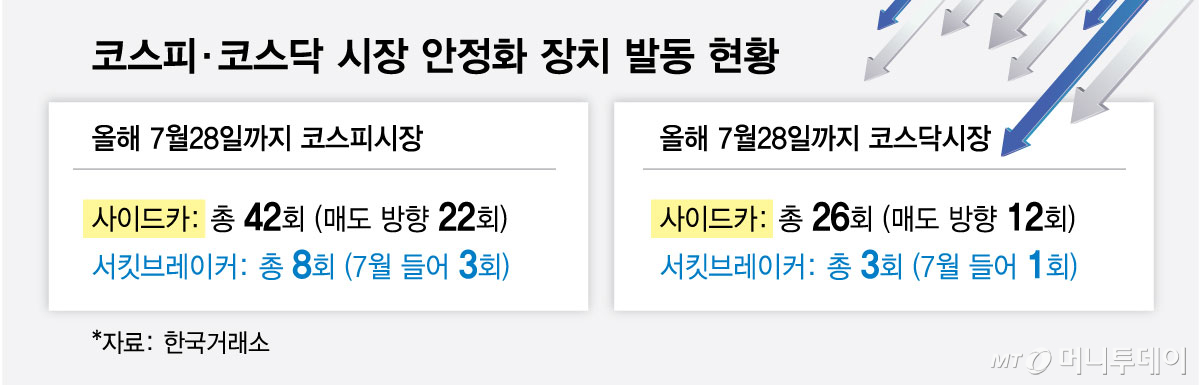
The activation of sidecars (futures market circuit breakers) has become routine. In the KOSPI market, a total of 42 sidecars have been triggered, while in the KOSDAQ market, it occurred for the 26th time. Of these, 22 were sell-side triggers in the KOSPI and 12 in the KOSDAQ.
Analysts suggest that the sharp declines in the KOSPI and KOSDAQ originated from concerns over domestic semiconductor supply and demand following CXMT's stock surge. Lee Kyung-min, a researcher at Daishin Securities, stated, "The domestic market plummeted as foreign investors sold off stocks centered on the semiconductor sector." He added, "News that a Chinese company has begun producing its own deep ultraviolet (DUV) lithography equipment raised concerns in China's semiconductor industry by potentially increasing equipment self-reliance and alleviating bottlenecks in expansion for Chinese memory firms like CXMT, thereby heightening vigilance regarding domestic semiconductor supply and demand."
The diagnosis also pointed to Nvidia's $250 billion guarantee related to OpenAI data center investments as a factor highlighting concerns over circular financing within the AI ecosystem. The researcher noted, "In the U.S. market, Nvidia, Micron, and SanDisk all fell sharply, exerting downward pressure on the domestic semiconductor sector. Additionally, Kioxia's decline and widening losses in U.S. memory stocks during after-hours trading further worsened sentiment across the entire memory sector."
Samsung Electronics and SK Hynix both plummeted. Samsung Electronics closed at 220,000 won, down 34,000 won (13.39%), while SK Hynix ended at 1.55 million won, down 266,000 won (14.65%). SK Square (-15.60%) and Samsung Electro-Mechanics (-15.92%) also saw sharp declines.
In the securities industry, it was noted that today's decline was excessive, and SK Hynix's earnings report on the 29th could serve as a catalyst for reversing market sentiment. Han Ji-young, a researcher at Kiwoom Securities, said, "The stock market's immunity has weakened significantly during this series of corrections, and the current crash is excessive. We can aim to reverse sentiment through the earnings reports of leading stocks scheduled from the 29th onward."
Some forecasts also suggest that a short-term rebound could occur technically. Kim Seok-hwan, a researcher at Mirae Asset Securities, stated, "After a sharp decline, there is a high probability of a technical rebound. Even factors such as excessive price drops, buybacks from short selling, and ETF (exchange-traded fund) rebalancing alone could trigger a rebound."
Forecasts indicate that the U.S. monetary policy decision on the 30th, followed by a series of earnings reports from major tech companies and AI CAPEX (capital expenditure) plans, could influence market direction. The researcher added, "If robust investment plans are confirmed, rapid unwinding of one-sided positions may occur."
There is also an observation that strong earnings could lead to profit-taking sales. Kang Jin-hyuk, a researcher at Shinhan Investment Corp., noted, "Amid simultaneous weakness in Asia, Korea's volatility has been overwhelming. Events are lined up: SK Hynix on the 29th, Meta and Microsoft on the 30th, and Amazon, Apple, and Kioxia on the 31st." He concluded, "Amid high volatility and profit-taking demands, strong semiconductor earnings could act as either a material for improving sentiment or a catalyst for selling pressure."

 in STOCK
