

During the first week of August (August 3–7), the KOSPI fell 5%, while the KOSDAQ rose 10%. Amid divergent fortunes between the two markets, renewable energy stocks and optical communication stocks surged regardless of overall market conditions. This was driven by growing expectations that they would benefit from U.S. government tariff measures and import ban bills.
According to Korea Exchange on the 8th, during the first week of August (August 3–7), the KOSPI closed at 6,258.77, down 336.68 points (5.1%) from the previous close. Conversely, the KOSDAQ finished trading at 798.81, up 79.05 points (10.98%) from the previous close.
Memory investment sentiment contracted again, causing semiconductor stocks to plummet. In particular, disappointing selling emerged after SanDisk announced weak guidance on the 6th. On the 7th, news that NVIDIA was considering downgrading the HBM (high-bandwidth memory) specifications for its next-generation GPU "Rubin Ultra" further worsened investor sentiment.
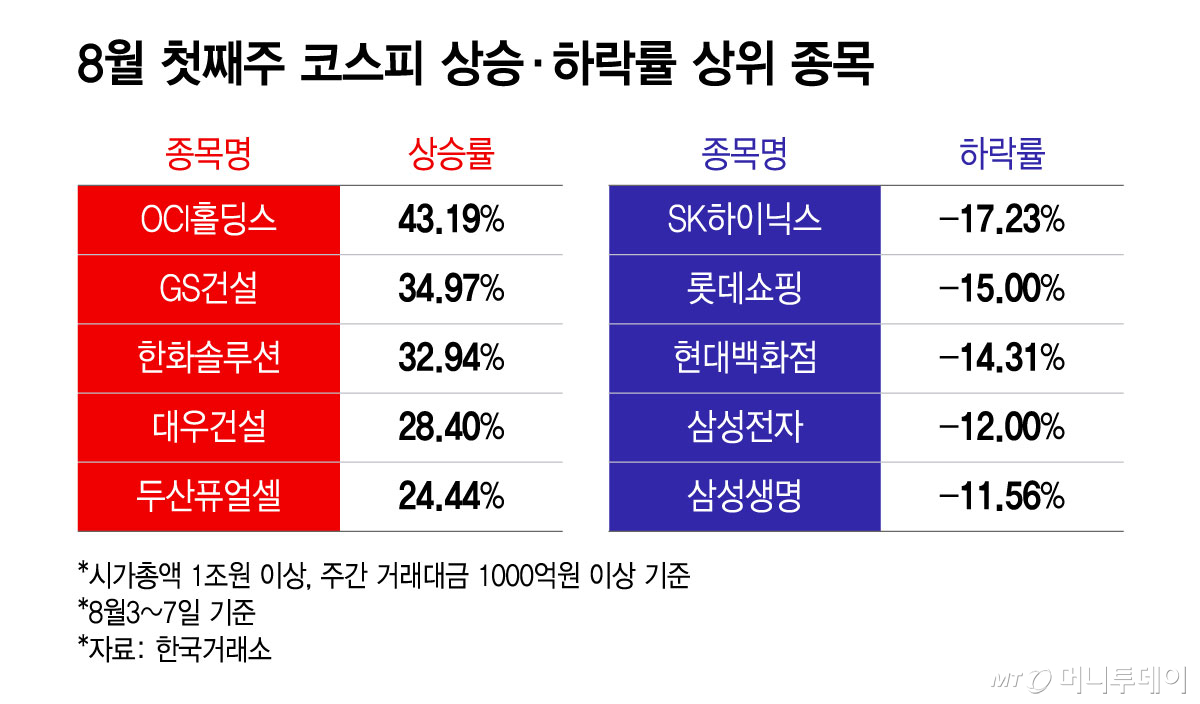
Among KOSPI stocks with a market capitalization of over 1 trillion won and trading volume exceeding 100 billion won during the first week of August, SK Hynix fell the most sharply, dropping 17.23%. Samsung Electronics also declined by 12%, while Samsung Life Insurance (down -11.56%), Samsung Electronics Preferred (-10.94%), SK Square (-9.54%), and Samsung C&T (-4.27%) also showed weakness.
Lotte Shopping and Hyundai Department Store, which recorded second-quarter earnings shocks, also dragged down the KOSPI index with sharp declines of 15% and 14.31%, respectively.
Even in a declining market, renewable energy stocks surged. OCI Holdings rose 43.19%, ranking first among KOSPI stocks for gains. Hanwha Solutions and Doosan Fuel Cell also climbed 32.94% and 24.44%, respectively.
The rise in these stocks was due to U.S. President Donald Trump. On the 6th (local time), President Trump signed an executive order imposing a 15% tariff on derivatives of polysilicon, a key raw material for solar products. He also set the minimum import price for polysilicon at $21 per kilogram. Both measures aim to prevent dumping of low-priced imports centered on China and other countries and to protect domestic production bases in the United States.
Expectations grew that domestic solar companies would benefit. In fact, OCI Holdings and Hanwha Solutions issued statements welcoming President Trump's decision.
On the KOSDAQ, U.S.-beneficiary stocks also emerged. During this period, among KOSDAQ stocks with a market capitalization of over 300 billion won and trading volume exceeding 50 billion won, OIS Solution rose the most, surging 69.11%. Bit & Electronics and RF Materials jumped 60.01% and 55.93%, respectively; both are optical communication stocks. According to major foreign media, the Trump administration is preparing an import ban on Chinese-made optical transceivers used in data centers to strengthen national security. Optical transceivers are core components that perform transmission and reception tasks by converting optical signals into electrical signals.
However, advice suggests investors should be cautious, as the rise in these stocks stems from expectations rather than fundamentals.
![[Cut] Kim Geun-hee's Market Lab / Graphic=Yoon Seon-jeong](https://thumb.mt.co.kr/cdn-cgi/image/f=avif/21/2026/08/2026080717155476003_2.jpg)

 in STOCK

