

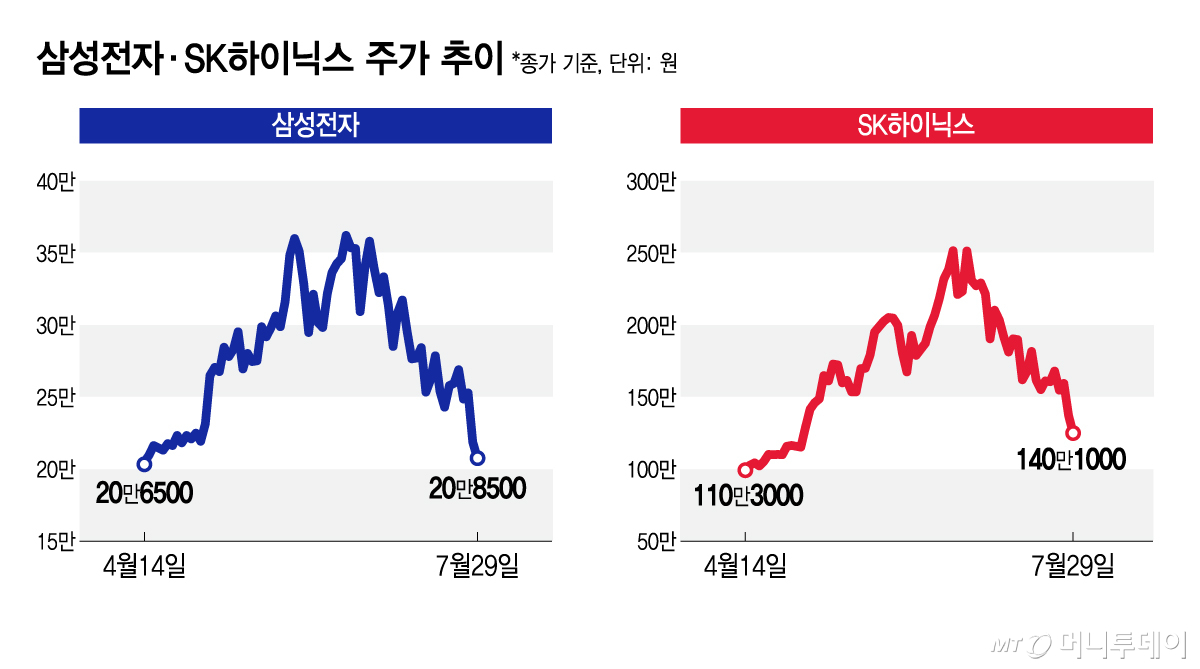
Although SK Hynix recorded its largest quarterly profit in history following Samsung Electronics, it has not avoided a sharp decline in the stock market. Expectations regarding the semiconductor industry have turned into doubts, spreading fear among investors. Securities firms unanimously agree that current stock prices are far too low compared to earnings forecasts. However, they note that tangible recovery will require resolving doubts about the industry outlook through earnings reports and other indicators.
On the 29th, Samsung Electronics closed at 208,500 won, down 5.23% from the previous trading day. The stock fell as low as 189,200 won during trading but narrowed its losses toward the close. SK Hynix closed at 1.401 million won, down 9.61%. For two consecutive days, it plummeted by 24%. Samsung Electronics dropped more than 18% over two days.
On this day, SK Hynix announced that its second-quarter operating profit reached 60.54 trillion won, a 557% increase from the same period last year. This marks the highest quarterly operating profit in company history and extends the streak to five consecutive quarters. The operating profit margin also hit a record high of 76% for the quarter. However, it fell short of market consensus estimates by about 5%.
Despite posting record-breaking profits following Samsung Electronics, stock prices plummeted. Securities firms assess that investor sentiment has contracted as doubts about the semiconductor industry have grown. Lee Young-won, a researcher at Heungkuk Securities, stated, "The decline in semiconductor stocks reflects a shift from expectations that AI growth will lead to concentrated performance gains into skepticism." He added, "Concerns over hyperscaler investment plans, the rapid advancement of Chinese semiconductor companies, and worries about peak earnings forecasts are compounding."
However, considering earnings trends and export indicators, many believe the recent sharp stock price decline is excessive. Lee Young-won noted, "The 12-month forward price-to-earnings ratio (PER) for Samsung Electronics and SK Hynix stands at just 3.3 times and 3.9 times, respectively." He added, "If related concerns ease, the excessive stock price correction will likely be corrected." Hwang San-hae, a researcher at LS Securities, said, "The U.S. stock market is showing robust trends, and hyperscaler stocks are moving independently of the semiconductor decline. We believe the broader AI investment cycle remains intact."
Furthermore, demand for memory semiconductors remains strong, and China's semiconductor growth is unlikely to immediately lead to intensified competition. Forecasts suggest the semiconductor cycle will not slow down as quickly as expected. Im Hye-yoon, a researcher at Hanwha Investment & Securities, stated, "Korean semiconductor exports in the first half of the year increased by 162.6% year-on-year, with memory semiconductors rising by 245%. Exports of memory semiconductors are expected to grow by more than 200% in the second half, and the gap with China's semiconductor industry remains significant."
Accordingly, the turning point for stock prices is expected to come with earnings reports from Meta and Microsoft scheduled for early morning on the 30th Korean time. In particular, attention focuses not only on their earnings but also on whether they will raise capital expenditure (CapEx) guidance. If these companies raise their CapEx guidance, concerns over AI investment cuts could ease.
Additionally, strengthening shareholder returns from Samsung Electronics and SK Hynix is seen as a factor that can defend against further stock price declines. During the earnings conference call, SK Hynix stated, "While investment demand will expand, our enhanced cash generation capabilities allow us to meaningfully increase shareholder returns. We are currently reviewing additional shareholder return execution plans." Notably, Samsung Electronics is at the stage of establishing a three-year shareholder return policy for 2027–2029. Kim Sun-woo, a researcher at Meritz Securities, predicted, "A clear shareholder return policy within this year will lead to a reevaluation of Samsung Electronics' stock price and could become visible as early as the second-quarter earnings report."

 in STOCK
