

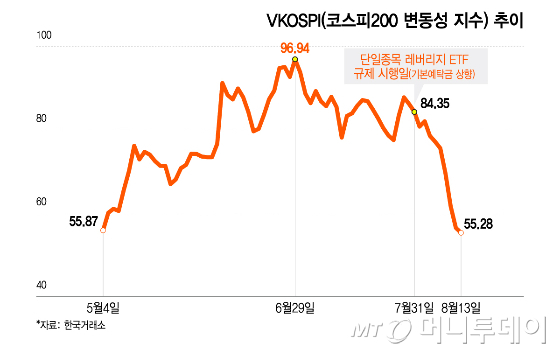
The VKOSPI, an index reflecting the volatility of the KOSPI 200, closed lower for seven consecutive trading days on the 13th, falling significantly from its late June peak. The securities industry attributes the decline in volatility to a sharp drop in trading volume following the implementation of regulations on single-stock leveraged ETFs and the cooling off of rotational trading toward non-semiconductor stocks.
According to data from Korea Exchange on the 13th, the VKOSPI fell 1.2 points (2.12%) from the previous trading day to close at 55.28, continuing its seven-day streak of declines. The previous day, it recorded 56.48, dropping below the 50th mark for the first time in about three months since May 4.
The VKOSPI is an indicator that reflects expected stock market volatility over the next 30 days based on option prices for the KOSPI 200. Typically, a level of 20 is considered normal. Levels above 30 indicate somewhat high volatility, 40 signals crisis conditions, and anything from 50 onward falls into the panic zone. The day's reading of 55.28 also belongs to the panic category, indicating that volatility remains at a high level; however, it has plummeted by 41.66 points (43%) from its peak of 96.94.
Jo Jun-ki, a researcher at SK Securities, stated, "Expected volatility is calculated by adding an option premium to realized volatility, which reflects actual market movements over recent trading days," and added, "The fact that expected volatility is currently lower than realized volatility suggests that investors anticipate a decline in future market volatility."
The securities industry points to the reduced impact of single-stock leveraged ETFs as one factor contributing to lower volatility. On the 31st of last month, the basic deposit requirement for trading single-stock leveraged ETFs was raised from 10 million won to 30 million won, leading to a sharp drop in trading volume. Just before the regulation took effect, total trading volume across 16 single-stock leveraged ETFs stood at 12.4485 trillion won; on the day of implementation, it plummeted to one-fourth of that amount, totaling 3.1518 trillion won. Some analysts argue that this reduction in capital inflow into single-stock leveraged ETFs has eased volatility triggered by rebalancing activities. Rebalancing for single-stock leveraged ETFs is proportional to their net asset value.
The emergence of rotational trading, which alleviated the concentration on semiconductor stocks, also helped curb volatility. On June 29, when the VKOSPI reached its peak, the KOSPI closed down 0.2% from the previous day; however, only 67 out of 832 stocks (8%) actually declined. In contrast, on a day when the index rose 3.56% to close higher, 281 out of 828 stocks (34%) posted gains alongside it.
Meanwhile, with investor deposits falling below 100 trillion won yesterday, margin loan balances have returned to around 30 trillion won recently. Concerns have been raised in some quarters about the potential for increased volatility due to rising margin investing; however, the market believes there is a low likelihood of extreme volatility resuming.
Heo Jae-hwan, Executive Director at Eugene Investment & Securities, remarked, "Compared to yesterday's KOSPI market capitalization of 5,430 trillion won, the 30th trillion won in margin loan balances is not absolutely large." He further noted, "While the KOSPI market capitalization has dropped by 27% from its peak and margin loan balances have decreased by only 21%, making them appear relatively larger compared to the market, this reflects investors' psychology of trying to recover losses rather than signaling a resurgence of 'margin investing (investing with debt)'."

 in STOCK
