

Foreign private equity funds (PEFs) are dominating the largest deals in this year's domestic M&A (mergers and acquisitions) market. This is seen as a result of high won-dollar exchange rates, legislative efforts by the National Assembly to regulate PEFs, and major investors halting new capital commitments to PEFs. Some observers also note that the political push for capital market soundness has backfired, creating unfavorable external economic conditions that only expand opportunities for foreign capital to enter Korea.
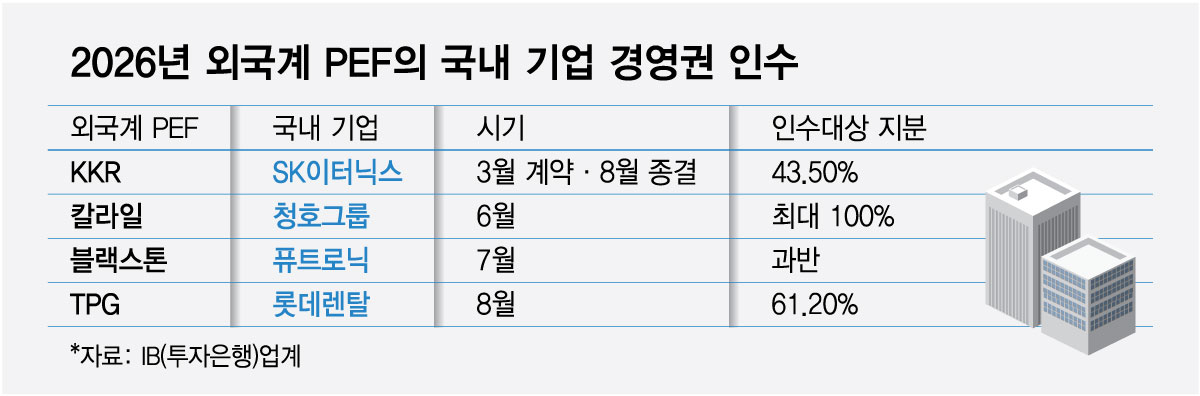
According to the IB (investment banking) industry on the 13th, overseas capital including foreign PEFs is effectively monopolizing top-tier deals in this year's domestic M&A market by transaction size. U.S.-based PEF manager TPG signed a deal on the 11th to acquire Lotte Rental's controlling stake worth 1.3105 trillion won from Lotte. Lotte Rental is Korea's number one car rental operator. The acquisition target includes all 61.2% of shares held by Hotel Lotte and Busan Lotte Hotel.
In June, U.S.-based PEF Carlyle signed a deal to acquire Cheongho Group, including water purifier manufacturer Cheongho Nis. IB industry sources estimate the transaction value at around 1 trillion won. U.S.-based PEF KKR also signed a deal in March to acquire 43.5% of SK Itonics shares from SK Discover and Han & Company for 347.9 billion won. U.S.-based PEF Bain Capital signed a deal on December 31 last year to acquire 43.66% of Eco Marketing's largest shareholder stake at 16,000 won per share, totaling 216.6 billion won. After three public tender offers and over-the-counter purchases this year, it secured 95% of the shares in May. The total investment amount is reported to be around 500 billion won.
Observations suggest that high exchange rate conditions are favorable for foreign PEFs conducting acquisition battles based on overseas capital raising. Foreign PEFs receive dollar-denominated capital commitments from investors when establishing funds, and when actual acquisition opportunities arise, they request capital calls (requests to pay the committed amount) to receive dollars, which are then converted into won to pay acquisition costs. As the won-dollar exchange rate rises, more won can be deployed with the same amount of dollars.
The period when foreign PEFs began making their mark in domestic corporate acquisition battles coincided with surging won-dollar exchange rates. In Seoul's foreign exchange market, the year-end closing rate for the won-dollar exchange rate in 2025 was 1,439 won, marking a 2.3% appreciation of the won on an annual basis. However, in June this year, influenced by the Middle East war and strong dollar trends, it surged to 1,561.50 won, the highest since March 2009. The closing rate for the won-dollar exchange rate in 2023 was 1,288 won.
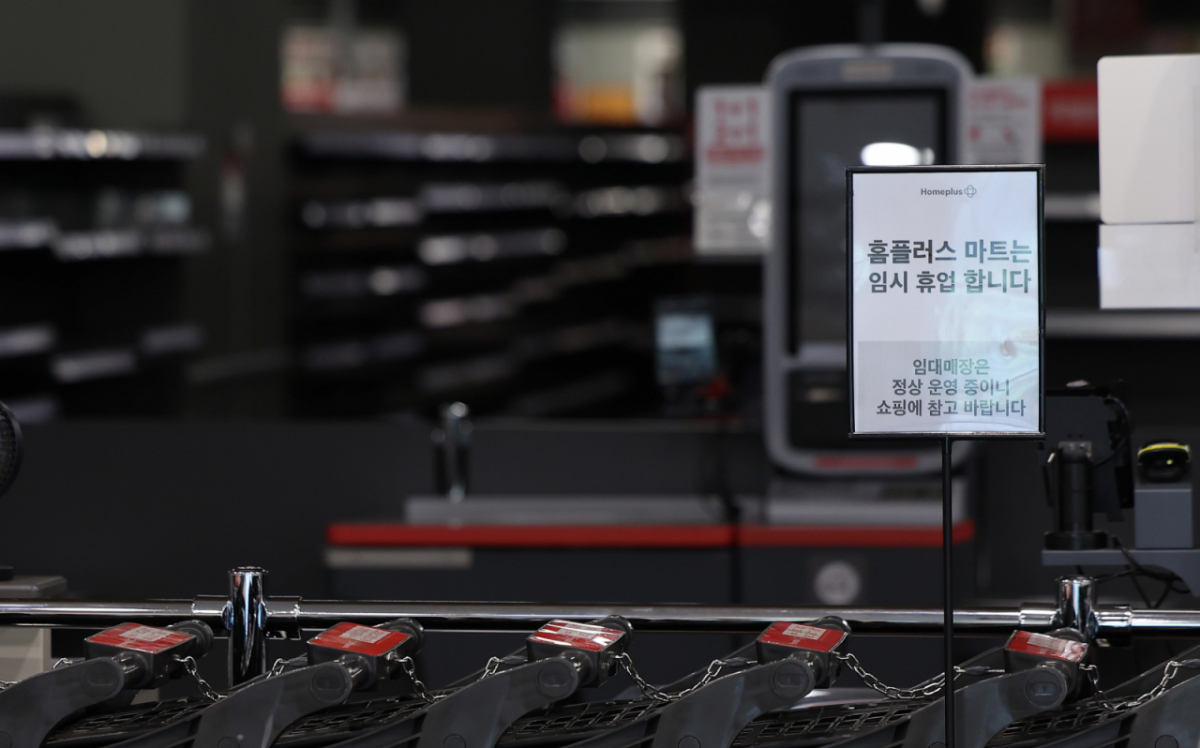
Domestic large institutional investors have become passive about investing in buyout-type PEFs following incidents such as the Homeplus crisis last year, which is cited as a factor reducing the financial capacity of domestic PEFs. Korea's largest institutional investor, the National Pension Service, has halted new investments in buyout-type PEFs since the Homeplus crisis and other incidents last year.
Moves to strengthen regulations on domestic PEFs are also identified as factors widening the competitiveness gap with foreign PEFs. The National Assembly is considering amendments to the Capital Market Act that include public disclosure of compensation for PEF managers and employees, stricter borrowing restrictions, appointment of compliance officers and strengthened internal controls, and notification to worker representatives when acquiring corporate control. Originally, legislative discussions began aimed at preventing excessive borrowing and short-term recovery after corporate acquisitions but expanded to comprehensively increase reporting obligations for PEFs. In the IB industry, there are observations that if regulations are applied primarily to domestic managers registered and supervised under the Capital Market Act, the domestic PEF industry could find itself in a disadvantaged position compared to foreign counterparts.
An executive at a major PEF said regarding the high exchange rate environment: "Foreign firms basically receive funds in dollars when making capital calls after signing commitments and then convert them before bringing them into Korea, so the current situation is fundamentally favorable for them." He added, "Regulations have not yet been finalized, but it is true that the industry has become subdued."

 in STOCK

