

Attention is focused on whether the domestic stock market, whose volatility has eased due to regulatory measures by financial authorities, can sustain a stable upward trajectory. While positive factors such as the growth momentum of major semiconductor stocks and easing inflation concerns continue, worries about interest rate hikes persist. Short-term volatility could expand depending on the content of the Federal Reserve System (Fed) 'July FOMC (Federal Open Market Committee) minutes.' Experts believe the stock market can regain resilience due to exchange rate stability and improved conditions for foreign capital inflows.
According to Korea Exchange data on the 17th, the KOSPI closed last week (the 10th–14) at 6,977.94 points on the final trading day, the 14th. After trading in a range around 6,200 points early last week, the KOSPI rose from mid-week and surpassed the 7,000-point mark during trading on the 14th. Over the past five trading days, the KOSPI has gained 719.17 points.
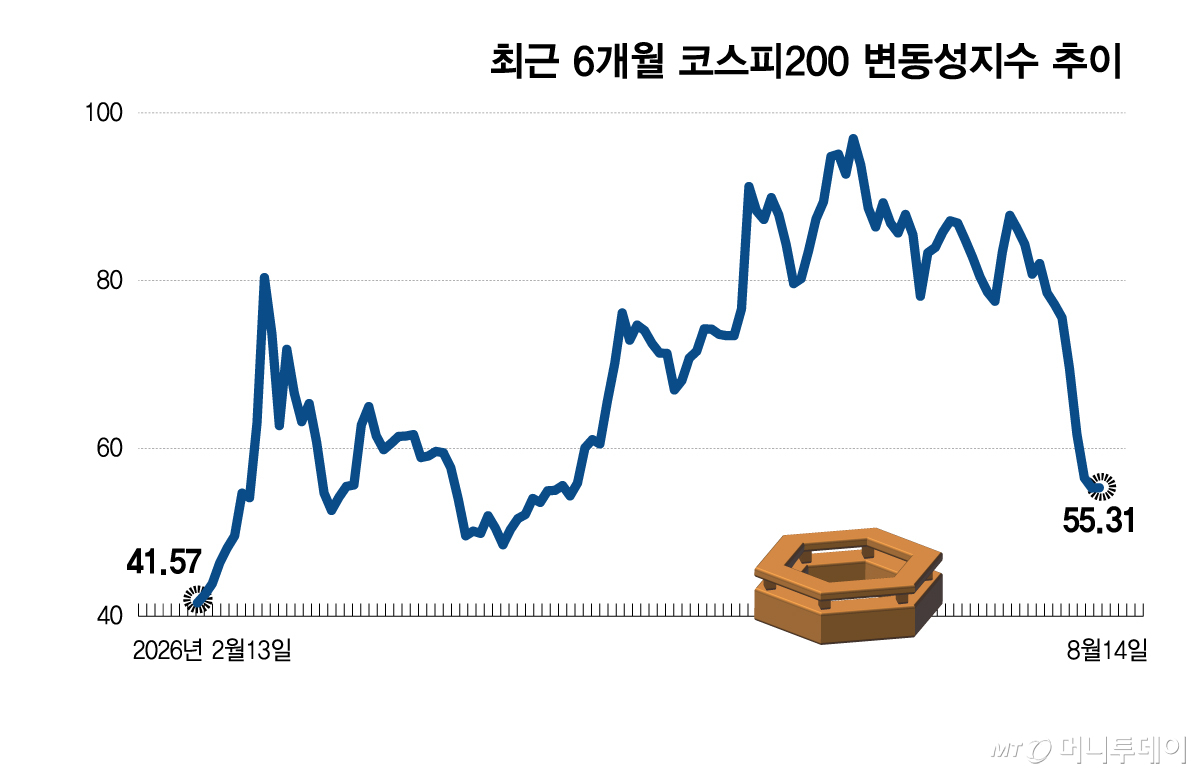
Volatility in the stock market also appears to have eased. The 'KOSPI 200 Volatility Index' closed at 55.31 on the 14th, down approximately 36% compared to the previous day, the 30th, when basic margin requirements for single-stock leveraged investments were raised by investor category.
The securities industry is leaning toward the view that the domestic stock market will enter a stable bull phase. With signs of slowing inflation confirmed and SanDisk presenting long-term growth prospects and high profitability, there is growing optimism that warmth will spread from AI (artificial intelligence) memory stocks to the broader market.
According to Korea Customs Service data, South Korea's exports from the 1st–10 reached $21.3 billion, a 45% year-on-year increase, setting a new record high. Among these, semiconductor exports surged by 155.4% to $10 billion during the same period. The U.S. July CPI (consumer price index) rose 3.4% year-on-year, showing moderation, while the PPI (producer price index) increased by 4.7%, falling below market expectations of 4.9%.
Lee Kyung-min, a researcher at Daishin Securities, stated, "If the KOSPI stabilizes in the 6,800–7,000 range amid a valuation normalization phase, the 8,500-point level (corresponding to a leading price-to-earnings ratio of around seven times) could come into view." He added, "Exchange rate stability and improved conditions for foreign capital inflows will act as upward pressure on the stock market."
This week, the domestic stock market is approaching an event that may reveal the U.S. Federal Reserve's stance on base rate hikes.
On the 19th (local time), the July FOMC minutes will be released. The minutes will provide insights into internal Fed committee members' assessments of inflation and economic conditions, as well as their views on interest rate hikes during the FOMC meeting held on the 28th–29. If hawkish (preferring monetary tightening) positions dominate in the minutes, they could exert upward pressure on Treasury yields.
Additionally, U.S. July import price data will be released on the 18th (local time), and preliminary S&P (Standard & Poor's) PMI (Purchasing Managers' Index for global manufacturing and services sectors) figures are scheduled for release on the 21st.
Kim Jong-min, a researcher at Samsung Securities, noted, "As foreign investors resume net purchases and warmth spreads across the market, the market has begun to react more sensitively to positive news than negative developments." However, he added, "It would be reasonable to lower overly high expectations for steep vertical rises in the index."

 in STOCK

