

Recent sharp declines in the domestic stock market are diagnosed as being more significantly influenced by supply-demand factors such as position reduction and risk management than corporate valuation. Market funds that had been concentrated on Samsung Electronics and SK Hynix did not circulate to small- and mid-cap stocks but instead flowed out entirely, leading to a second consecutive day of sharp declines. On the 29th, the KOSPI closed below the psychological support level of 6,000 points. Experts viewed this as an abnormal market slump triggered by panic selling and advised paying close attention to potential recovery triggers.
According to Korea Exchange, the KOSPI closed regular trading at 5,663.24 points, down 360.42 points (5.98%) from the previous day. The KOSPI fell for a second consecutive day. Over this period, the decline reached 16.82%. Based on closing prices, the KOSPI dropped more than 37% within just 25 trading days after setting an all-time high of 9,114.55 points on June 22.
Examining supply-demand conditions in the KOSPI market, individuals and foreign investors sold stocks worth 3.0724 trillion won and 789.1 billion won, respectively, by the end of regular trading. In contrast, institutional investors purchased stocks worth 3.7854 trillion won net. Financial investment firms accounted for 56% (2.1217 trillion won) of institutional investor investments. This supply-demand situation was similar to when the KOSPI rallied toward the 10,000-point mark. At that time, industry observers attributed the net stock purchases by financial investment firms to trading volumes from foreign institutional investors via ETFs (exchange-traded funds) and swaps.
The KOSPI index fell alongside the stock prices of Samsung Electronics and SK Hynix, which together account for approximately 50% of the total market capitalization of the entire KOSPI market. On this day, Samsung Electronics and SK Hynix declined by 5.23% and 9.61%, respectively. Companies linked through industry ties or equity relationships, such as SK Square, Samsung Life Insurance, and Samsung C&T, also fell by 8.11%, 6.84%, and 6.39% during the same period.
Securities firms have also lowered their expectations for Samsung Electronics and SK Hynix. Mirae Asset Securities set target prices of 370,000 won for Samsung Electronics and 2.8 million won for SK Hynix on this day, representing a 33% downward revision from previous levels. BNK Investment & Securities also lowered its target price for SK Hynix from 1.85 million won to 1.48 million won. Kim Young-geon, a researcher at Mirae Asset Securities, stated, "Although we judged that the stock price adjustment due to potential downward revisions in NAND contract prices had largely settled, the localization of deep ultraviolet (DUV) lithography equipment—a core semiconductor manufacturing tool in China—has continued." He added, "Given the overall industry-wide stock price decline triggered by this issue, revising target prices has become unavoidable."
Experts viewed the KOSPI's sharp drop as an exceptional situation and urged attention to signs of recovery. Noh Dong-gil, a researcher at Shinhan Investment Corp., said, "The fact that the KOSPI reached high levels alone is insufficient to explain the recent speed of decline. During upward trends, stock prices and earnings rose together, but during downward trends, valuations collapsed before earnings forecasts." Researcher Noh further noted, "Industries that had avoided semiconductor concentration were pushed below their fair value, and intraday prices were more significantly influenced by position reduction and risk management than corporate valuation." He added, "Rotational buying will likely begin when the decline in semiconductor stock prices ends and foreign selling pressure subsides."
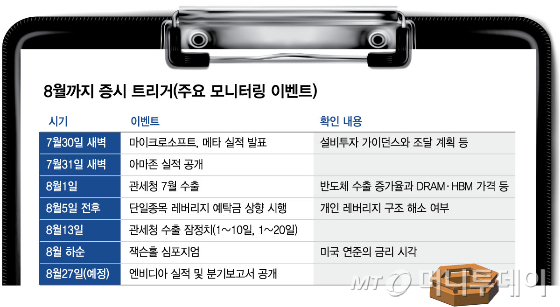
Han Ji-young, a researcher at Kiwoom Securities, stated, "The essence of today's sharp drop lies in most stockholders locking in losses and engaging in panic selling. What matters is identifying what triggers a recovery." Researcher Han highlighted the following as key potential triggers: (1) earnings and cash flow reports from major U.S. hyperscaler companies; (2) expectations for negotiations between the United States and Iran; and (3) the July FOMC meeting.

 in STOCK
