

"Its accuracy exceeds expectations, and its deployment was very rapid."
This is an assessment from a representative of a country operating Hanwha Aerospace's Multiple Launch Rocket System (MRLS) "Cheonmu." As the name suggests, Cheonmu fires multiple rockets into the sky. It has evolved from a weapon that simply fires many rounds to one that strikes far and precisely. Another advantage of Cheonmu is its ability to execute the entire project, including education, technical support, and logistics support.
Cheonmu is a domestic multiple launch rocket system capable of striking key enemy areas within a short time. It combines the basic characteristics of MRLS, which fires multiple rockets simultaneously, with precision guidance technology and long-range strike capabilities.
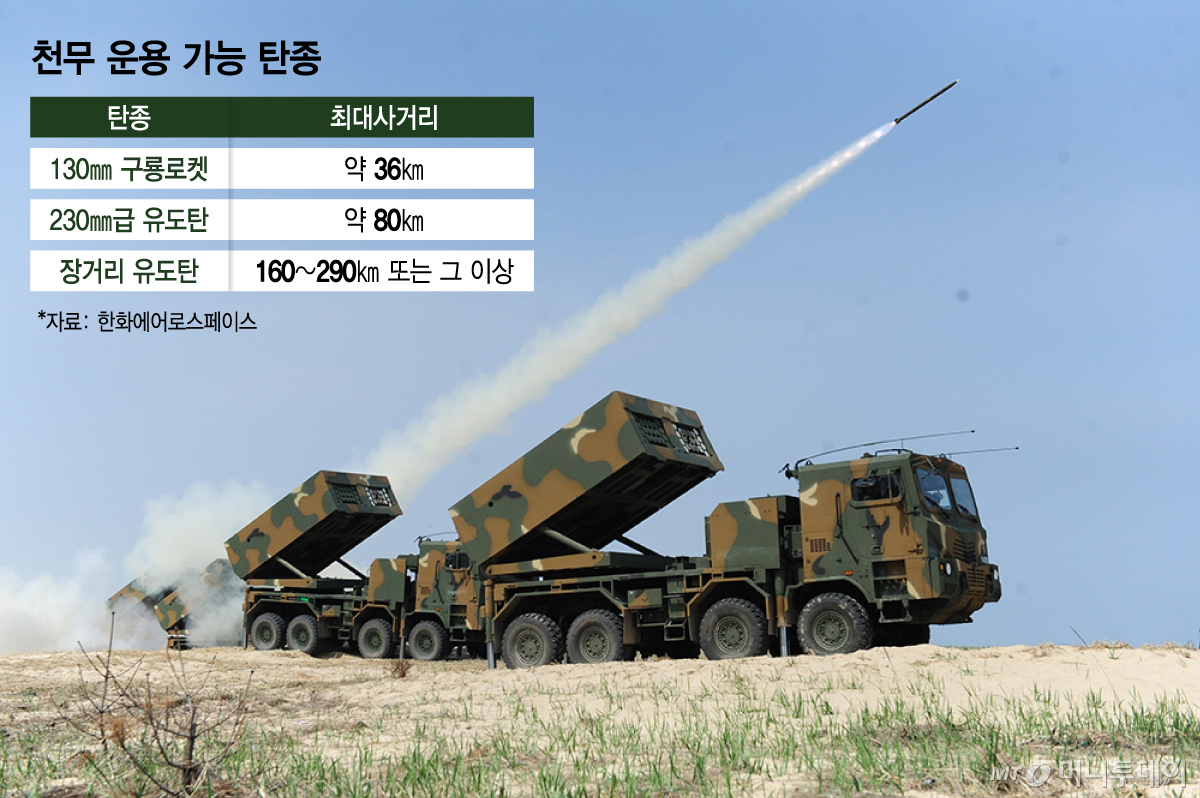
Cheonmu's greatest competitive edge lies in its ability to operate various types of ammunition within a single launch system. It can deploy the 130mm Guryong rocket, guided missiles up to 230mm class with a maximum range of 80km, as well as guided missiles with ranges of up to 160km, 290km, or even greater. This allows customers to select the required firepower based on their operational environment and strike objectives.
In particular, Cheonmu focuses not just on firing a large number of rounds, but on accurately striking necessary targets. By applying precision guidance technology to guided missiles, it ensures high accuracy even at long ranges, enabling effective strikes against key targets such as enemy artillery positions and command facilities.
A Hanwha Aerospace representative stated, "One of the aspects most highly rated by overseas customers is its precision strike capability." They further explained, "In today's Daejeon where long-range precision strikes are increasingly important, accuracy is a core competitive advantage that enhances not only combat efficiency but also ammunition operational efficiency."
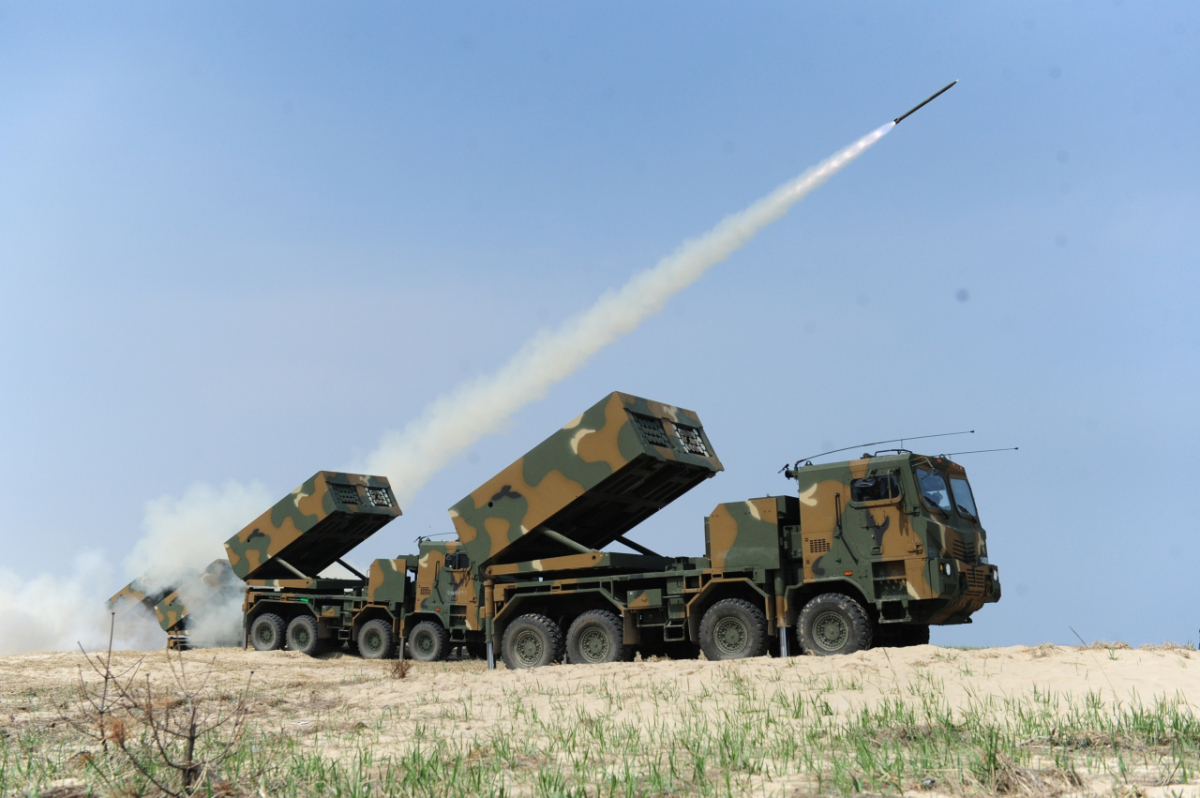
While MRLS can unleash significant firepower in a short time, it risks exposing its launch position. Cheonmu addresses this limitation through high mobility. Mounted on wheeled vehicles, it can travel at speeds of up to approximately 80 km/h. Designed to fire the first round within about seven minutes after reaching the firing point, it allows for rapid relocation after an attack to avoid enemy counterattacks.
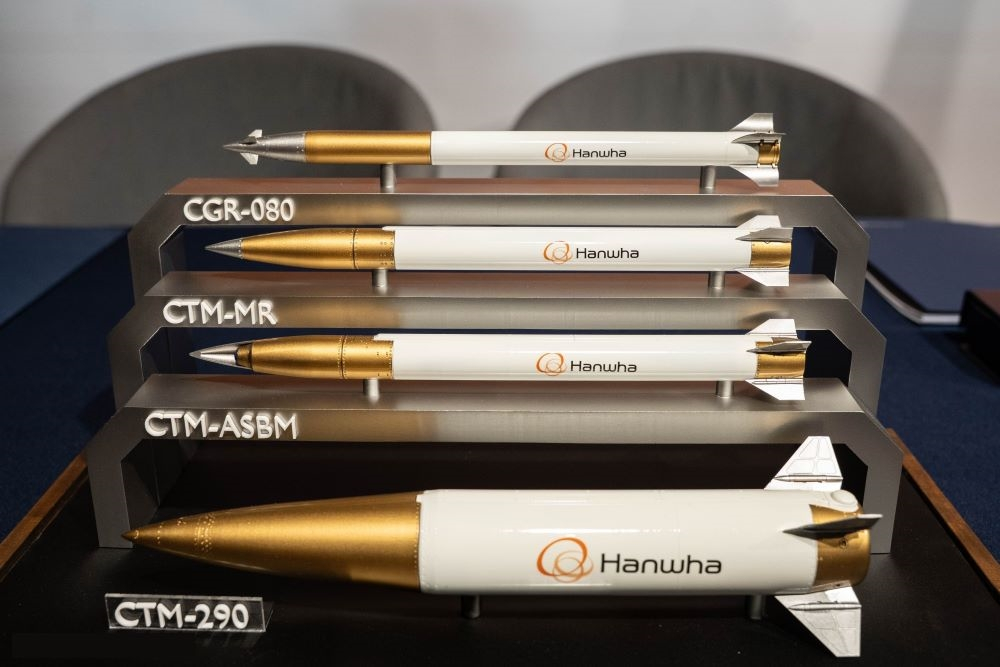
Hanwha Aerospace provides integrated solutions that include not only the launch system but also guided missiles, ammunition, training, and military logistics support (MRO). Defense weapons must be operated for decades after purchase, so in addition to equipment performance itself, the ability to operate them stably has become a crucial competitive advantage.
The package export strategy linked with other weapon systems is also notable. A representative case is Poland. In 2022, Hanwha Aerospace signed a basic contract with Poland for the supply of Cheonmu launchers and guided missiles. Later that November, a first execution contract worth approximately 5 trillion won was concluded to supply 218 Cheonmu launchers and guided missiles, marking Cheonmu's initial entry into the European market. In 2024, a second execution contract worth about 2 trillion won for supplying 72 Cheonmu units and guided missiles was also finalized.
Poland, having already introduced K9 self-propelled howitzers on a large scale, now operates the Korean artillery system together with Cheonmu. While K9 projects firepower by moving and firing shells, Cheonmu strikes at greater distances using rockets and missiles. Operating both systems together offers the advantage of responding to different range and firepower requirements.
Cheonmu's export front is expanding rapidly, centered on Northern Europe. In January, Hanwha Aerospace signed a supply contract worth 1.3 trillion won with Norway's Defence Materiel Agency for 16 Cheonmu units, guided missiles, and comprehensive logistics support. This is significant because it represents a "full package" that includes not only launchers but also guided missiles and comprehensive logistics support.
Above all, in the Norwegian market, Cheonmu competed against the U.S. High Mobility Artillery Rocket System (HIMARS). This case demonstrates the status of K-defense, as a NATO member country in Europe chose a Korean-made multiple launch rocket system after competing with a U.S.-made system.
Estonia cannot be overlooked either. Estonia signed a contract last December to introduce six Cheonmu units and three types of missiles, then added three more units just five months later. This outcome resulted from comprehensive evaluations of performance, on-time delivery as promised, high reliability, systematic follow-up support including education and logistics, and rapid responses to customer requirements.
The Middle East, where demand for long-range precision firepower is increasing due to geopolitical instability, has recently become a market Hanwha Aerospace is actively pursuing. With security tensions escalating amid conflicts such as the Iran war, there is growing interest in modernizing existing forces and developing long-range firepower systems. A Hanwha Aerospace representative stated, "We are expanding into the global market not through simple product sales but through customized business models that include local production, technology cooperation, and long-term logistics support."
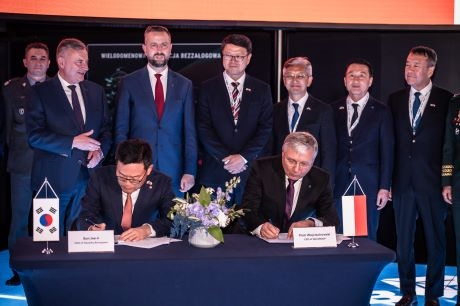
Cheonmu is taking a step beyond exporting finished products by transitioning to a local co-production system. Recently, Hanwha Aerospace established a joint venture with Poland's defense company WB Group and has begun construction of a factory for the local production of Cheonmu guided missiles. The joint venture, held 51% by Hanwha Aerospace and 49% by WB Group, will be responsible for production. The goal is to expand beyond simple assembly to include the application and production of local components. This demonstrates that Cheonmu's export model has evolved from supplying finished products to combining local production with industrial cooperation.
A Hanwha Aerospace representative stated, "Hanwha Aerospace aims not merely to supply weapons but to be a strategic partner that develops capabilities together with customers over the long term." They added, "Through local production, technology cooperation, and long-term logistics support, we will further strengthen trust with our customers and secure sustainable competitiveness in the global market."

 in INDUSTRY


