

With a bill amending the Capital Markets Act to apply fair value instead of market value as the basis for merger consideration in recent corporate mergers passing the National Assembly plenary session, expectations are rising that long-stalled capital market initiatives such as mandatory public tender offers and priority allocation of new shares will gain momentum. With the composition of the National Assembly Political Affairs Committee, a standing committee, completed and the party convention concluded, full-scale discussions are expected to begin.
According to the financial investment industry on the 23rd, following the abolition of the market value standard for merger consideration, key capital market policy tasks have emerged as introducing the mandatory public tender offer system and priority allocation of new shares. Although related bills were introduced last year, these issues had remained stagnant; now that they are being reconsidered, discussions are expected to get underway. With the political sphere declaring its intent to accelerate capital market modernization tasks, expectations for the enactment of relevant legislation have also risen.
In particular, the mandatory public tender offer system was mentioned at the Democratic Party of Korea’s policy coordination meeting on the 30th of last month as a capital market modernization task to be resolved swiftly. The financial authorities have also emphasized the need to introduce the mandatory public tender offer system in the second half of the year.
The mandatory public tender offer is a system that guarantees minority shareholders the opportunity to sell their shares at a price reflecting the control premium during corporate M&A (mergers and acquisitions). It grants ordinary shareholders the right to sell their held shares at the same price as controlling shareholders. The purpose is to improve the situation where, in corporate M&As, major shareholders sell their stakes at high prices reflecting the control premium while ordinary shareholders do not receive such premiums.
The system was introduced in 1997 but was abolished just one year later on the grounds that it made M&A difficult during the foreign exchange crisis. However, with concerns raised over cases of harm to minority shareholders, arguments for reintroducing the system are gaining strength.
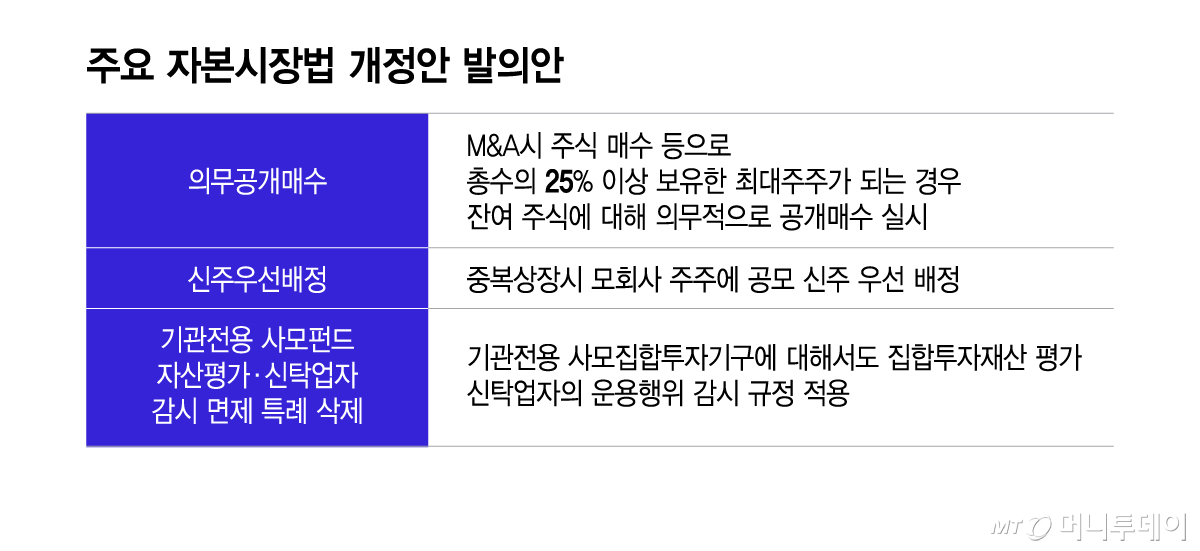
Among the numerous capital market law amendment bills submitted to the National Assembly is a provision requiring that when an acquirer secures 25% of the target company’s shares, it must offer the remaining 75% to minority shareholders under the same conditions.
Opinions differ on the ratio for public tender offers: some advocate for 100% of all remaining shares, while others propose 50% plus one share. Recently, Park Hong-bae, a Democratic Party of Korea lawmaker serving on the National Assembly Political Affairs Committee, introduced an amendment to the Capital Markets Act mandating a public tender offer for all remaining shares. Consequently, discussions are expected to begin, including efforts to develop compromise proposals.
Priority allocation of new shares is a measure that gives shareholders of a parent company the first opportunity to purchase shares of a newly spun-off company during a split listing. This measure considers cases like LG Chem and LG Energy Solution, where transferring a core business segment from the parent company to a subsidiary could reduce the parent company’s value and harm minority shareholders. Currently, shareholders opposing a spin-off are granted the right to request share repurchase, but priority allocation of new shares is not provided.
According to the guidelines on prohibiting dual listing that took full effect on the 3rd of this month, a parent company’s board of directors must prepare shareholder protection measures as one of five key obligations. Therefore, priority allocation of new shares can serve as one such shareholder protection measure. An amendment bill recently introduced by Kim Hyun-jeong, a Democratic Party of Korea lawmaker serving on the Political Affairs Committee, stipulates that 15% of publicly offered new shares must be allocated to ordinary shareholders of the parent company on a priority basis.
Additionally, an amendment to the Capital Markets Act (among others, Han Min-su (Rep.)) has been submitted to apply regulations on collective investment property valuation and trustee operation conduct monitoring to private equity funds (PEFs) dedicated exclusively to institutional investors. While exceptions were previously recognized as special cases to ensure operational autonomy and reduce regulatory burdens, the proposal seeks to delete these exceptions. This would establish a legal basis for financial authorities to supervise PEFs.

 in STOCK
