

During the third week of August (the 18th–21), the domestic stock market closed lower after a tense tug-of-war between rising long-term bond yields in major countries and growing expectations for shareholder returns. However, following SK Hynix's decision to retire shares worth 40 trillion won, expectations grew that Samsung Electronics would also expand its shareholder return program, prompting semiconductor stocks to rally once again. Additionally, companies that posted strong second-quarter results drew significant market attention.
According to data from the Korea Exchange on the 23rd, KOSPI closed at 6,912.95, down 64.99 points (0.93%) compared to Jeonju. On the 19th, a KOSPI sell-side sidecar (futures market circuit breaker) was triggered, and on the 20th, a KOSPI buy-side sidecar (futures market circuit breaker) was activated.
After passing through "Black July," KOSPI had been on an upward trend but suffered a sharp 7.26% plunge on the 18th and 19th due to rising U.S. long-term bond yields. However, the situation reversed after SK Hynix announced its decision to retire shares worth 40 trillion won and plans to expand shareholder returns following the market close on the 19th, along with the U.S. Treasury Department's announcement to increase its Treasury buyback program. Buybacks refer to the repurchase of existing government bonds traded in the market. As a result, U.S. long-term bond yields declined.
Expectations grew that Samsung Electronics would also announce a shareholder return policy worth 100 trillion won, causing KOSPI to surge sharply by 6.83% over two days from the 20th to the 21st. In fact, Samsung Electronics announced its large-scale shareholder return plan following the market close on the 21st.
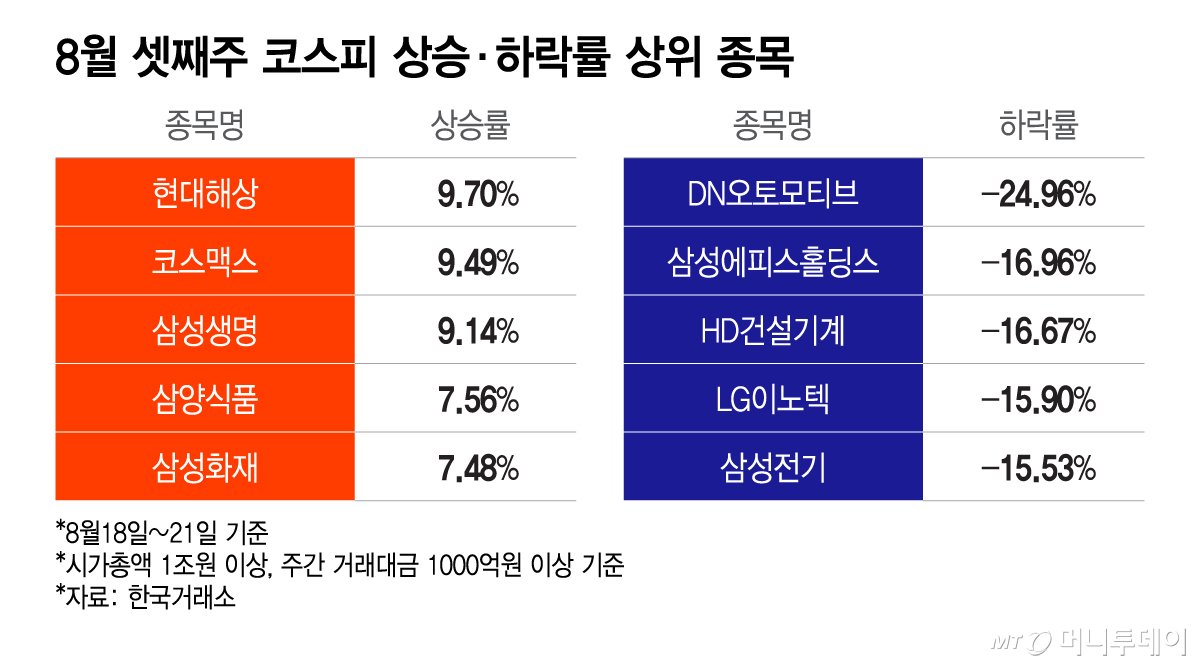
From the 18th to the 21st, SK Hynix rose 5.17%, and Samsung Electronics gained 2.55%. Samsung Life Insurance and Samsung C&T, which hold stakes in Samsung Electronics, surged 9.14% and 7.18%, respectively.
Lee Kyung-min, head of the FICC Research Division at Daishin Securities, stated, "There was clear sectoral differentiation driven by shareholder return momentum. The semiconductor sector showed strength, while other sectors such as Samsung Life Insurance and Samsung C&T also rose in tandem."
Companies with clear earnings growth trends also gained. Among KOSPI-listed companies (market capitalization of 1 trillion won or more and trading volume of 100 trillion won or more), Hyundai Marine & Fire Insurance recorded the highest gain at 9.7%. Its second-quarter net profit increased by 58.2% year-on-year to 391.8 billion won, beating earnings expectations. Consequently, on the 18th, 11 securities firms including LS Securities, Hanwha Investment & Securities, and Shinhan Investment Corp raised their target prices for Hyundai Marine & Fire Insurance.
Jung Jun-seop, a researcher at NH Investment & Securities, analyzed, "As Hyundai Marine & Fire Insurance focused more on financial soundness than profitability, it extended asset duration, leading to improvements in both insurance underwriting results and investment gains/losses."
Cosmax and Samyang Foods also surged 9.49% and 7.56%, respectively, driven by strong second-quarter earnings growth. Securities firms analyzed that both companies were led by growing overseas sales. Projections suggest they will continue to grow primarily through overseas sales in the second half of the year.
In contrast, stocks that surged during the second week of August (August 10–14), including DN Automotive, LG Innotek, and Samsung Electro-Mechanics, fell again this week. This was due to profit-taking amid deteriorating investor sentiment caused by factors such as rising U.S. long-term bond yields. DN Automotive plummeted 24.96%, while LG Innotek and Samsung Electro-Mechanics declined 15.90% and 15.53%, respectively.
![[Cut] Kim Geun-hee's Stock Market Lab Up / Graphic=Yoon Seon-jeong](https://thumb.mt.co.kr/cdn-cgi/image/f=avif/21/2026/08/2026082117360154802_2.jpg)

 in STOCK

