

The Financial Supervisory Service (FSS) has decided to expedite the review of securities registration statements that have been thoroughly corrected during the IPO and rights offering (paid-in capital increase) processes. Conversely, for submissions that fail to reflect corrective requirements, the FSS will publicly disclose details such as "insufficient reflection" via DART to allow investors to make informed decisions. This regulatory improvement plan was introduced in response to recent criticisms that companies are facing difficulties raising funds through public stock offerings due to the FSS's stringent review of securities registration statements.
On the morning of the 28th, at a meeting with securities firms regarding IPO and rights offering (paid-in capital increase) underwriting operations held at the Korea Financial Investment Association in Yeouido, Seoul, the FSS announced the introduction of the "Differentiated System for Corrective Requests on Securities Registration Statements."
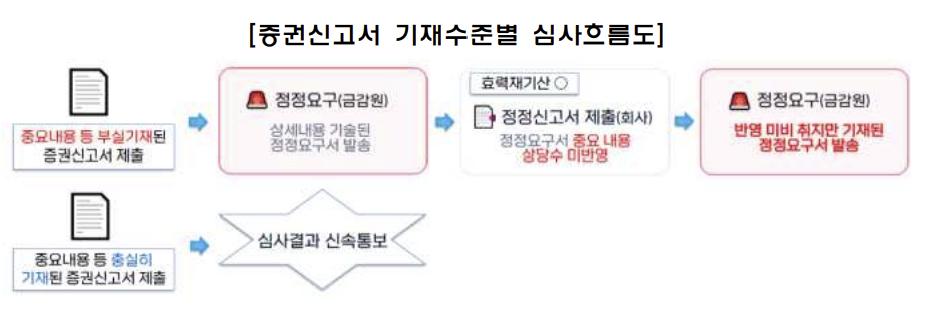
The core of this differentiated system is to expedite the review of well-corrected statements to ensure no delays in corporate fundraising, while publicly disclosing insufficient submissions. When issuing an initial corrective request, the FSS will send a detailed corrective notice outlining all areas requiring improvement.
For subsequent corrected submissions following the initial request, if improvements remain inadequate, the FSS will issue a notice stating only that "the submitted corrected statement did not sufficiently reflect the corrective requirements." This measure aims to prevent excessive burden on the FSS's review process caused by repetitive corrections and re-corrections.
In particular, when most of the corrective requirements are not reflected, the FSS will publicly disclose via DART (Electronic Public Disclosure System) that "the submitted corrected statement did not sufficiently reflect the corrective requirements." This is intended to inform the market and investors about the company's inadequate correction practices, aiding their investment decisions.
At the same time, securities registration statements that thoroughly disclose risk factors and other relevant information will receive review results as quickly as possible.
This decision comes amid a significant decline in direct fundraising through corporate stock issuance, including IPOs and rights offerings (paid-in capital increases), this year.
A monthly trend analysis of stock issuances, including IPOs and rights offerings (paid-in capital increases), shows only 27 cases in the first quarter: four in January, seven in February, and 16 in March. From April to July, there were 31 cases, bringing the year-to-date total to 58. Compared to the 59th cases recorded in the fourth quarter of last year alone, this indicates a contraction in fundraising through public stock offerings.
The FSS stated that since the implementation of the demand forecasting system improvement plan in July last year, the mandatory holding commitment ratio by institutional investors has increased significantly. The proportion of mandatory holding commitments among all allocated shares for public offerings by institutional investors rose to 77.7%, a 48.7 percentage point increase from before the reform (29%). The mandatory holding commitment ratio for policy funds jumped to 95%.
However, since the 15th-day commitment currently accounts for the highest proportion, plans are underway to increase the ratios for longer-term commitments such as 30 days and 90 days. Additionally, requirements for demand forecasting participation by private investment management companies and other entities will be strengthened.
Regarding the pre-demand forecasting for IPO pricing scheduled for November and the cornerstone investor system aimed at expanding long-term investors, the FSS plans to coordinate and communicate detailed content with lead underwriters.
An FSS official stated, "We will continuously work to alleviate market concerns by sharing information related to securities registration statement reviews through various channels such as briefing sessions," adding, "We will strive to ensure that smooth corporate fundraising and investor protection are achieved simultaneously."

 in STOCK
