

Although the Stewardship Code, introduced to ensure responsible shareholder rights exercise by institutional investors, has reached its 10th anniversary this year, it appears that expansion in scale has not yet translated into substantive voting practices. Many asset management companies either uniformly approved all agenda items at shareholders' meetings or did not exercise their voting rights at all, and the practice of repeating identical reasons for exercising voting rights across different agenda items continues. Experts point out that the next challenge for the Stewardship Code is to go beyond merely increasing the number of participating institutional investors by thoroughly reviewing individual agenda items and providing clear grounds for decisions.
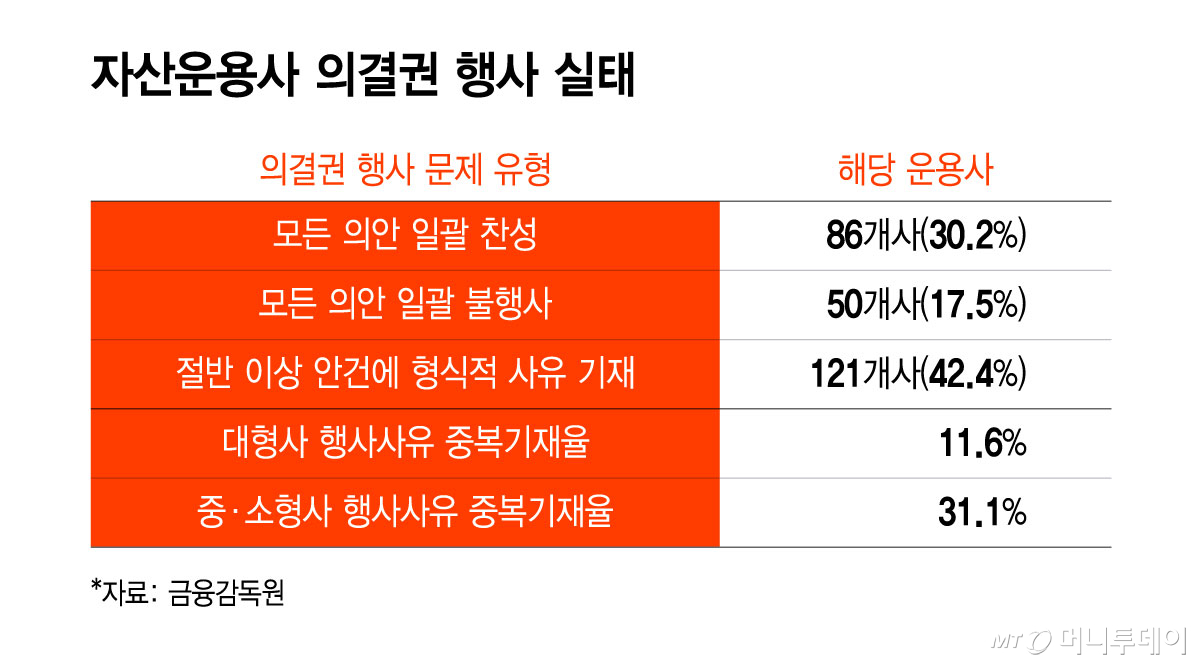
According to the financial investment industry on the 25th, a review by the Financial Supervisory Service (FSS) of voting rights exercise and disclosure records for 46,827 shareholders' meeting agenda items disclosed by 285 asset management companies from April last year through March this year revealed that 86 firms (30.2%) uniformly approved all proposals, while 50 firms (17.5%) did not exercise voting rights on any proposal. Combined, these two categories accounted for 136 firms (47.7%), which the FSS identified as a major area of deficiency.
The reasons given for exercising voting rights were also criticized. For more than half of the agenda items at shareholders' meetings, 121 asset management companies (42.4%) cited formal reasons such as "minimal impact on the shareholders' meeting" or "no infringement of shareholder rights." The rate of duplicate entries—repeating the same reason for different types and content of agenda items—was 31.1% for mid- and small-sized asset management firms, approximately 2.7 times higher than that of large firms (11.6%). This highlights a gap in quality between large and smaller firms in the process of analyzing individual agenda items and providing grounds for decisions, moving beyond mere formalities.
An industry official stated, "With shareholders' meetings concentrated during specific periods, analyzing individual corporate agenda items and preparing supporting grounds requires significant manpower and costs." The official added, "Differences in personnel and systems supporting voting rights tasks between large and mid- to small-sized firms may also contribute to the qualitative gap in voting practices."
In reality, among 67 public asset management companies, only 18 (26.9%) established dedicated organizations for voting rights, and just 20 (29.9%) incorporated related tasks into their key performance indicators (KPIs). The FSS also evaluated that asset management firms with robust internal management systems exercise and disclose voting rights more faithfully and are more active in shareholder activities compared to those without such systems.
Some asset management companies are advancing the sophistication of their voting rights analysis. KB Asset Management is utilizing generative artificial intelligence (AI) to verify and analyze voting records and review proposals for appointing outside directors. Trustone Asset Management has established a phased shareholder engagement process covering everything from monitoring invested companies and private dialogues to issuing shareholder letters, exercising voting rights, and post-implementation management.
Financial authorities are also shifting their focus from quantitative expansion to qualitative implementation as the Stewardship Code marks its 10th anniversary. The FSS has diagnosed that market trust in asset managers' shareholder activities remains low and, for the first time this year, publicly disclosed specific inspection criteria and examples of deficiencies to the industry. Moving forward, the FSS plans to continue releasing inspection results along with best practices and deficiency cases to encourage operational improvements. Whether the Stewardship Code can progress beyond merely expanding participation to genuinely elevating the level of fiduciary responsibility remains a key challenge for the future.

 in STOCK
