

The National Pension Service was found to hold more than 6.5 trillion won worth of stocks in Chinese listed companies that appeared on the blacklist of the U.S. Department of War (formerly Ministry of Defense), which prohibits participation in procurement projects, as of the end of last year based on the June list of Chinese Military Companies (CMC). The holdings have increased by 1.85 times over the past year, leading to assessments that balancing returns on retirement assets against geopolitical risks has emerged as a key challenge. While domestic public institutional investors related to trade have raised concerns about the possibility of the U.S. reshaping supply chains to contain China, the National Pension Service participated in the Hong Kong IPO (initial public offering) of newly designated CMC companies this year.
On the 25th, Money Today conducted a comparative analysis of the latest CMC list from the U.S. Department of War (dated June 8) and the overseas stock holdings disclosed by the National Pension Service on the 13th. The result showed that 21 companies among the overseas stocks held by the National Pension Service as of the end of last year were included in the latest CMC list. The total valuation of these holdings was 6.5961 trillion won. Applying the latest CMC list to the National Pension Service's overseas stock holdings as of the end of 2024 would have covered 19 companies with a scale of 3.5712 trillion won. The increase in last year's valuation appears to be due to rising stock prices, share cancellations, exchange rates, and expansion of held stocks. Since the National Pension Service omits items valued at less than 1 billion won in its disclosures, the actual scale of holdings could be larger.
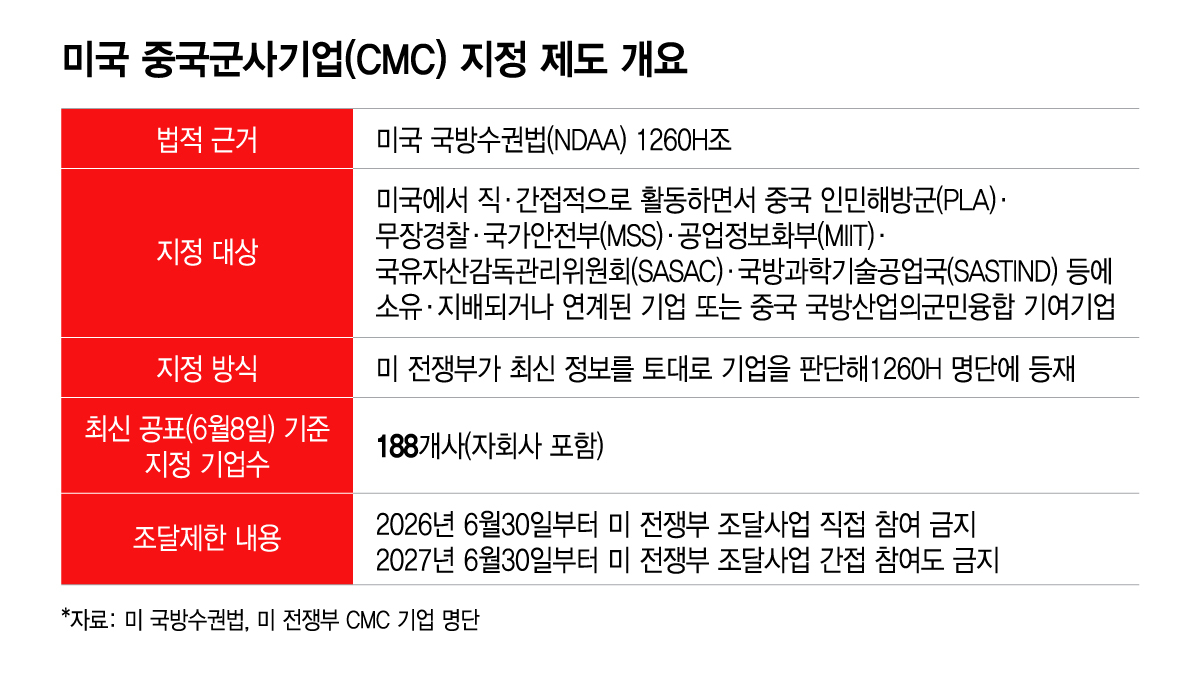
According to the U.S. Department of War and the National Defense Authorization Act (NDAA), CMC designations include companies that are owned, controlled, or affiliated with the Chinese People's Liberation Army (PLA) or armed police forces while operating directly or indirectly in the United States under Section 1260H of the NDAA, as well as companies contributing to the military-civilian fusion of China's defense industry (conversion of civilian technology for military use). Although there were originally no effective sanctions against CMC-designated companies, participation in direct procurement projects by the U.S. Department of War has been prohibited since June 30 this year. Indirect participation will be banned starting June 30, 2027.
The latest CMC list dated June 8 this year includes a total of 188 companies (including subsidiaries), representing an increase of approximately 40% compared to the previous list from January 2025. Newly designated CMC companies on June 8 included major Chinese technology firms such as Alibaba and Baidu. The valuation of newly designated CMC companies held by the National Pension Service, including Alibaba and Baidu, amounts to approximately 2.9 trillion won.
![[Beijing=AP/NEWSIS] U.S. President Donald Trump (left) walks toward his private vehicle after concluding his schedule at Zhongnanhai in Beijing, China, on the 15th (local time), receiving a farewell from Chinese President Xi Jinping. 2026.05.15. /Photo=Min Kyung-chan](https://thumb.mt.co.kr/cdn-cgi/image/f=avif/21/2026/08/2026082517020573523_2.jpg)
The National Pension Service also invested in the Hong Kong stock market IPO (initial public offering) of Zhongji Innolight, a company newly designated as CMC this year, through the cornerstone (pre-allocation prior to listing) method last month. The National Pension Service already held shares of Zhongji Innolight listed on China's mainland stock markets worth several hundred billion won and participated in a 250 million U.S. dollar (approximately 346.5 billion won) cornerstone contract at the Hong Kong IPO alongside institutional investors such as BlackRock.
This month, it was reported that the U.S. Federal Communications Commission (FCC) is even considering restrictions on imports of Chinese-made optical transceivers, leading to an assessment that Zhongji Innolight faces heightened business risks in the United States. In an analysis article on regulatory measures in the ICT sector, including the U.S. push for regulations against Zhongji Innolight, prepared at the U.S. Trade Office in Washington D.C. by KOTRA (Korea Trade-Investment Promotion Agency), it was stated that "expanding regulations on Chinese products may provide market opportunities for alternative suppliers in the short term, but in the medium to long term, it is likely to lead to a direction requiring higher supply chain transparency and compliance levels for all overseas ICT companies entering the U.S. market."
Kim Min-soo, a Supreme Council member of the People Power Party, recently stated at a Supreme Council meeting regarding the National Pension Service's investment in Zhongji Innolight: "While the United States is strengthening regulations on Chinese CMC companies internationally, South Korea is investing China-linked companies using National Pension funds." He added, "Do not tell us not to ask about the source of National Pension investments; we believe it is time for a special investigation and a national audit to determine how National Pension funds are invested and utilized." The National Pension Service has maintained that it is difficult to confirm details regarding individual investment items.

 in STOCK

