

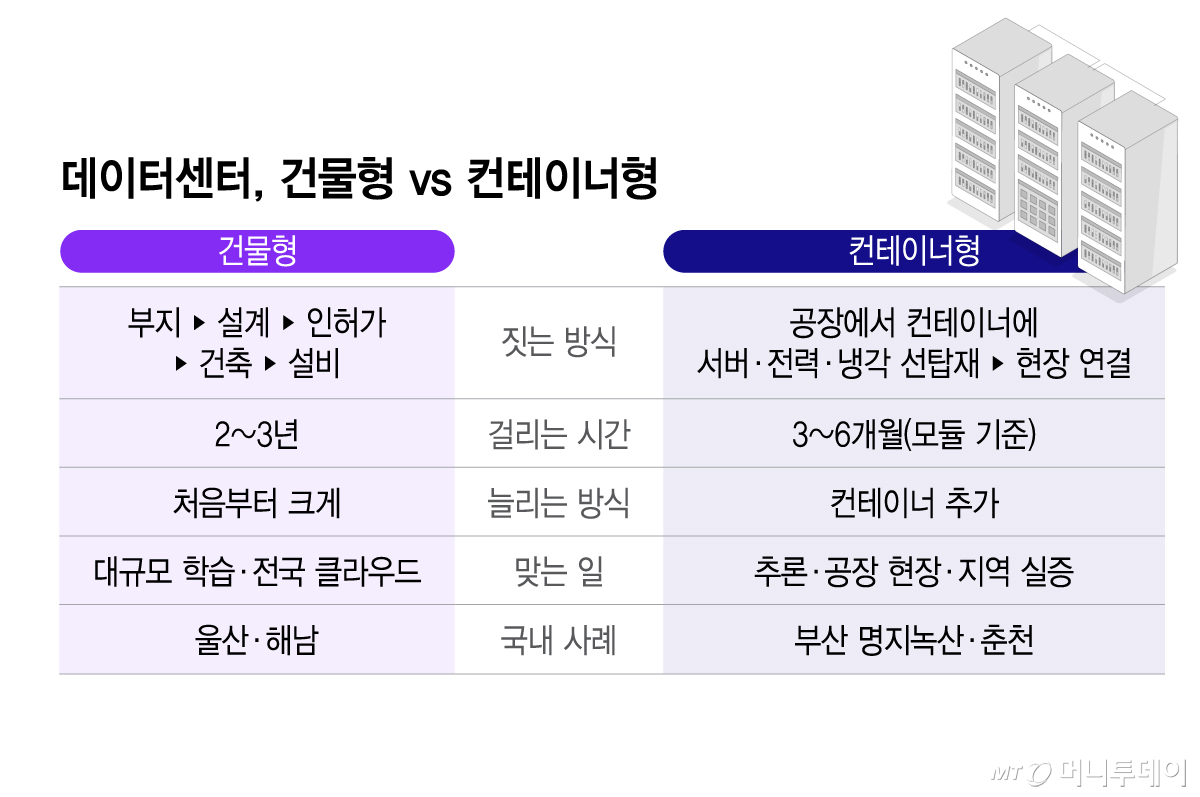
Local governments are fiercely competing to attract AI data centers. The issue is speed. The Ulsan Mipo Industrial Complex data center, backed by SK Group and Amazon Web Services (AWS) with 7 trillion won in investment, broke ground last August but will not begin operations until Phase 1 in 2027. The Haenam Solar City National AI Computing Center, which started construction on the 3rd of last month, is also scheduled to open only in 2028. At this pace, it will be difficult to keep up with the rapidly upgrading GPUs in between.
Pre-fabricated modular data centers (PMDCs), which place containers instead of constructing buildings, are filling this gap. In this approach, servers, power, cooling, and network systems are pre-installed in containers at a factory; on-site work involves only connecting them. Data centers can be built in as little as three months.
According to industry sources on the 4th, LG CNS (LG C&S), Samsung SDS (Samsung SDS), and Ellis Group have successively launched modular data centers this year. In March, LG CNS unveiled an "AI Box" that fits 576 GPUs (graphics processing units) into a single container. Its construction period is six months—one-fourth the time required for building-type data centers (two years). Samsung Material and Samsung SDS announced in July that they will build a modular AI data center in Chuncheon, Gangwon Province, at a cost of approximately 60 billion won.
The first to go online will be Busan. The Myeongji Noksan National Industrial Complex Edge AI Data Center, selected as a pilot project by the Ministry of Trade, Industry and Energy, began construction in July with a target for pilot operations in December. With a scale of 18.3 billion won, the project is led by Korea Industrial Complex Corporation's Busan headquarters, with participation from five entities including Ellis Group.
Ellis Group's "Ellis AI PMDC" will be installed there. The company states that it can go online in as little as three months on a modular basis. Using its proprietary virtualization software "ECI," the system combines 32 NVIDIA H200 GPUs and 168 domestic NPUs (neural processing units) into a single resource pool: GPUs handle training, while NPUs manage inference. Tenant companies receive resources on demand without needing to own equipment; if demand increases, additional containers are added. Park Jeong-guk, CTO of Ellis Group, said, "As more models directly install computing infrastructure within industrial complexes, local governments will be able to demonstrate attraction results much faster."
Constructing a building-type data center requires securing land, obtaining permits, connecting power supply, and completing construction—a process that takes two to three years. By then, GPU generations have already changed. Chips that were cutting-edge at the time of groundbreaking become outdated by completion. Market research firm MarketsandMarkets forecasts that the modular data center market will grow from 29.9 billion dollars in 2024 to 79.5 billion dollars in 2030, representing an annual growth rate of 17.7%. Crusoe, which is building OpenAI's StarGate, opened a factory in Yangsan, South Korea, this year with a 200 million dollar investment in Colorado to construct modular data centers. Following the Ministry of Trade, Industry and Energy's launch of industrial complex pilot projects, the Ministry of Science and ICT has also decided to support small-scale data centers with 8.9 billion won.
However, container-type data centers have limited computing capacity for large-scale model training or nationwide cloud operations. Like conventional data centers, they require prior access to power and communication networks. The three- or six-month timeline refers only to the module installation period, not the full project duration including land acquisition and permitting. Even in the Busan project, the total construction period is one year.
Nevertheless, their utility is clear due to differing roles. For locations that cannot wait years for a trillion-won data center to open, factories where sensitive process data cannot be shared externally, or regional industries needing to conduct proof-of-concept trials, rapidly installing a single container is considered the better option.

 in TECH
