

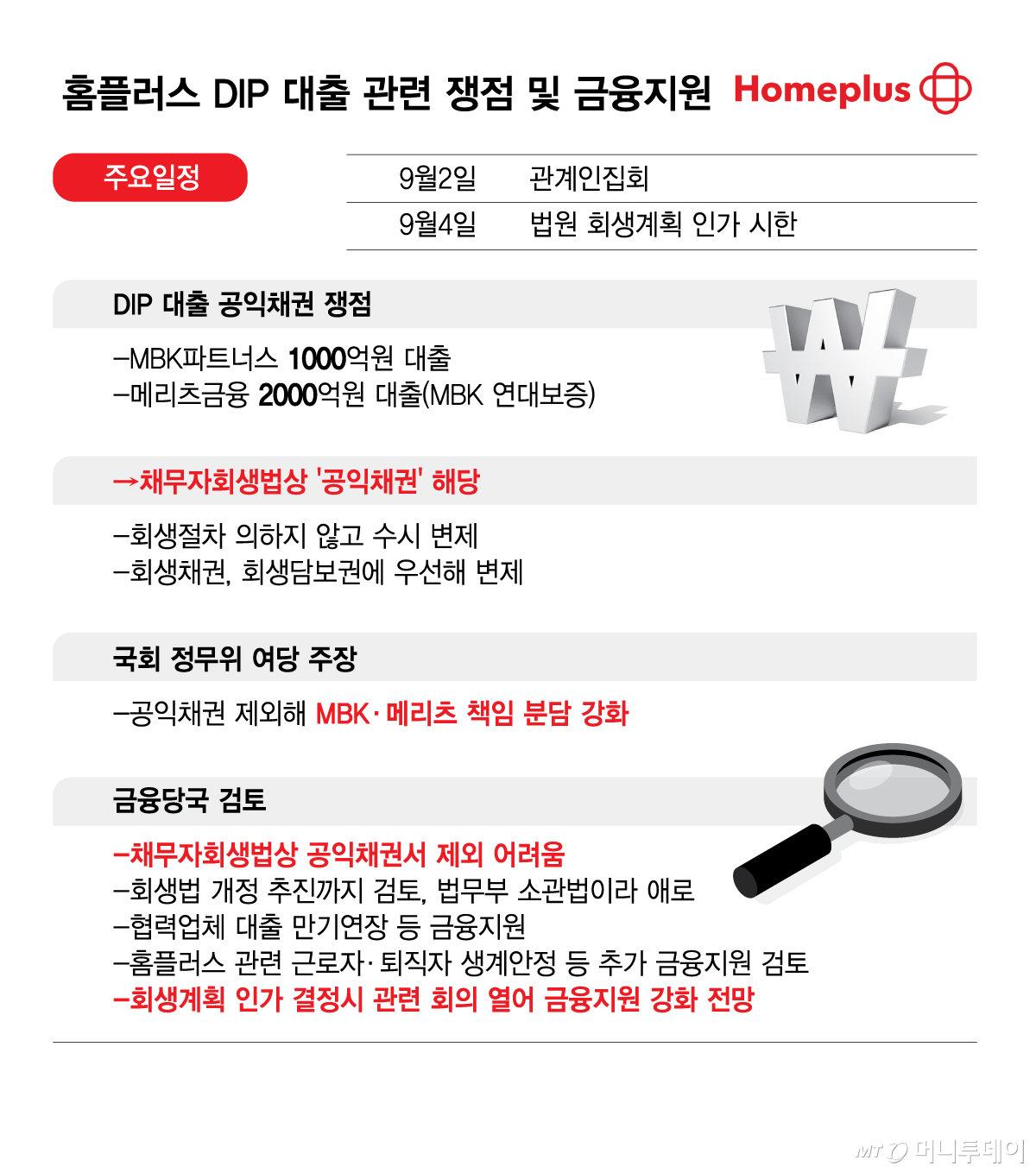
As the court prepares to decide whether to approve Homeplus's reorganization plan, it remains unclear whether MBK Partners and Meritz Financial Group's DIP financing (emergency loans) will be excluded from public claims. Maintaining DIP loans as public claims with priority repayment over other reorganization claims has made it difficult for the ruling party's demand to "strengthen the sharing responsibility of MBK and Meritz." The financial authorities plan to expand financial support for cooperating companies, workers, and retirees once the decision on approving the reorganization plan is announced.
According to the financial investment industry and financial authorities on the 1st, there is no clear solution other than amending the law to exclude DIP loans from public claims, a measure repeatedly mentioned by Lee Chan-jin, Governor of the Financial Supervisory Service, at the National Assembly's Political Affairs Committee. A financial authority official stated, "We are considering ways to exclude them from public claims, but it is not easy as they are clearly stipulated under the Debtor Rehabilitation Act," and added, "Unless creditors themselves refuse to accept them, third parties cannot force exclusion."
Homeplus is approaching a creditors' meeting on the 2nd to seek creditor consent and judgment on its reorganization plan. If the meeting passes, the court will decide whether to approve the reorganization plan by no later than the 4th.
The controversy over excluding DIP loans from public claims is intensifying as Homeplus's reorganization proceedings approach, primarily due to arguments holding MBK and Meritz Financial Group responsible. Democratic Party of Korea lawmakers on the National Assembly's Political Affairs Committee argue that MBK and Meritz Financial Group are also responsible for Homeplus's deteriorating management and the sale of related bonds, and thus DIP loans should be excluded from public claims. Min Byeong-deok, a Democratic Party lawmaker, plans to hold a press conference on the 2nd demanding approval of Homeplus's reorganization plan.
Under the Debtor Rehabilitation Act, DIP loans are classified as public claims and are repaid at any time regardless of reorganization proceedings. In particular, they are prioritized over reorganization claims and reorganization secured claims, meaning that if Homeplus generates profits, funds will be repaid to MBK and Meritz Financial Group. Ruling party political affairs committee members believe that MBK and Meritz Financial Group, which bear responsibility for Homeplus's deteriorating management, should share a portion of the costs.
The problem is that there are no exception clauses in the Debtor Rehabilitation Act to exclude DIP loans from public claims on grounds of sharing responsibility, and since the act falls under the jurisdiction of the Ministry of Justice, it is also difficult for financial authorities to push for legal amendments. Although Lee Chan-jin, Governor of the Financial Supervisory Service, has instructed that the possibility of amending the law be considered, as the competent ministry is the Ministry of Justice, submitting a reorganization law amendment bill to the National Assembly places a burden on the financial authorities.
Consequently, the financial authorities are expected to expand financial support to ensure livelihood stability for cooperating companies, workers, and retirees. Commercial banks are likely to be requested to expand financial support through measures such as extending loan maturities and granting repayment deferrals for cooperating companies. The Financial Services Commission and the Financial Supervisory Service held a "Financial Sector Response Check Meeting on Cancellation of Homeplus Reorganization Proceedings" on July 6 and decided to provide emergency liquidity up to 300 billion won to affected small and mid-sized companies.
Once the court decides whether to approve Homeplus's reorganization plan, it is highly likely that the financial authorities will also hold a check meeting to discuss support measures. A financial authority official stated, "Since the damage to cooperating and supply companies, workers, and retirees is greater than other market stability risks, we are focusing on financial support."
The financial authorities appear set to review loans that flowed into Homeplus's leased stores and related creditor group agreements. Measures such as extending maturities and granting repayment deferrals for loans related to leased stores are being strongly discussed to prevent immediate defaults.
The "seniority rule" for individual investors who invested in Homeplus bonds, as well as disciplinary procedures against bond-selling firms such as Hana Securities, are expected to accelerate. The financial authorities have completed their inspection of bond-selling firms including Hana Securities and submitted an inspector's opinion report, and plan to send a preliminary notice containing the first proposed penalty measures shortly.

 in STOCK
