

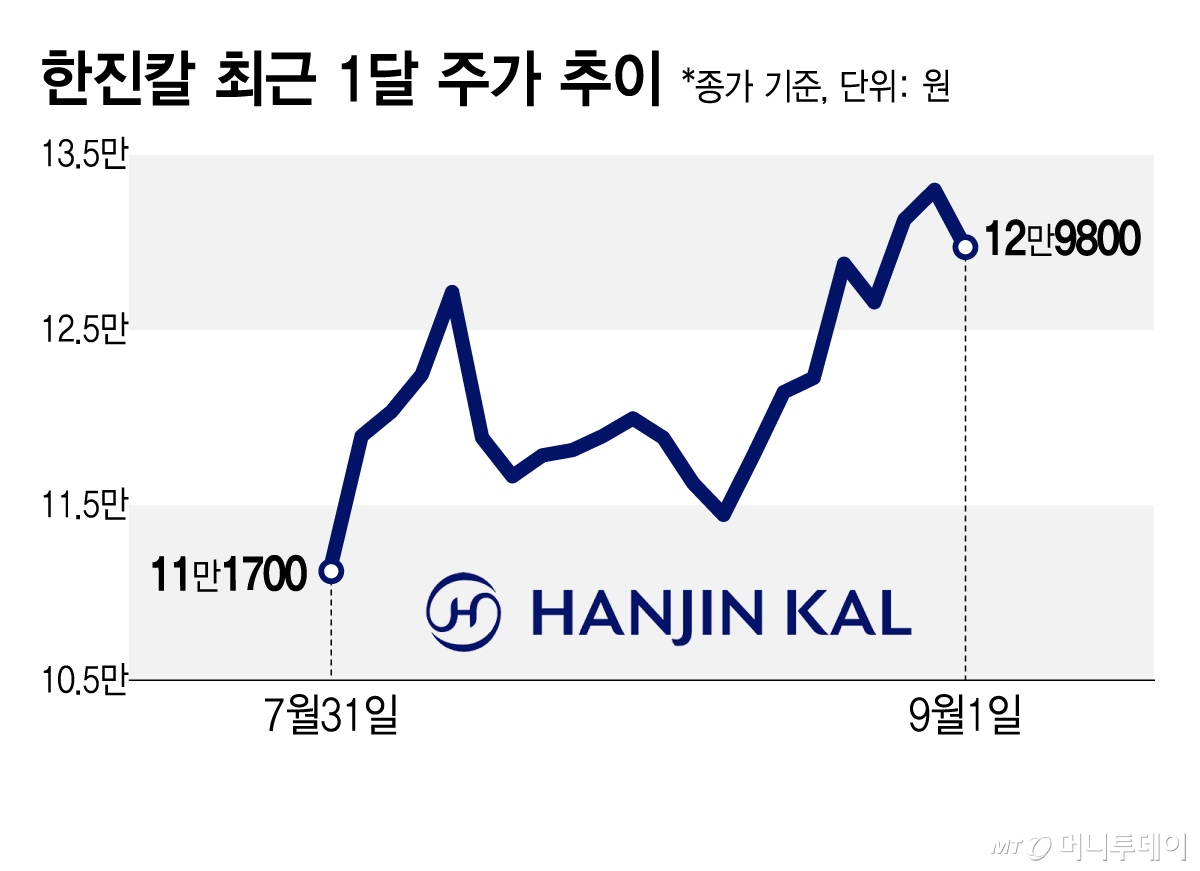
As the management disputes between Hanjin Cal and Korea Zinc, both listed on the KOSPI, have flared up again, their stock prices are also being affected. Since August, both companies have shown a gradual upward trajectory, but market sentiment regarding their stock price outlook differs somewhat.
On the 1st, Hanjin Kal closed at 129,800 won on the Korea Exchange, down 2.41% from the previous trading day. Since late July, when it was in the 100,000-won range, the stock has followed an upward trend. While recent positive factors such as reduced fuel cost burdens, stable exchange rates, and a recovery in international passenger demand have been present, the market views the management dispute as having stimulated investor sentiment.
Hoban Construction, which became Hanjin Kal's second-largest shareholder in 2022, has continuously increased its stake, recently reaching 20.15%, sparking renewed attention to the shareholding battle. The gap with Jo Won-tae (Chairman), the first-largest shareholder of Hanjin Cal, is only 0.41 percentage points (p).
There have been no specific statements yet indicating that Hoban Construction is aiming for control of Hanjin Cal; it still maintains that its purpose is investment. Considering that over 40% of shares are held by pro-Jo (Chairman) entities such as Delta Air Lines and the Korea Development Bank, in addition to Jo (Chairman)'s stake, some forecasts suggest a full-blown management dispute may not occur.
However, the market and investors are closely watching Hoban Construction's continuous increase in its Hanjin Kal shareholding. Ultimately, if Hoban Construction considers taking over Hanjin Kal's management, it would have no choice but to make additional purchases, creating an atmosphere among the market and investors that a sharp stock price rise could occur.
In addition, there are analyses suggesting that Korea Development Bank, which holds a 10.58% stake, may sell its shares after year-end this year when the integration of Korean Air and Asiana Airlines is finalized. If Hoban Construction targets this, the management competition could accelerate further.
A securities industry official stated, "In the second quarter of last year, Hoban Construction also increased its shareholding by 1 percentage point, on which days Hanjin Kal's stock price hit the upper limit for two consecutive days," adding, "Regarding Hanjin Kal, the market and investors view that there are still events remaining that could add more management premium."
Not only Hanjin Kal but also the management dispute at Korea Zinc has recently resurfaced. Although two years have passed since September 2024, when Yeungpoong and private equity fund MBK attempted a hostile M&A (mergers and acquisitions), legal battles and boardroom struggles between both sides remain in a stalemate.
Particularly, attention is focused on which side will secure the audit committee members elected at the extraordinary general meeting of shareholders scheduled for the 9th. The reason both sides are currently engaged in a tug-of-war over allegations of private misuse of funds by the largest shareholder family of Korea Zinc, who allegedly used part of an investment fund's capital to invest in unlisted companies, is speculated to be a strategy to gain the upper hand at the extraordinary shareholders' meeting.
Consequently, Korea Zinc's stock price since August has also generally followed an upward trend. However, looking at the most recent stock prices, it dropped by nearly 10% within two trading days. While challenges both inside and outside management, such as the issue of securing global core mineral supply chains, exist, there are also claims that the resurgence of a battle where no premium is clearly visible in the management-related competition has increased investor fatigue.
Unlike Hanjin Cal, which may reach a stage where someone must buy more shares due to a vote-off, the market believes that Korea Zinc's management dispute has shifted to a struggle for board leadership and is therefore unrelated to stock prices.
Another securities industry official said, "The core of the management disputes between the two companies is that one side faces a dispute where someone must buy more shares in the future, while the other side has already seen significant accumulation and now revolves around who secures voting rights," adding, "The market and investors are viewing the next steps differently."

 in STOCK
