

As the Bank of Korea raised its base rate and global long-term government bond yields hit record highs, risk-averse sentiment grew, yet bank stock ETFs (exchange-traded funds) recorded strong returns. This is because banks can benefit from higher interest income due to high rates, while their solid earnings and dividends enhance their appeal as defensive stocks during volatile market conditions. Experts recommend a "barbell strategy" that includes bank stock ETFs alongside growth stocks such as semiconductors.
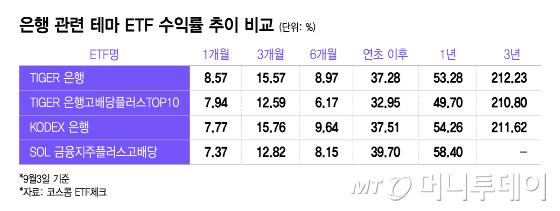
According to KOSCOM's ETF CHECK data as of the 3rd, the recent three-month return for 'KODEX Bank' stood at 15.76%, placing it among the top five performers among domestically listed ETFs. Similarly, 'TIGER Bank', which tracks the same KRX Bank Index, posted a return of 15.57%.
High-dividend ETFs such as 'SOL Financial Holding Plus High Dividend' (12.82%) and 'TIGER Bank High Dividend Plus TOP10' (12.59%) also ranked 11th and 12th, respectively. Among the top 10 holdings in these products, seven and nine are bank stocks, respectively.
Banks are widely recognized as prime beneficiaries of high interest rates, driving their stock prices upward. The Bank of Korea raised its base rate not only in July but also in August. This has improved key profitability metrics for banks, such as net interest margin (NIM), leading to increased interest income. Additionally, rising market interest rates—including those on government bonds—have fueled expectations that the spread between loan and deposit rates will widen. Typically, loan rates tend to reflect increases in market rates more quickly than deposit rates.
Projections also suggest that the environment favorable to bank stocks will persist for some time, as interest rates are unlikely to decline easily soon. Kang Song-cheol, a researcher at Eugene Investment & Securities, stated, "International oil prices have risen due to the Middle East war, and major countries including South Korea are actively implementing fiscal stimulus measures. Furthermore, big tech companies are issuing bonds to raise funds for AI (artificial intelligence) investments, and halting such investments is highly unlikely."
There is also growing recognition of bank stocks as defensive assets supported by solid earnings amid volatile market conditions. Since July, the concentration in semiconductors has eased, and signs of sector rotation have spread across industries, making bank stock returns stand out. In fact, the combined net profit of the five major financial holding companies—KB, Shinhan, Hana, Woori, and NH Agricultural Cooperative Financial Group—for the first half of this year totaled 13.1183 trillion won, with four of them (excluding Woori) achieving record-high earnings.
Aggressive dividend payouts by bank stocks can serve as an additional source of income, earning them extra points from investors. Financial holding companies are aligning with the government's value-up program policy and have a high proportion of foreign investor holdings, making them among the most proactive in shareholder returns. Both KODEX Bank and SOL/TIGER High Dividend Plus ETFs are managed as monthly dividend products.
In light of this, experts advise investing in bank stock ETFs that offer both benefits from high interest rates and strong fundamentals through earnings and dividends. Kim Jeong-hyun, head of the ETF Group at Shinhan Asset Management, said, "If semiconductors have served as the offensive arm of portfolios, then bank and financial holding ETFs can act as defensive assets to secure relative stability and reduce volatility."

 in STOCK
