

Retail investors are increasingly spreading their investments across different securities firms based on their goals—whether for domestic stocks, overseas stocks, funds, or pensions—and even transferring their assets to find better terms. As the concept of a 'primary securities firm' where investors concentrated all their assets in one firm fades, competition among securities firms is shifting from merely acquiring accounts to securing more customer assets.
According to the financial investment industry on the 3rd, retail investors are using multiple securities firms after comparing not only commissions and exchange conditions but also investment products, trading convenience, tax calculation methods, and various events. For example, they may use Securities Firm A for domestic stocks, Firm B for overseas stocks, and Firm C for pensions or ISAs (Individual Comprehensive Asset Management Accounts). In some cases, when a better-conditioned securities firm is found, investors even transfer their existing stocks or accounts to that firm.
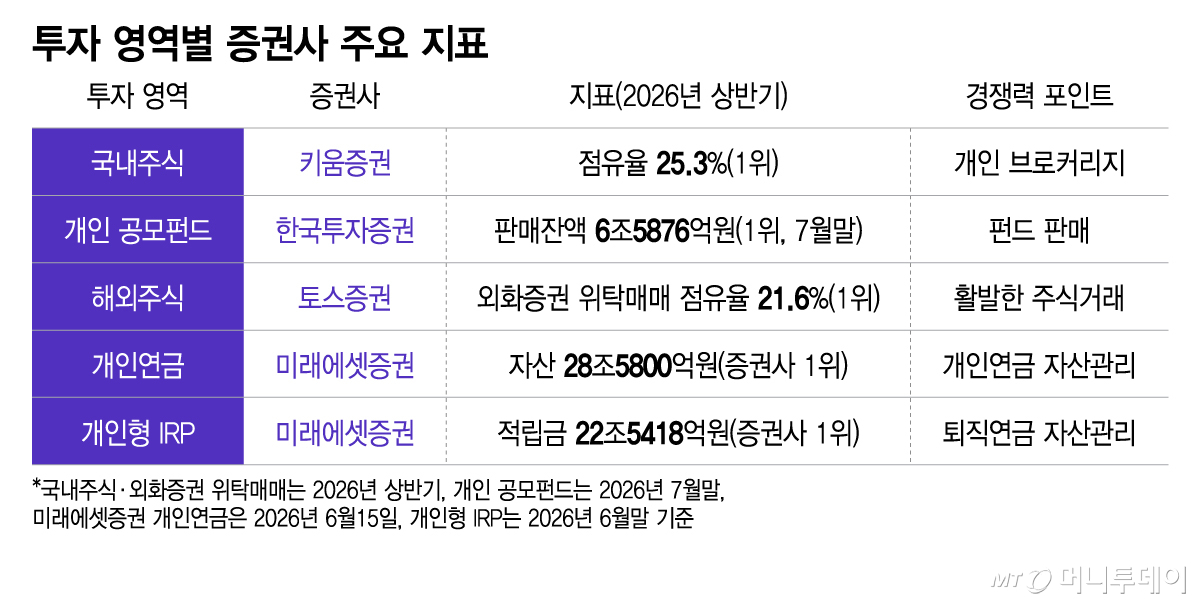
This investment behavior is also reflected in the performance results of individual securities firms. Kiwoom Securities held the No. 1 market share in the domestic stock retail (individual) market with 25.3% in the first half of this year, meaning one out of every four won in transaction value for domestic stocks by retail investors went through Kiwoom. However, when it comes to funds, the ranking flips. According to an analysis of statistics from the Korea Financial Investment Association, as of late July, Kiwoom Securities' outstanding balance of individual public fund sales was 318.1 billion won, placing it 16th among securities firms. In contrast, Korea Investment & Securities held 6.5876 trillion won—20.7 times that of Kiwoom.
In overseas stocks and pensions, another strong player emerges. Mirae Asset Securities manages the largest scale of assets in both overseas stocks and pensions within the industry. Overseas stock assets surpassed 50 trillion won last October, while pension assets reached 80.81 trillion won as of late June this year.
In overseas stock trading, Toss Securities has shown remarkable performance. In the first half of this year, the amount of foreign currency securities entrusted trading through Toss Securities was approximately 367 trillion won, ranking No. 1 in the industry. Its market share reached 21.6%, and it also recorded the highest foreign currency securities custody fees in the industry. Just as Kiwoom leads in domestic stocks, Korea Investment dominates individual public funds, and Toss excels in overseas stock trading, the leading firm varies depending on the investment category.
Investors are not only using multiple securities firms but also transferring their assets. One retail investor transferred five overseas stocks previously traded at Kiwoom Securities to Samsung Securities via a 'transfer-in' service from another firm. This was not selling and repurchasing stocks but moving the actual holdings to an account at a different securities firm, following a comparison of commissions and benefits for receiving transfers from other firms.
Some investors have moved their general stocks, pension savings, and ISAs to different securities firms after comparing domestic stock trading commissions. There are also cases where investors transferred their ISAs after weighing the convenience of ETF (Exchange-Traded Fund) investments and event benefits, or attempted to switch securities firms due to differences in how capital gains from overseas stock transfers are calculated.
Securities firms have launched competitions to retain moving customers. A representative example is the 'transfer-in' event, where cash payments are made based on the amount transferred when bringing domestic or overseas stocks held at other securities firms. A securities industry official stated, "In the past, retail competition focused on acquiring new account holders, but now the battlefield has expanded to include capturing customer assets even from competing firms."
From the perspective of securities firms, simply acquiring one account no longer guarantees securing a customer's investment assets. The focus of competition among securities firms is shifting from being a 'primary firm' that exclusively serves a single customer to competing for a larger share of the customer's total investment funds—a battle for 'share of wallet.'

 in STOCK
