

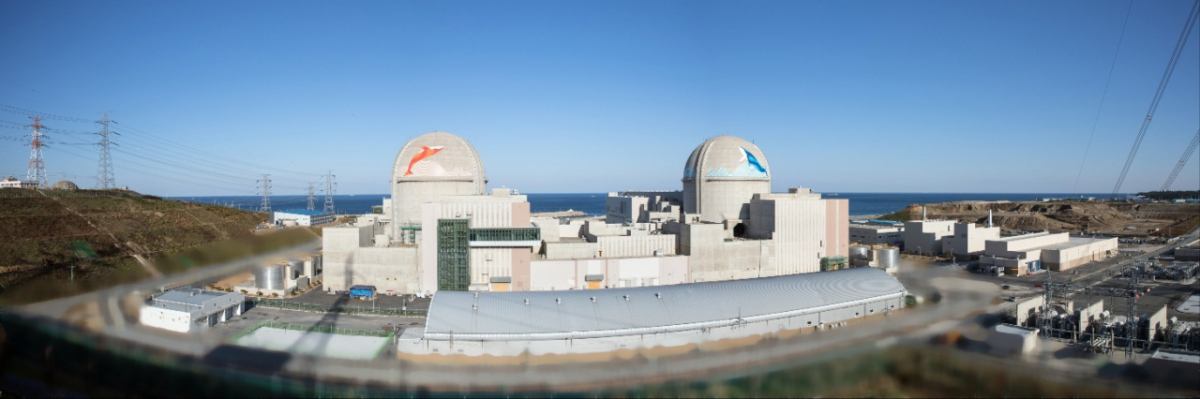
As part of South Korea's investment project in the United States, a $130 billion (175 trillion won) nuclear power plant construction project involving eight reactors has been included, leading to expectations that domestic nuclear-related companies will participate extensively in the project. The domestic nuclear industry is regarded as the top nuclear partner for the U.S., recognized for its construction and operational capabilities as well as its contribution to energy security.
According to reports from the National Assembly and the government on the 7th, the U.S. investment project includes the construction of eight nuclear power plants in the United States. The total investment amount is $130 billion, with six reactors being Westinghouse's AP1000 model and the remaining two being Korea Hydro & Nuclear Power's APR1400 model.
Last year, South Korea agreed to a tariff deal with the United States and committed to a $350 billion investment in the U.S. Of this amount, $150 billion will be allocated to shipbuilding cooperation projects, while $200 billion will go toward investments in energy and advanced industries. If the nuclear power project is finalized as part of the U.S. investment initiative, it would account for more than half of the total investment scale.
Following the signing of a memorandum of understanding (MOU) on strategic investment with the United States, the South Korean government has been closely identifying potential targets for the U.S. investment project through continuous consultations with Washington. Among these, nuclear power has been considered a leading candidate based on commercial viability, return on investment potential, and participation by domestic companies.
South Korea's investment in U.S. nuclear power aligns with American interests. The United States currently operates 94 commercial nuclear reactors, many of which are aging significantly, with an average facility age exceeding 40 years. However, since the Three Mile Island nuclear accident in 1979, construction of new large-scale nuclear plants in the U.S. has been halted for over three decades, effectively causing the collapse of the American nuclear power ecosystem.
With electricity demand surging due to AI data centers and other factors, the United States faces a shortage of adequate power infrastructure, making it urgent to secure partners for building large-scale domestic nuclear plants.
The Trump administration announced last year its decision to restart nuclear power operations and pledged to break ground on 10 new large reactors by 2030. To achieve this goal, it signed an investment commitment worth $80 billion (approximately 120 trillion won) with investment firm Brookfield, uranium supplier Cameco, and Westinghouse to accelerate the deployment of AP1000 reactors.
Analysts indicate that South Korea is the most suitable partner for U.S. nuclear power construction. The greatest advantage of South Korea's nuclear industry lies in its ability to deliver projects at reasonable prices and on schedule. While large-scale nuclear projects in other countries often face delays and cost overruns, South Korea has extensive experience in timely construction, including the Barakah nuclear plant in the United Arab Emirates (UAE) and several domestic reactors.
In particular, the APR1400 reactor model developed by Korea Hydro & Nuclear Power holds design certification from the U.S. Nuclear Regulatory Commission (NRC), allowing it to apply for construction permits without additional technical reviews when building new plants in the United States. In contrast, France's design certification process with the NRC has been suspended. Compared to competing nations, South Korean nuclear technology enables faster project advancement in the U.S.
There are also advantages from a security perspective. Currently, only South Korea, the United States, France, Russia, and China possess large-scale nuclear reactor construction technology. Among these, China and Russia face significant limitations on entering the U.S. market due to security concerns.
Yang Seung-yoon, a researcher at Eugene Investment & Securities, stated, "From the U.S. perspective, the APR1400 is the optimal alternative that has obtained NRC design certification and is supported by construction experience from domestic companies," adding that it represents a solution that simultaneously meets U.S. energy security and national interests.
Although the South Korean government will bear the costs of constructing the eight reactors, there is a high likelihood that numerous domestic companies will participate in the project. As a result, funds invested in the United States are expected to flow back into South Korea.
Under the ROK-U.S. Strategic Investment MOU, the United States must prioritize Korean suppliers when selecting vendors for goods and services related to the project. In the case of nuclear power plants, there are virtually no companies in the U.S. with construction capabilities, meaning reliance on Korean firms such as Hanwha Solutions (formerly HanSu), Doosan Enerbility, and Hyundai Engineering & Construction is inevitable. There is also a high probability that the project will beed as an EPC (Engineering, Procurement, and Construction) contract awarded to Team Korea, a consortium of South Korean companies, in a turnkey manner covering design, procurement, and construction.
Jang Moon-jun, a researcher at KB Securities, analyzed, "Over the past year and a half, the United States has focused on designing the overall structure of its nuclear policy, finance, and procurement systems. Now, it is entering a phase where individual projects with identified developers and sites will be realized," adding that "it will also become clear who, how, and to what extent South Korean companies will participate in the nuclear value chain."

 in ECONOMY
