

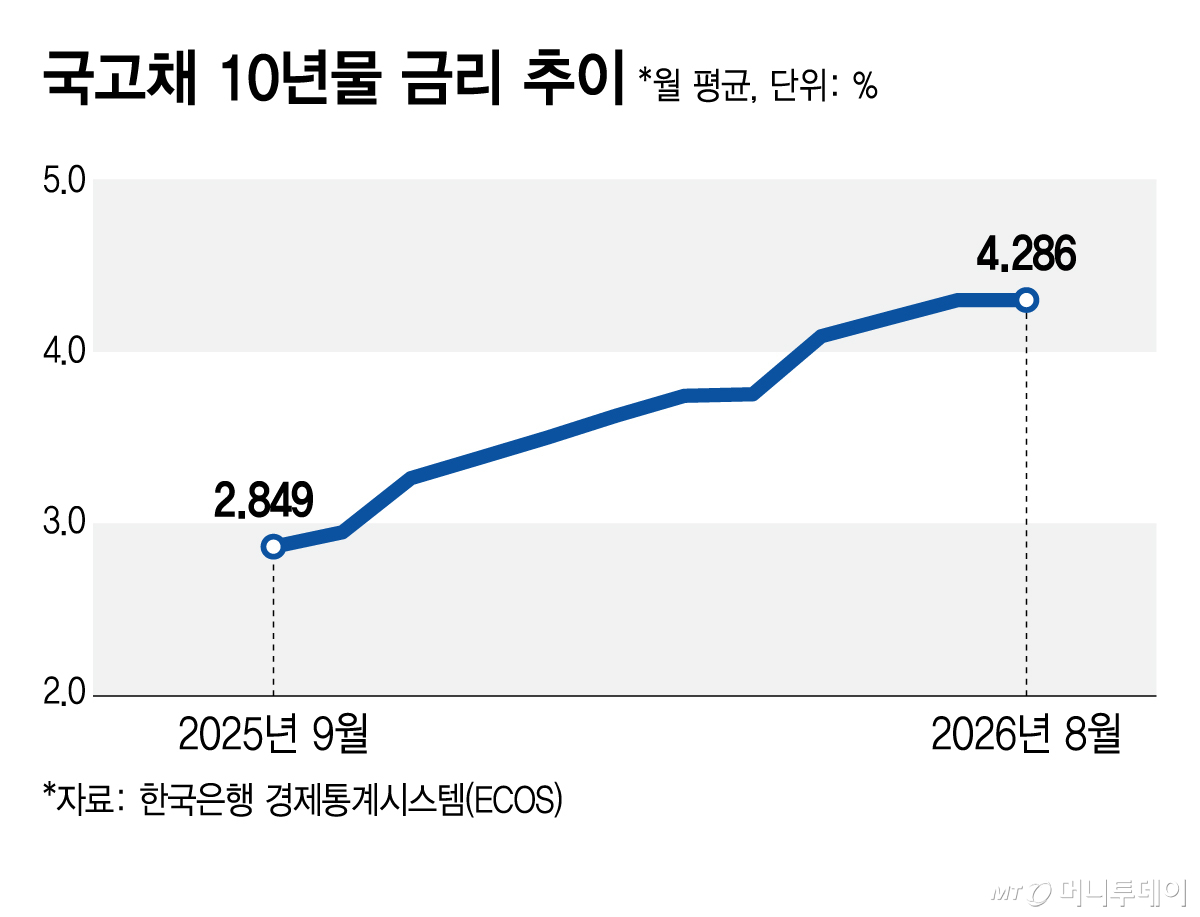
"A global wave of bond sell-offs is actually becoming an opportunity for retirement pension investors. While rising interest rates have driven down the prices of existing bonds, new investors purchasing bonds can secure higher yields over the long term. With domestic long-term government bond yields now reaching the 4th% range, a path has opened for individual investors to purchase personal-use government bonds offering yields in the high 4% range through retirement pensions."
According to the financial investment industry on the 8th, starting from the 9th, individuals will be able to purchase 10-year and 20-year government bonds through Defined Contribution (DC) type retirement pensions and Individual Retirement Pension Plans (IRP). Five securities firms—Mirae Asset Securities, Samsung Securities, Korea Investment & Securities, NH Investment & Securities, and KB Securities—and three banks—Shinhan Bank, Hana Bank, and NH NongHyup Bank—will offer these bonds.
Personal-use government bonds are savings-type government bonds sold exclusively to individuals by the government to support long-term asset formation for private citizens. Previously, it was already possible to invest in general Treasury bonds or government bond ETFs (exchange-traded funds) through retirement pensions. What is newly permitted this time is the purchase of personal-use government bonds within DC and IRP accounts.
The recent investment environment is also enhancing the appeal of personal-use government bonds. In major countries, selling pressure on government bonds has emerged due to a combination of inflation, interest rate hikes, and concerns over fiscal burdens. Domestically too, long-term government bond yields have risen to high levels in the 4th% range. On the 7th, the 10th-year Treasury bond yield closed at an annualized 4.385%, the 20th-year at 4.567%, and the 30th-year at 4.631%.
Bond yields and prices move in opposite directions. When yields rise, existing bondholders may incur valuation losses, but new investors purchasing bonds can secure higher yields. This is why a global wave of bond sell-offs paradoxically becomes an opportunity for new investors.
The coupon rates for personal-use government bonds issued in September are 4.415% annually for the 10th-year and 4.570% for the 20th-year. An additional premium rate of 0.35 percentage points is added to each. If held until maturity, investors will receive compound interest benefits based on an annualized 4.765% for the 10th-year and 4.920% for the 20th-year. The pre-tax cumulative return rates upon holding to maturity are approximately 59.3% for the 10th-year and approximately 161.3% for the 20th-year.
When compared with retirement pension time deposits, the interest rate difference is striking. Woori Bank's September IRP retirement pension time deposit offers an annualized 3.30% for a one-year term and 3.20% for three- and five-year terms. KB Kookmin Bank offers 3.22% for one year, 3.15% for three years, and 3.03% for five years. A simple comparison of interest rates shows that these are more than 1 percentage point lower than the combined coupon rate and premium rate of personal-use government bonds.
Personal-use government bonds were introduced in June 2024. Until now, individuals could invest through dedicated accounts but could not purchase them within retirement pension accounts. The government plans to issue a total of 230 billion won worth of personal-use government bonds in September, an increase of 80 billion won (53.3%) from the previous month. Of this amount, the issuance for the 10th-year and 20-year bonds will be 110 billion won and 65 billion won, respectively, allowing investment through retirement pensions starting from the 9th.
Investment experts caution that individuals should not invest in personal-use government bonds based solely on high interest rates. These require a long-term commitment of either 10 or 20 years and cannot be freely bought and sold in the market like general Treasury bonds. Early redemption is generally possible only one year after issuance, but in such cases, investors will not receive the premium rate or compound interest benefits. A financial industry official stated, "When choosing between short-term principal-and-interest-guaranteed products like time deposits and personal-use government bonds, it is necessary to consider not only interest rates but also the fund management period and liquidity."

 in STOCK
