

Despite global geopolitical instability, the unveiling of OpenAI’s next-generation artificial intelligence (AI) “GPT-6 Astra” has reaffirmed expectations for a supercycle in Korea’s leading sector—semiconductors—and renewed investor sentiment. As signs of an upward trend in the KOSPI have emerged since September, foreign institutional investors continue to maintain positive outlooks on the index. Their views are more proactive than those of cautious domestic securities firms, drawing attention to whether the KOSPI can achieve a genuine recovery.
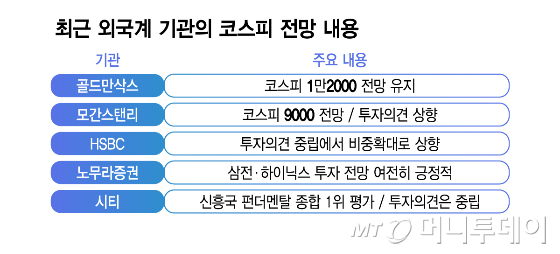
According to the financial investment industry on the 8th, Timothy M., Senior Equity Strategist for Goldman Sachs Asia-Pacific, stated in an interview with Bloomberg News on the 7th that he maintains his previous KOSPI target of 12,000. Goldman Sachs raised its KOSPI forecast from 9,000 to 12,000 on June 3, when the KOSPI index was above 8,000 and heading toward 9,000.
The strategist’s latest interview is noteworthy because it reflects continued optimism despite experiencing extreme domestic market volatility following the launch of a single-stock leverage ETF in July and a rotating trading pattern (sequential buying shifts) throughout August. Notably, in July, the KOSPI fell to below 5,100—less than half of Goldman Sachs’ target—due to severe liquidity concentration and foreign investor outflows.
Goldman Sachs’ projection of a KOSPI index reaching 12,000 is based on the possibility of a semiconductor supercycle driven by global chip shortages. The strategist said, “We maintain our target because we believe earnings will support (semiconductor stocks),” and added, “The market has not yet fully priced in how long this earnings cycle will last.”
Not only Goldman Sachs but also Morgan Stanley initially set its KOSPI target at 9,000 earlier last month, characterizing the July crash as a “reset” that had already reflected much of the negative impact on stock prices. Moreover, it upgraded its investment rating from neutral to overweight. At the same time, it noted that due to the impact of single-stock leverage ETFs and subsequent regulatory tightening, retail investors have exited the market, weakening domestic supply-demand dynamics; thus, foreign investor inflows in the second half could determine the KOSPI’s direction.
Hong Kong-based investment bank HSBC also upgraded its investment rating on the Korean stock market from neutral to overweight last month, citing reduced volatility and significant mitigation of excessive leverage risks. In addition, Nomura Securities issued a report on the 4th maintaining high investment outlooks for Samsung Electronics and SK Hynix, offering positive assessments of key stocks that significantly influence KOSPI fluctuations.
However, Citigroup took a cautious stance in its emerging markets asset allocation report last month, assigning South Korea the top comprehensive fundamentals score among 12 countries while maintaining a neutral investment rating.
The domestic capital market is closely watching increased foreign investor inflows into the KOSPI since September. Morgan Stanley identified foreign investor inflows as a key indicator for the second-half KOSPI trajectory; since this month, foreign investors have purchased net over 1.4 trillion won in the KOSPI based on exchange data. On the 8th alone, foreigners bought net 709.2 billion won. Institutional investors bought net 425.1 billion won, and other corporations bought net 1.7658 trillion won, while retail investors sold net 2.8844 trillion won.
On the 7th alone, foreign investors purchased net 2.5137 trillion won at the Korea Exchange, driving the KOSPI’s near-5% gain. This contrasts with August, when foreign investors sold net approximately 1 trillion won despite a market-wide rotating trading pattern that had reduced volatility. From January through late August this year, foreign investors exhibited an outflow trend, selling net about 170 trillion won in the KOSPI.
Domestic experts anticipate that changes in foreign investor flows, positive outlooks from foreign institutional investors, continued semiconductor supercycles led by key stocks, and large-scale shareholder return initiatives could serve as signals for a KOSPI rebound in the second half of the year.
Na Jeong-hwan, Researcher at NH Investment & Securities, stated, “Trading volume on the KOSPI, KOSDAQ, and Next Market exceeded 150 trillion won on June 1 but contracted to just 35 trillion won by the 2nd, indicating a sharp decline in domestic stock trading volumes. Depending on foreign investors’ spot-futures investment direction, short-term stock price volatility could expand.”

 in STOCK
