

Recent analysis indicates that as the scale of private investment assets—including private equity, private lending, and infrastructure—expands and becomes a key asset allocation tool for institutional investors, there is a growing need to broaden investment opportunities for general investors. While South Korea has strengthened investor protection mechanisms following the Lim·Optimus large-scale redemption suspension incident, it is necessary to establish pathways for accessing high-quality private investment assets without compromising investor protection standards, drawing lessons from cases in the United States and the European Union (EU).
According to the financial services industry on the 8th, Hwang Se-wun, a senior research fellow at the Capital Market Research Institute, stated in his research report titled "Comparative Analysis of Private Fund Entry Regulations and Domestic Policy Implications" that "with recent trends emphasizing investor protection, market attention is increasingly focused on determining how far to allow general investors access to private investment assets." This comes as the private asset market—including unlisted stocks, private lending, and infrastructure—expands, and companies remain in unlisted status for longer periods, raising concerns that investment returns generated in the private market may become concentrated among institutional investors and high-net-worth individuals.
According to global market research firm Institutional Investor Fortune Business Insights, the global private fund market size was $6.7498 trillion last year, is projected to reach $7.4995 trillion this year, and is expected to grow to $20.2427 trillion by 2034.
South Korea's private fund system has been strengthened in recent years with a focus on investor protection and market discipline following the large-scale redemption suspension incident involving Lim·Optimus. In March 2021, an amendment to the Capital Market Act reflecting improvements in private funds restructured the system into general private funds and institutional investor-exclusive private funds. General investors are prohibited from participating in institutional investor-exclusive private funds, while general private funds open to them include investor protection mechanisms such as monitoring and check functions by sales firms and custodial institutional investors.
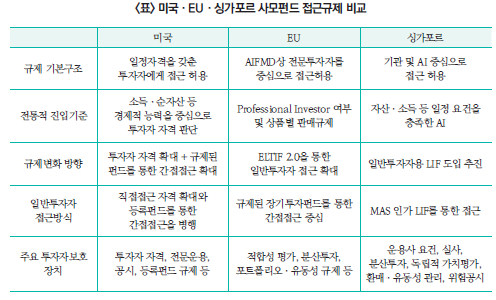
Major countries are increasingly moving toward expanding accessibility not merely by easing entry restrictions but by combining investor qualification requirements with product regulations. This is because private investment assets carry risks such as low liquidity, high information asymmetry, and difficulties in valuation.
The United States has refined investor qualifications while allowing access to the private market primarily through its accredited investor system. Since 2020, the U.S. Securities and Exchange Commission (SEC) has recognized individuals who possess certain professional qualifications and financial expertise in addition to income and net worth requirements.
At the same time, there are efforts to expand general investors' access to private assets through regulated investment vehicles. In August last year, the Trump administration issued an executive order outlining a policy direction to expand opportunities for participants in defined contribution (DC) retirement pension plans to invest in alternative assets such as private equity and private lending.
The EU and Singapore are shifting toward adding new pathways for general investors to access private assets rather than broadly expanding investor qualifications. Overseas, instead of fully liberalizing general investors' access to the private market, countries are recognizing investor expertise or utilizing regulated collective investment vehicles to expand access routes while combining corresponding investor protection measures.
Therefore, proposals suggest considering ways to further refine criteria for professional investors and expand access primarily through indirect investment via regulated collective investment vehicles. Senior Research Fellow Hwang stated, "The core of private fund policy should not be deregulation but rather 'rational diversification of access pathways to private assets.' For investors who possess both expertise and risk management capabilities, gradually expanding direct investment opportunities would be appropriate, while for general investors, providing access through diversified and professionally managed feeder funds would be suitable."

 in STOCK
