

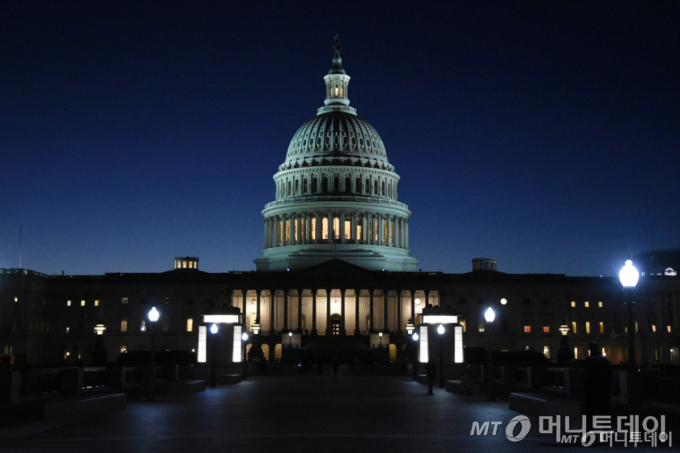
The U.S. CLARITY Act failed to pass in the Senate, leaving the GENIUS Act, scheduled for implementation next year, as a key policy issue for the virtual asset market at year-end. With the circulation of U.S.-origin stablecoins entering its final countdown, concerns are mounting among Korean industry players whose related legislation remains stalled.
According to industry sources on the 16th, major domestic blockchain companies reviewed their future response strategies following news overnight from the U.S. Senate that the cloture motion (to end debate) for the CLARITY Act was defeated. The legislative momentum in the U.S. had previously served as a primary justification for urging the enactment of Korea’s Digital Asset Basic Act.
The U.S. has divided its virtual asset legislation into two tracks: the CLARITY Act, which focuses on defining market structure, and the GENIUS Act, which contains regulations on stablecoin issuance and circulation. The GENIUS Act completed its legislative process last July and is confirmed to take effect in January next year.
The GENIUS Act has entered its final preparation phase ahead of implementation after the U.S. Treasury Department announced proposed sub-regulations (NRPM) last month. In Korea, meanwhile, legislation for the Digital Asset Basic Act—which bundles market structure and stablecoin regulations—has been stalled for two years. As U.S. stablecoins spread, concerns are growing that they may soon capture the domestic market. There is also worry about potential disadvantages for Korean businesses due to the misalignment of legislative timing between the two countries.
Law firm Hwawoo recently stated in a report: "The Treasury Department's announcement signals that sub-regulatory preparations for implementing the law have officially begun, offering implications for Korea’s legal framework and business sector." It added, "Especially, it is necessary to review distribution requirements and verification/due diligence obligations, and to consider mutual recognition and supervisory cooperation frameworks with major countries' regulations while accounting for the global circulation potential of stablecoins."
The Hwawoo research team further noted: "Following the GENIUS Act, the Treasury Department's announcement reaffirmed a policy direction that regulates stablecoins as payment and settlement instruments, predicated on cross-border payments and settlements. Korea must continue to closely monitor the revision direction of its Foreign Exchange Transaction Act."
The originally scheduled submission date for the government’s Digital Asset Basic Act, initially announced by financial authorities for the second half of last year, has been repeatedly delayed. In political circles, it is pointed out that as the legislative process enters the fourth quarter, the national audit and budget debate have emerged as additional variables.
The primary reason cited for the delay in domestic legislation is disputes over regulations such as the decentralization of ownership in virtual asset exchanges (limits on major shareholder stakes). Domestic exchanges are pushing back against the introduction of asymmetric regulations not found overseas, following strengthened major shareholder reviews under the amended Specific Financial Information Act.
While discussions continue, domestic companies have begun preparing their business operations. Kakao and Toss, which have agreed to cooperate with USDC issuer Circle, and DouNamu, which announced collaboration with international credit card company Visa, are representative examples. However, these companies remain silent on specific business plans due to the ripple effects of regulatory uncertainty.
A representative from a domestic blockchain firm stated: "While we can prepare for technical reviews or overseas cooperation, it is difficult to finalize actual investment scale or business structure until issuer entities, reserve assets, and redemption obligations are determined." He added, "Only when regulations become concrete can we move beyond memorandums of understanding (MOUs) or business reviews to the commercialization stage."
Some analysts suggest that if legislation on stablecoins fails to gain momentum, domestic companies may proceed with overseas operations while assuming regulatory risks.
Lee Jun-ho, a researcher at Hana Securities, stated: "Although there was an intention to discuss the bill by early December this year, continued delays have raised the possibility that no conclusion will be reached until the first half of next year." He added, "Domestic companies that have not yet begun commercialization may see their competitiveness erode over time, making it highly likely they will initiate operations with a global focus first."
The researcher further noted: "The U.S. is pursuing parallel institutionalization by confirming stablecoin regulations through the GENIUS Act, allowing businesses via separate guidelines from authorities, and clarifying structure through the CLARITY Act. If Korean authorities attempt to finalize their system only after confirming the U.S.'s final structure, the timeline could be delayed accordingly."
According to foreign media such as Axios on the 15th (local time), the U.S. Senate held a cloture vote today to proceed with deliberation of the CLARITY Act, but it was defeated with 49 votes in favor and 50 against. With the Republican Party holding 53 seats out of 100 total, cooperation from the opposition was necessary to reach the passage threshold of 60 votes; however, the Democratic Party, which holds 45 seats, cast Ban (CEO) citing insufficient provisions on conflict-of-interest clauses surrounding the president's family.
Under Senate rules, this vote is not related to the bill's formal rejection. The bill may be referred back for reconsideration. However, prevailing forecasts in local political circles suggest that passage of the bill within this year has become virtually impossible, considering the margin by which the affirmative votes fell short, the upcoming midterm elections in November, and potential congressional realignment after the election.

 in STOCK
