

Although the maximum price system for petroleum products is approaching its tenth implementation, the first loss compensation for four refiners has not been carried out for over six months. This delay stems from the need to isolate only the costs incurred on domestic sales of gasoline, diesel, and kerosene, as well as the fact that there are approximately 100 detailed contentious issues surrounding the scope of cost recognition, making it time-consuming to establish standards. Since the 4.2 trillion won in contingency funds secured by the government will be forfeited if not spent within this year, the first settlement is expected to occur around year-end.
According to the petroleum industry on the 16th, the government has implemented the maximum price system for petroleum products nine times since March, yet loss compensation for refiners continues to be postponed. The maximum price system is a measure where the government sets price caps on gasoline, diesel, and kerosene to prevent sharp increases in international oil prices caused by the war between the United States and Iran from being directly reflected in domestic petroleum product prices. Under this structure, refiners cannot supply petroleum products above the maximum price set by the government but receive post-facto compensation for losses incurred during this process.
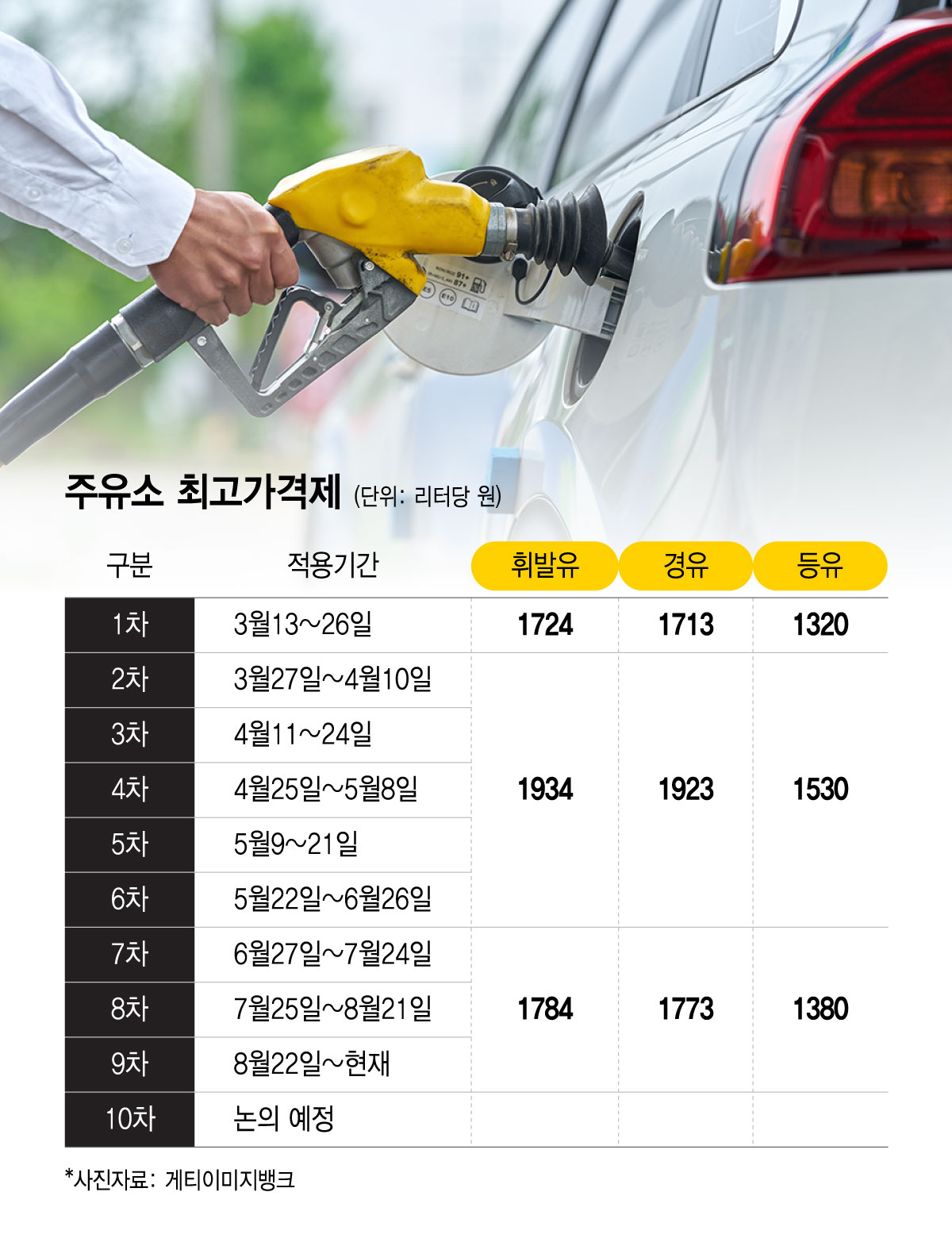
By implementation phase: Phase 1 (March 13–26) applied maximum prices of 1,724 won per liter for gasoline, 1,713 won for diesel, and 1,320 won for kerosene; Phases 2–6 (March 27–June 26) set them at 1,934 won, 1,923 won, and 1,530 won respectively; Phases 7 (June 27–July 24), 8 (July 25–August 21), and 9 (August 22–present) applied maximum prices of 1,784 won, 1,773 won, and 1,380 won respectively. The government is scheduled to hold a meeting with relevant ministries this week to decide on the tenth maximum price.
The Settlement Committee has been conducting its first settlement for the period from March 13 to June 30. The delay in settlement is not due to an inability to establish major principles for loss compensation; the principle of calculating losses based on "cost standards" is already specified in official notices. The current contentious issue is determining "how far the scope of costs should be recognized." It must be decided one by one whether individual expenses such as crude oil purchase costs and sales management fees are included in the settlement cost base, and if so, up to what level they will be recognized. It is reported that there are approximately 100 detailed issues requiring review.
The complex production structure of petroleum products makes it difficult to calculate costs simply, which adds to the burden of the settlement process. When crude oil is refined, multiple products such as gasoline, diesel, naphtha, and jet fuel are produced simultaneously, but only three products—gasoline, diesel, and kerosene—are subject to the maximum price system. This means that only the costs incurred for these specific products must be separately identified.
Domestic and export volumes must also be distinguished. Although refiners export a significant portion of their petroleum products, the loss compensation under the maximum price system applies only to gasoline, diesel, and kerosene sold domestically. Therefore, it is necessary to separate costs incurred for the production and supply of exported products so they are not included in the cost base for loss compensation.
Differences in accounting systems and cost processing methods among refiners also present variables. Even when requesting the same data, certain refiners' accounting systems may make it difficult to extract data in the required format, prompting coordination on how to standardize company-specific data. Accordingly, the Settlement Committee has distributed a "Data Submission Guideline" outlining what data refiners must submit and in what format, with refiners currently submitting their data by the end of this month.
Ultimately, the scale of the first settlement is expected to be revealed as late as early December. The government and the Settlement Committee aim to begin calculating loss amounts in earnest next month and complete the first settlement within this year. This is because if the 4.2 trillion won in contingency funds secured by the government for loss compensation are not spent within this year, the budget cannot be utilized.
The industry is responding cautiously as this settlement could set a precedent for future operations of the maximum price system. An industry official stated, "If loss compensation is abandoned due to immediate performance concerns, it could affect the principles of loss compensation when similar systems are implemented in the future." Another official added, "When the market conditions are poor and the maximum price system is implemented, losses can increase further; therefore, this settlement standard is important as a precedent for future application."

 in INDUSTRY
