

Major securities firms have sequentially invested in virtual asset exchanges this year, prompting analysis that their moves go beyond entering the coin market — they are preparing for changes in the stock and bond markets. The scope of blockchain technology application is expanding from virtual assets to the issuance and trading of stocks and bonds, with plans even being pursued to settle transaction amounts using stablecoins. Securities firms are proactively securing the customer base, blockchain technology, and digital asset business experience held by virtual asset exchanges to prepare for a new securities trading environment.
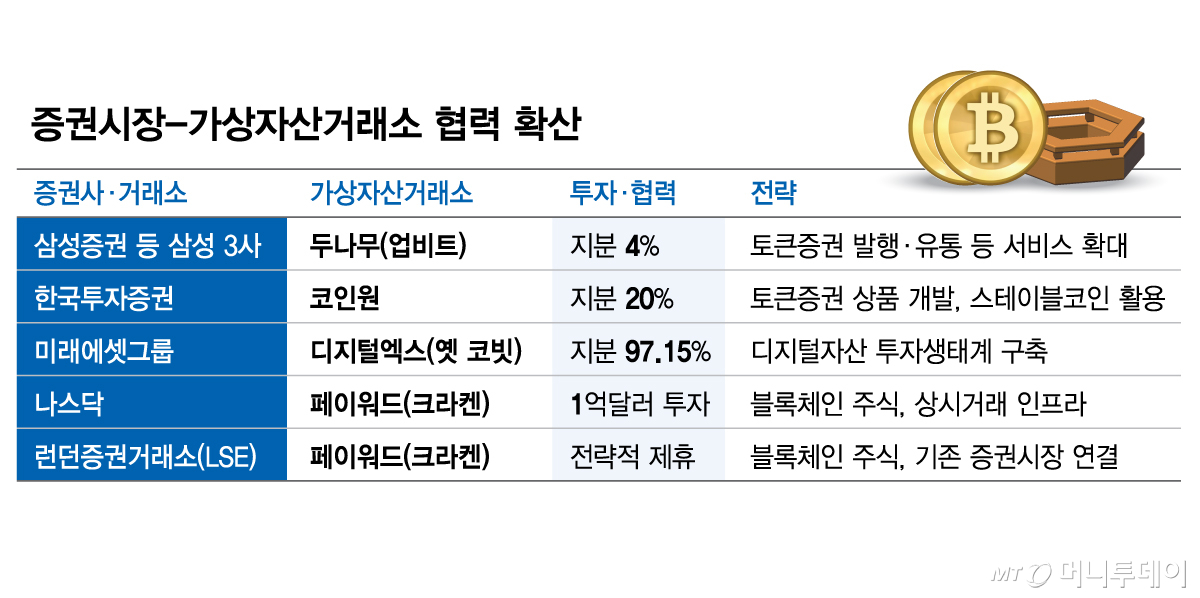
According to the financial investment industry on the 16th, Samsung Securities acquired a 4% stake in DuNamu, the operator of Upbit, for 612.8 billion won in May alongside Samsung SDS and Samsung Card. Samsung Securities holds 2%, while Samsung SDS and Samsung Card each hold 1%. Samsung Securities stated that its investment purpose is to 'strengthen competitiveness in digital asset business and secure synergies.' It plans to cooperate with DuNamu on the issuance and distribution of tokenized securities and virtual asset services.
Korea Investment & Securities signed a contract to acquire a 20% stake in Coinone in the same month, rising to become one of its top three shareholders. Korea Investment & Securities announced it would combine its existing financial services with Coinone's blockchain technology in line with the institutionalization of digital assets such as tokenized securities and stablecoins.
Mirae Asset Group acquired Cobit through Mirae Asset Consulting, a non-financial affiliate. Mirae Asset Consulting initially planned to acquire 92.06% of Cobit's shares, then purchased additional shares to raise its stake to 97.15%. It is reported that several financial companies, including Kiwoom Securities, are also discussing investment and cooperation plans with Bithumb.
Currently, virtual asset exchanges cannot directly handle stocks or bonds. Tokenized securities utilizing blockchain are legally considered securities. How virtual asset exchanges will connect with the securities market remains unclear as relevant regulations are further developed in the future.
Nevertheless, analysis suggests that the reason securities firms are partnering with exchanges lies in the customers, technology, and experience these exchanges have already secured. Virtual asset exchanges have operated platforms used by many retail investors and have accumulated technology and experience in trading and storing digital assets.
Hwang Se-woon, senior research fellow at the Capital Market Research Institute, stated, "Virtual asset exchanges are already large-scale platforms with sufficient investor touchpoints and have accumulated significant know-how in digital asset management and custody." He analyzed that as capital market products are likely to expand in the digital asset field, securities firms are moving to proactively secure business foundations and capabilities to prepare for future market expansion.
The background behind securities firms' interest in virtual asset exchanges lies in the expanding utility of blockchain technology. Until now, blockchain was a technology associated with virtual assets like Bitcoin, but it has begun to be applied to existing securities such as stocks and bonds.
A prime example is tokenized securities. This involves recording securities such as stocks and bonds and their ownership relationships on a blockchain-based ledger. Financial authorities view tokenized securities not as a new type of financial product but as an issuance method for existing securities in a new way.
Recently, the Financial Services Commission announced a policy direction to expand tokenization, which has focused on fractional investment, to include existing financial products such as stocks, bonds, and funds. In the long term, it also plans to utilize stablecoins as payment methods for tokenized securities transactions. The goal is to gradually build a market that utilizes blockchain from issuance through trading, clearing, and settlement of securities.
Globally, the integration of existing securities markets and virtual asset operators is gaining momentum. On the 10th, U.S. NASDAQ announced it would invest $100 million in Payward, the parent company of virtual asset exchange Kraken. The two companies will cooperate on building market infrastructure for tokenized stocks and 24-hour trading. The London Stock Exchange (LSE) also announced on the 1st that it is partnering with Payward to establish a tokenized stock market.
A financial industry official stated, "This does not mean virtual asset exchanges will become places that directly trade stocks and bonds in the future." He added, "As blockchain's application expands beyond coin trading to include issuance, trading, and settlement of stocks and bonds, the value of technology and business experience accumulated by virtual asset exchanges is also increasing."

 in STOCK
