

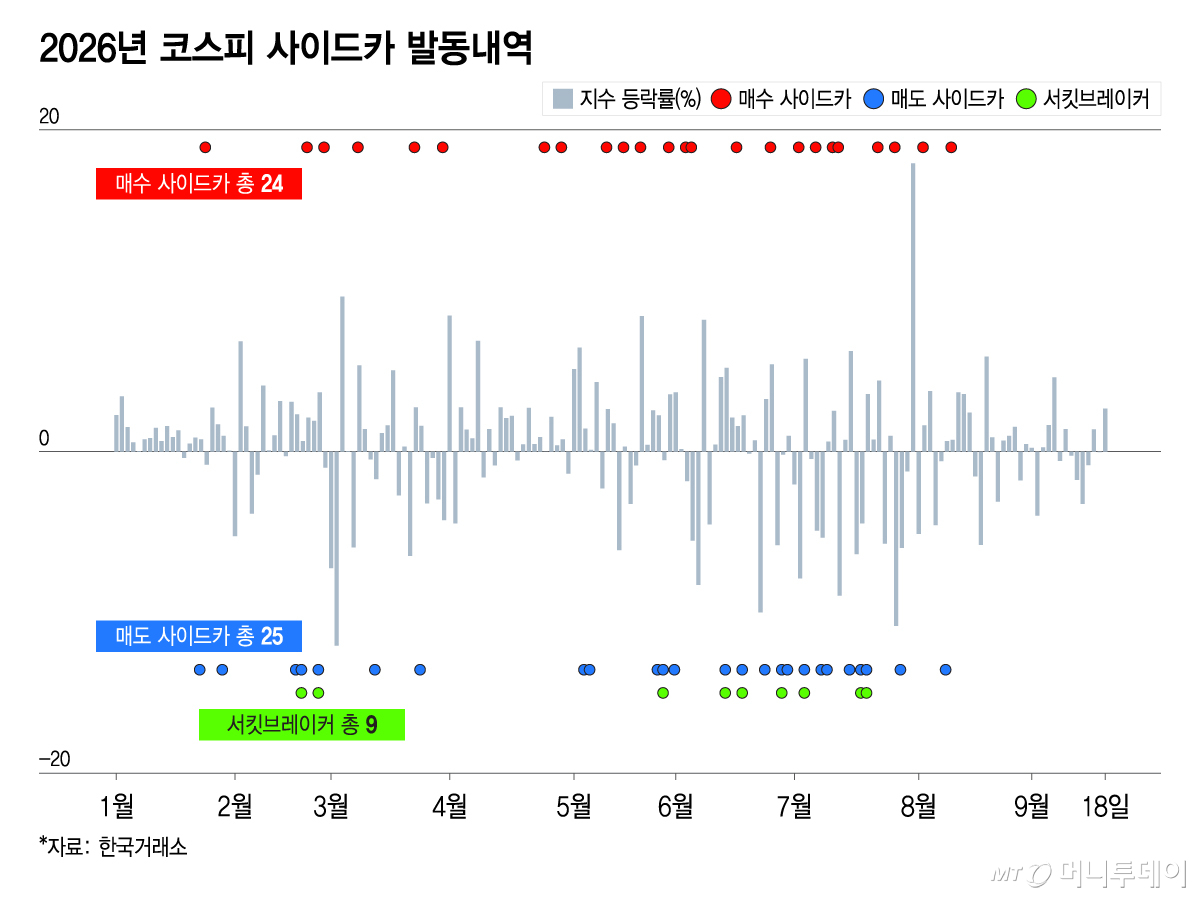
The warning sound in the KOSPI market has finally gone silent. The KOSPI market extended its period without triggering a program trading order suspension (sidecar (futures market circuit breaker)) to 21 consecutive trading sessions, the longest this year. Market volatility is expected to shrink as large-scale share buybacks and a slowdown in the AI-driven rally coincide.
According to Korea Exchange's listing disclosure system (KIND) on the 20th, the KOSPI market saw sidecar (futures market circuit breaker) triggered 49 times this year (24 buy-side, 25 sell-side), but no activations have occurred since last month's 21st. The KOSPI market's sidecar (futures market circuit breaker) is a volatility mitigation mechanism that suspends the validity of on-exchange program orders for five minutes if the KOSPI 200 futures price rises or falls by 5% or more compared to the previous day and sustains that level for one minute or longer.
This year, the market has encountered a sidecar (futures market circuit breaker) once every 3.6 trading sessions on average. In particular, the longest period of silence since the outbreak of the U.S.-Iran war was only 17 trading sessions (April 9 to May 4), and even before the conflict, the market traded without a sidecar (futures market circuit breaker) for just 21 consecutive days at the start of the year (the 2nd to the 30th).
Another volatility indicator, the KOSPI 200 Volatility Index (V-KOSPI200), closed the week at 43.56, halving from its year-to-date high of 96.94 on June 29 and returning to pre-war levels. This represents a 23.9% decline compared to the recent sidecar (futures market circuit breaker) activation day (57.26 on August 20).
The market points to large-scale share buybacks by the two leading semiconductor companies as the primary reason for the sharp drop in volatility. The prevailing view is that SK Hynix, starting from last month's 20th, and Samsung Electronics, from the 24th of the same month, absorbed on-exchange supply, emerging as stabilizing forces for market liquidity.
In fact, the net purchase amount by other corporations reflected in the buy volumes of both companies exceeded 1 trillion won daily over a 22-day period from last month's 20th, excluding only two trading days. On last month's 31st and September 1st, while retail investors, foreign investors, and institutional investors all took net selling positions, other corporations alone provided net buying support to the stock market.
Another analysis suggests that investor confidence has waned as AI beneficiary stocks, which previously led the rally, have failed to find a rebound catalyst amid global interest rate hikes and other repercussions. The average daily trading volume in the KOSPI market declined from 37 trillion won in July to 26 trillion won last month and further dropped to 21 trillion won this month.
Market participants' attention now focuses on supply-demand trends after the net buying by other corporations ceases. This is because Samsung Electronics and SK Hynix have repurchased their own shares faster than market expectations.
Both companies initially set their share buyback periods to extend through mid-to-late November in their prior filings, but Samsung Electronics has already executed 74.7% of its planned purchase volume, while SK Hynix has completed 58.8%. Considering the remaining volume and the pattern of split purchases, Samsung Electronics is expected to finish its buyback by early next month, with SK Hynix wrapping up around mid-month.
Once the share buyback effect fades, both domestic and external conditions will remain challenging. Domestic export-oriented companies facing the third-quarter earnings season are confronting exchange rate loss risks due to a sharp drop in the won-dollar exchange rate. From a macroeconomic perspective, armed conflict in the Middle East is accelerating the sustained high trajectory of international oil prices, putting pressure on interest rates. The October FOMC (Federal Open Market Committee) meeting and the November U.S. midterm elections are also identified as critical junctures.
Meanwhile, the KOSDAQ market closed without triggering a sidecar (futures market circuit breaker) for 20 consecutive trading sessions starting from last month's 24th. This year, it has accumulated 32 activations in total (18 buy-side, 14 sell-side).

 in STOCK
