

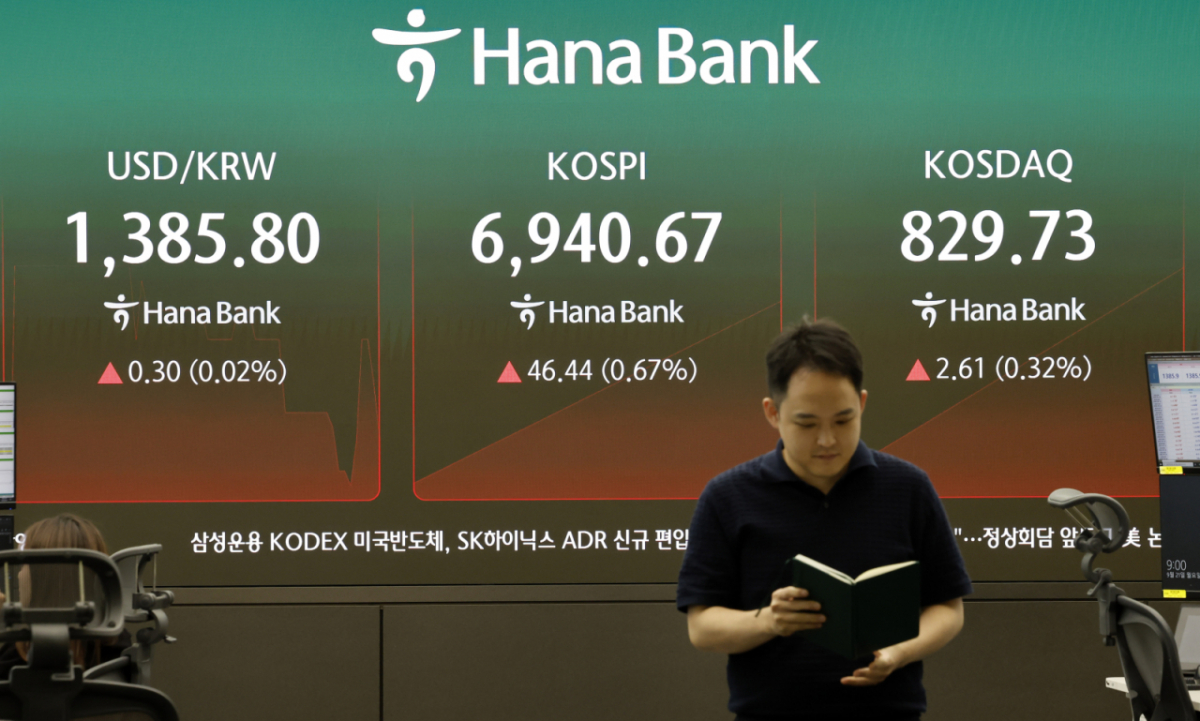
The KOSPI has been hovering around the 7,000-point level during trading, buoyed by strong performance in U.S. semiconductor stocks.
Although uncertainty over interest rates persists after the Federal Reserve System and the Bank of Japan raised their base rates by 25 basis points (1bp = 0.01 percentage point), buying pressure is flowing into domestic semiconductor stocks amid expectations for improved earnings from companies related to artificial intelligence (AI).
According to data from the Korea Exchange as of 11:28 a.m. on the 21st, the KOSPI was trading at 7,000.40, up 106.17 points (1.54%) from the previous session. The index fluctuated within a range of 40 to 100 points during the day and traded near the 7,000-point mark.
Samsung Electronics and SK Hynix, which are large-cap KOSPI stocks and leading semiconductor companies, also staged a rebound. In particular, Samsung Electronics showed strong gains in the 4th% range, recovering above the 270,000 won level.
Domestic semiconductor materials, components and equipment stocks rose alongside them. SFA Semiconductor (up 20.29%), WY (up 16.29%), Hanam Micron (up 14.62%), PSK (up 7.57%), and Wonik IPS (up 6.58%) all posted gains.
The favorable trend in U.S. semiconductor stocks, which withstood global interest rate hike pressures, is seen as having spilled over into the domestic stock market. On the 18th (local time), the Philadelphia Semiconductor Index rose by 2.78% on the New York Stock Exchange, reflecting strong performance in AI-related stocks centered on semiconductors.
Broadcom (up 2.97%), Micron (up 3.92%), ASML (up 3.08%), Lam Research (up 6.87%), Applied Materials (up 6.51%), and ARM (up 4.04%) all rose in unison. Despite the U.S. 10-year Treasury yield surpassing 5% intraday and the 2nd-year yield surging to its highest level since July 2024, the upward trend continued.
Kiwoom Securities' analyst Han Ji-young said, "Amid noise triggered by comments from Sam Altman, CEO of Anthropic, in early last week, and despite high burdens from macroeconomic uncertainties such as a sharp rise in U.S. 10-year yields, the September Federal Open Market Committee (FOMC) meeting, and the Bank of Japan (BOJ) conference throughout the week, the stock market recovered its initial losses by the latter half of the week."
She added, "This indirectly demonstrates that the stock market's resilience to external shocks was strong because the fundamentals—such as the AI capital expenditure (CAPEX) cycle and corporate earnings momentum, which are essential drivers of the stock market—remained intact."
Eugene Investment & Securities Executive Director Heo Jae-hwan commented on the KOSPI market conditions that day: "Even after the U.S. and Japan decided to raise their base rates, stocks held up better than expected, suggesting the market is building resilience against external negative factors.
Even with rising interest rates, there is optimism that AI and semiconductor companies will generate profits and maintain solid earnings, and domestic semiconductor firms face low valuation burdens."
However, some assessments indicate that investor sentiment in the domestic stock market has not yet recovered compared to the U.S. This view is based on the fact that the upward trajectory of domestic semiconductor stocks has been more limited than that of global semiconductor peers.
Following Sanjeon Nics completing its share buyback program, there are expectations that foreign investors will fill the supply-demand gap and drive prices higher again.
Hyundai Motor Securities researcher Kim Jae-seung said, "The rebound in Samsung Electronics' stock price has been constrained due to weak investor sentiment in the domestic market, while the ADR premium for SK Hynix continues to expand."
He added that "with a relaxation of the negative macroeconomic environment and the conclusion of two major events—the anticipated listing of Anthropic in early November and the U.S. midterm elections—foreign investors will resume net purchases, sparking a year-end rally."

 in STOCK
