

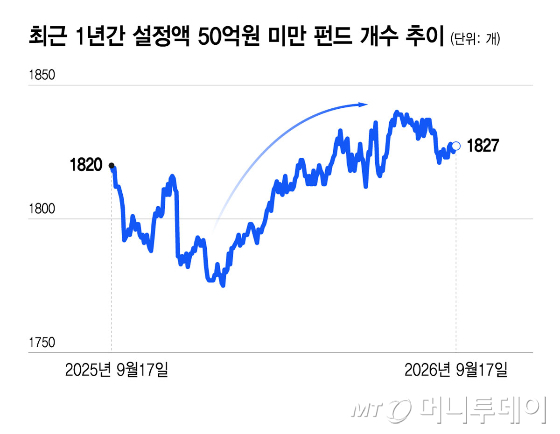
Small-scale "rounding-up funds" with setup amounts under 5 billion won have been increasing since the beginning of this year. This is due to investors withdrawing from general public offering funds as capital flows into ETFs (exchange-traded funds).
The government has sought to prevent a proliferation of such funds, citing concerns that if diversification becomes difficult and operational efficiency declines, it could lead to investor losses. However, the industry argues for further regulatory relaxation, pointing out that some funds were designed from the start to be small or have achieved high returns despite having setup amounts under 5 billion won, resulting in net asset values exceeding 5 billion won.
According to the Korea Financial Investment Association on the 21st, as of the 17th, the number of domestic and foreign funds with setup amounts under 5 billion won stood at 1,827. This represents an increase of 50 from the end of last year's 1,777, showing a steady rise since the beginning of this year.
By type, stock-type funds and bond-type funds increased significantly. Stock-type funds rose from 545 at the end of last year to 572 on the 17th, an increase of 27. Bond-type funds grew from 159 to 189 during the same period, an increase of 30. In contrast, mixed bond-type and mixed stock-type funds decreased by more than 10 each.
The industry views the increase in rounding-up funds as a result of market restructuring centered on ETFs, leading investors to withdraw. Analysis suggests that capital from general public offering funds has shifted toward direct investments or new funds, resulting in relatively tighter supply and demand conditions.
Rounding-up funds are identified as targets for government management due to concerns over operational inefficiency. When a fund is small, the management fees received by the asset manager decrease while cost burdens may increase. Due to limited initial capital, it becomes difficult to diversify into assets requiring minimum investment amounts, such as bonds or alternative investments. Additionally, redemptions by some investors can have a relatively significant impact on the fund, and marketing efforts to attract new capital may be limited. Such operational inefficiencies could even lead to investment losses.
Financial authorities regulate that if a rounding-up fund's proportion exceeds 5% of an asset manager's public offering funds, that manager is prohibited from launching new public offering funds.
Rounding-up funds receive different evaluations depending on the situation, such as when investors withdraw and the setup amount shrinks or when the fund was designed from the start to be small-scale. For example, if a 3 billion won fund was established primarily for specific institutional investors or professional investors, even a slight decrease in the setup amount could be highlighted as a significant change.
Accordingly, financial authorities have partially reflected industry demands by relaxing judgment criteria for certain rounding-up funds and reducing management burdens. The Financial Services Commission announced improvements to the public offering fund system in 2022, relaxing the judgment criterion for rounding-up funds from "funds established over one year ago with setup principal under 5 billion won" to "funds established over two years ago with setup principal under 5 billion won." This criterion applies to funds where asset managers have invested their own proprietary capital or where performance-based fees are applied, strengthening the manager's responsibility. Additionally, overseas feeder funds investing in offshore funds are not classified as rounding-up funds, considering they do not engage in direct investments.
In the financial investment industry, voices are emerging calling for additional regulatory relaxation to reflect recent market conditions. This is because there are public offering funds with setup amounts under 5 billion won but high returns that result in net asset values exceeding 5 billion won. The stance is that funds with high returns should be reflected in the judgment criteria.
An official from the asset management industry stated, "When contacting customers of funds classified as rounding-up funds to encourage redemptions, we find cases where they are satisfied with the returns and hesitate to redeem." He added, "The industry continues to point out that rounding-up funds should be judged based on the higher of the setup principal amount or net asset value by comparing the two figures."

 in STOCK
