

The KOSPI index surpassed the 7,000-point closing level for the first time in six trading days, buoyed by gains in the semiconductor sector. In the securities industry, expectations are mixed: some anticipate a wait-and-see stance ahead of the Chuseok holiday break, while others predict that investor sentiment toward AI (artificial intelligence) investments will hinge on the outcome of the U.S.-China summit.
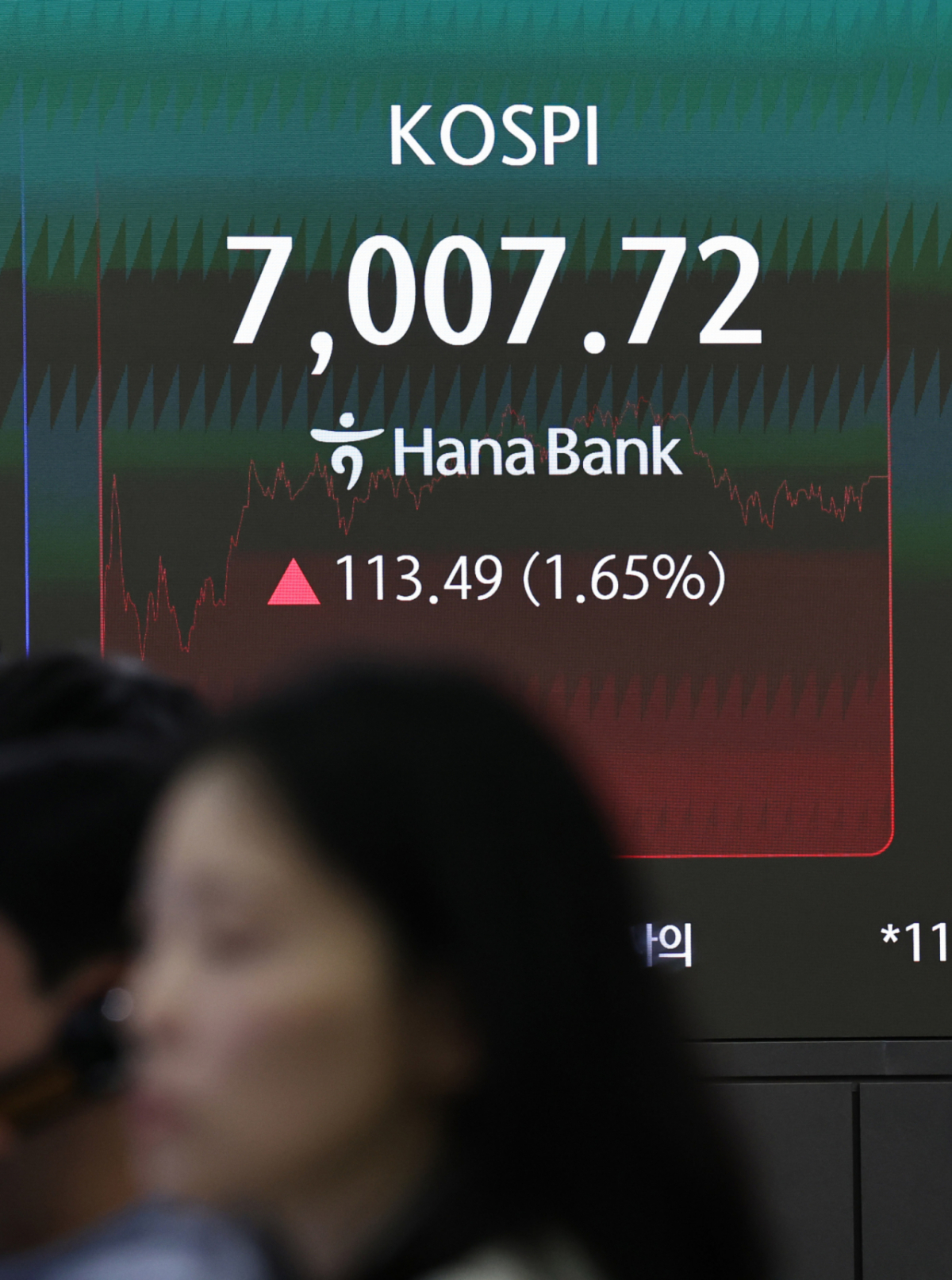
On the 21st, the KOSPI index closed trading at 7,007.72, up 113.49 points (1.65%) from the previous day. This marked its first close above the 7,000-point level in six trading days since the 10th. The rally is attributed to positive momentum in U.S. semiconductor stocks spilling over into domestic markets. Despite the U.S. 10-year Treasury yield surpassing 5% intraday on the 18th (local time), the Philadelphia Semiconductor Index rose by 2.78%, reflecting continued strength in semiconductor stocks.
Strong performance in domestic semiconductor exports also fueled the index's rise. According to the "Export and Import Status Report for the 1st–20, 2026" released by the Korea Customs Service on this day, semiconductor export value surged 259.4% to $34.1 billion, setting a new record high as of mid-September.
Lee Kyung-min, FICC Deputy Head at Daishin Securities, stated, "While we must consider the supply-demand effects triggered by SanDisk's inclusion in the U.S. S&P 100 Index, TrendForce's forecast for rising memory prices and comments from Intel's CEO (Chief Executive Officer) about worsening memory shortages have sustained expectations for strong semiconductor earnings." He further analyzed that with base rates determined in the U.S. and Japan, external uncertainties have eased.
In the KOSPI market (based on Korea Exchange data), institutional investors purchased 1.4923 trillion won worth of stocks, while retail investors bought 2.9789 trillion won. Foreign investors sold off 160.2 billion won. Other corporations, presumed to be conducting share buybacks for Samsung Electronics and SK Hynix, made net purchases totaling 1.6585 trillion won.
Samsung Electronics rose by over 4%, while SK Hynix gained more than 1%. Semiconductor-related stocks such as WY and SFA Semiconductors surged in double digits. Hyundai Motor and LG Energy Solution declined by 0.96% and 2.47%, respectively.
The KOSDAQ index closed at 836.27, up 9.15 points (1.11%) from the previous trading day. Retail investors made net purchases of 142.7 billion won, while foreign investors and institutional investors sold off 99.1 billion won and 30.6 billion won, respectively. Among top market capitalization stocks, strong performance was evident in semiconductor materials, components, and equipment (소부장) shares. Wonik IPS and iOTechnics each rose by over 6%.
Experts in the financial investment industry forecast that a wait-and-see stance will emerge in domestic markets ahead of the Chuseok holiday break on the 24th–25. A key issue to watch during the holiday period is the U.S.-China summit scheduled for the 24th (U.S. time). Han Ji-young, a researcher at Kiwoom Securities, said, "If this summit concludes at a level confirming continued AI competition between the two countries, it will lower the likelihood of policy realization for slowing AI development and improve investment sentiment across the entire AI infrastructure, including semiconductors."

 in STOCK
