

Wall Street firms are lowering their target prices for Hyundai Motor. The stock, which had surged on expectations of a physical AI robot business, has fallen to less than half of its previous level, reflecting the gap in target price valuations. With performance slowing due to a third-quarter strike and a strong won, investor sentiment driven by expectations for new AI businesses remains dormant.
According to the financial investment industry on the 22nd, Samsung Securities lowered Hyundai Motor's target price from 600,000 won to 500,000 won on the 15th. The highest target price for Hyundai Motor proposed by securities firms in the first half of this year was 1.2 million won.
Earlier, other firms that lowered their target prices include Yuanta Securities (690,000 won → 570,000 won), NH Investment & Securities (760,000 won → 620,000 won), Korea Investment & Securities (770,000 won → 640,000 won), Hana Securities (760,000 won → 650,000 won), Meritz Securities (770,000 won → 680,000 won), Heungkuk Securities (880,000 won → 720,000 won), and Kyobo Securities (800,000 won → 740,000 won).
On the 21st, Hyundai Motor closed regular trading at 361,500 won. The stock price, which had risen to 787,000 won on June 1, has halved in just over 100 days.
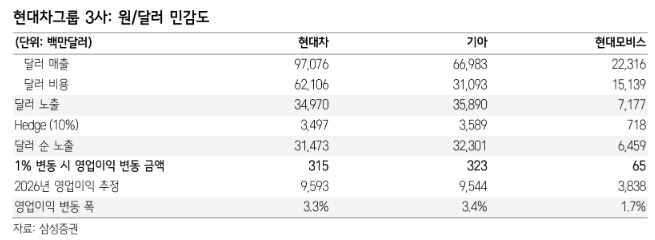
Wall Street firms have recently announced that they are lowering their profit estimates for Hyundai Motor for this year and next, reflecting the recent strong won trend, and accordingly reducing target prices. Recently, LS Investment & Securities lowered its revenue forecast for Hyundai Motor by 1.2% for this year and 3.2% for next year. The operating profit forecast was cut further to 2.7% for this year and 7.0% for next year.
In addition, the industry has raised concerns that Hyundai Motor's earnings will be hampered by strikes. The industry estimates that sales could decline by more than 2 trillion won. Performance-based pay, which was a subsidiary item in past wage negotiations, has emerged as a core issue in labor-management disputes.
Lee Eun-young, a researcher at Samsung Securities, said, "Performance slowdown is expected due to the third-quarter strike and strong won," adding, "The negative impact of the strong won will continue until next year, and next year is expected to see a gap in AI technology momentum."
Haneul, a researcher at NH Investment & Securities, stated, "The robotics business is proceeding as scheduled, but expectations are gradually fading due to a lack of updates even after the CID (CEO Investor Day) event," noting that there are downside risks such as the shift to electric powertrains, the spread of the sharing economy, slowing global demand, and intensifying competition.

 in STOCK
